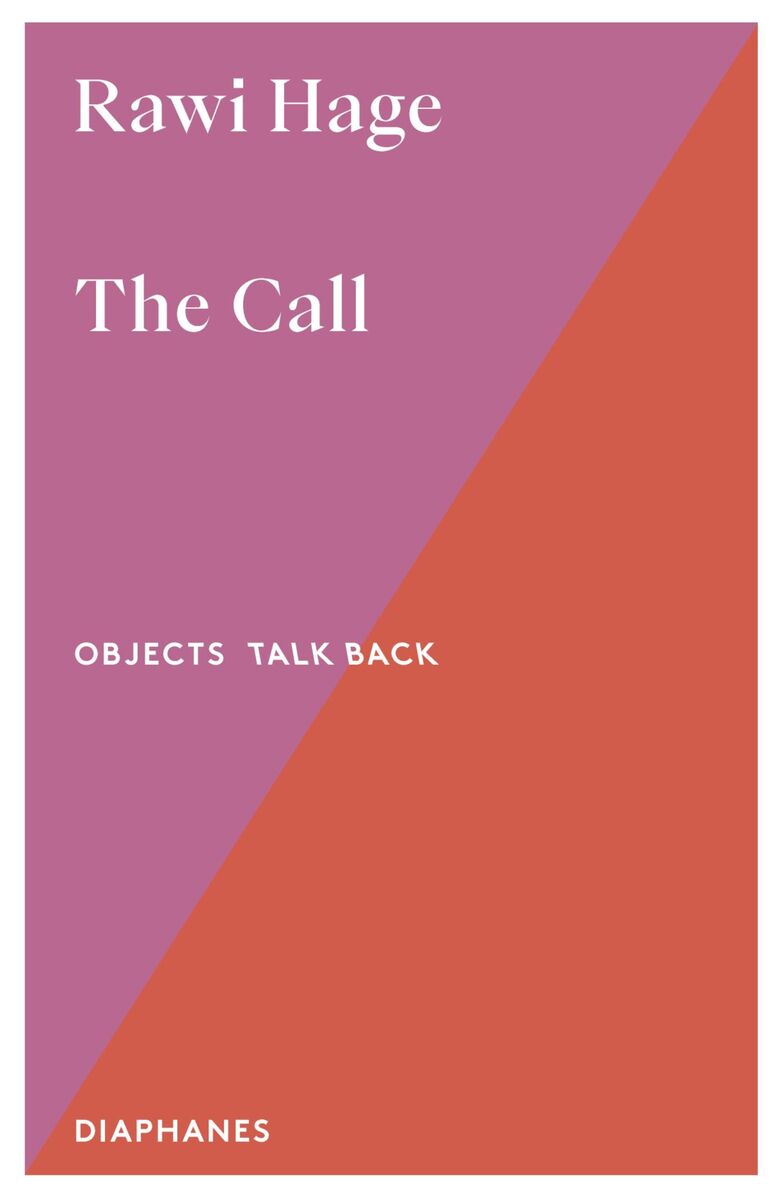
The Call
Diaphanes, 2025
Paper: 978-3-0358-0795-0 | eISBN: 978-3-0358-0801-8 (PDF)
Paper: 978-3-0358-0795-0 | eISBN: 978-3-0358-0801-8 (PDF)
ABOUT THIS BOOK | AUTHOR BIOGRAPHY
ABOUT THIS BOOK
A personal reflection on fragmentation, language, and place.
Following one of the Turfan archaeological expeditions in the early 1900s, a fragment of a Manichaean text written in Uighur and Old Turkic found its way to the Asian Art Museum in Berlin. Originating from the Northern Silk Road region (now the Xinjiang Uighur Region in China), these “loose leaves” became a source of inspiration for Rawi Hage.
Hage writes, “I was born near Byblos in Lebanon. The ancient city of Byblos is believed to be the place where the first alphabet was invented.” Encountering this rare and precious manuscript, with its layered and multicolored words, Hage reflects on the movement, uprooting, displacement, and migration of both objects and people.
Following one of the Turfan archaeological expeditions in the early 1900s, a fragment of a Manichaean text written in Uighur and Old Turkic found its way to the Asian Art Museum in Berlin. Originating from the Northern Silk Road region (now the Xinjiang Uighur Region in China), these “loose leaves” became a source of inspiration for Rawi Hage.
Hage writes, “I was born near Byblos in Lebanon. The ancient city of Byblos is believed to be the place where the first alphabet was invented.” Encountering this rare and precious manuscript, with its layered and multicolored words, Hage reflects on the movement, uprooting, displacement, and migration of both objects and people.