
 A SCHOLARLY BOOK REPOSITORY
129 start with A start with A

As the first African-American fiction writer to achieve a national reputation, Ohio native Charles W. Chesnutt (1858–1932) in many ways established the terms of the black literary tradition now exemplified by such writers as Toni Morrison, Alice Walker, and Charles Johnson.
Following the highly autobiographical nonfiction produced by Frederick Douglass, Harriet Jacobs, and other slave narrative writers, Chesnutt’s complex, multi-layered short fiction transformed the relationship between African-American writers and their readers. But despite generous praise from W. D. Howells and other important critics of his day, and from such prominent readers as William L. Andrews, Henry Louis Gates, Jr., and Eric Sundquist in ours, Chesnutt occupies a curiously ambiguous place in American literary history.
In The Absent Man, Charles Duncan demonstrates that Chesnutt’s uneasy position in the American literary tradition can be traced to his remarkable narrative subtlety. Profoundly aware of the delicacy of his situation as a black intellectual at the turn of the century, Chesnutt infused his work with an intricate, enigmatic artistic vision that defies monolithic or unambiguously political interpretation, especially with regard to issues of race and identity that preoccupied him throughout his career.
In this first book-length study of the innovative short fiction, Duncan devotes particular attention to elucidating these sophisticated narrative strategies as the grounding for Chesnutt’s inauguration of a tradition of African-American fiction.
Absinthe 28: Orphaned of Light features contemporary literature of migration translated from and to Arabic. In short stories, creative nonfiction essays, poetry, and selections from novels, a multiplicity of migration experiences is brought to the fore: life in diaspora, undocumented labor, refugeehood, human trafficking, internal displacement, exile.
This issue brings together names familiar to readers of Arabic literature in translation, such as Ghassan Kanafani and Saadi Youssef, with writers making their English-language debuts, such as Dearborn, MI-based Kurdish Iraqi poet Gulala Nouri and Libyan novelist Mohamad Alasfar. Likewise, the issue includes veteran translators Marilyn Booth, Nancy Roberts, and Khaled Mattawa alongside newcomers, several of them graduate students at the University of Michigan.
Each piece is accompanied by a translator’s reflection that meditates on the work’s themes as well as the creative process of translation, and the issue’s poetry is presented in a side-by-side Arabic-English format.
Absinthe 28 comes to us at a time when, according to the UN, one in every 78 people on earth is displaced. This collection serves as a reminder that translation and migration are inextricably linked.
Absinthe 29: Translating Jewish Multilingualism showcases the variety of languages and genres in which modern Jewish writers have expressed themselves. Spanning short stories, essays, poetry, and selections from novels, the selection of literary works featured in this issue of Absinthe cuts across distinctions between European and non-European literary traditions and addresses diverse themes, including social class, gender, immigration, religious traditions, love and marriage, and the act of writing itself.
Rather than consider disparate Jewish languages and histories in isolation, we bring them into conversation within an open-ended framework that explores Jewish multilingualism in the modern world. The multilingual narrative of Jewish modernity told through them, in seven languages, spans from the 1880s to the 2020s.
Its wide geographical distribution ranges from Tel Aviv to São Paulo through Buenos Aires, Istanbul, Thessaloniki, Livorno, Warsaw, Prague, and Chicago. Each text and context exhibits different aspects of the Jewish encounter with the conditions of modern society, exemplifying the ways in which Jewish writing engages and negotiates different cultures and traditions.
The new volume of Absinthe foregrounds the multilingual legacy of Jewish migration and diasporic life that has become ubiquitous in modern Jewish writing, and it is evident in the enriching and disruptive presence of multiple languages and literary traditions in each of these texts. The title of this volume, Translating Jewish Multilingualism, refers both to the English translations of these texts and to the processes of translation, mediation, and hybridization encapsulated in the works themselves.
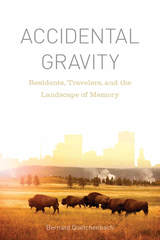
Accidental Gravity negotiates the difficult edge between a naive belief in an enduring, unassailable natural world and the equally naive belief that human life takes place in some unnatural, more mediated context. The title refers to the accidental but nonetheless meaningful nexus where the personal meets and combines with the universal—those serendipitous moments when the individual life connects to the larger rhythms of time and planet.


Winner, 2021 Gilda Women's Book Award
In this honest and tender collection of essays, award-winning memoirist Michele Weldon asks what it means to be a mature woman seeking a life of purpose and meaning through work, family, and relationships. Facing ageism and invisibility within popular culture, Weldon examines the effects of raising children, striving for applause, failing expectations, forming new friendships, reconciling lost dreams, and restoring one’s faith. With sincerity and humor, she unwraps family traditions, painting classes, lap swimming, dress codes, and career disappointments. She addresses white privilege and her evolving understanding of racism. And she asks crucial questions about mortality, finding connection in writing and stories.
Frank, eloquent, and daring, Weldon dissects the intricacies of life, journeying toward self-discovery as a mother, daughter, sister, and friend. Readers of any age or gender will recognize the universal experience of learning to accept oneself and asking essential questions—even if there are no easy answers.
Volume 12 of Adams Family Correspondence, with 276 documents spanning from March 1797 through April 1798, opens with the inauguration of John Adams as president and closes just after details of the XYZ affair are made public in America. Through private networks of correspondence, the Adamses reveal both their individual concerns for the well-being of the nation and the depth of their public and political engagement with the republic. Abigail’s letters to friend and foe demonstrate the important role she played as an unofficial member of the administration. John Quincy and Thomas Boylston’s letters from The Hague, Paris, London, and finally Berlin offer keen observations about the political turmoil in France and its consequences, the shifting European landscape as a result of the war, and court life in Berlin following the coronation of Frederick William III.
In the midst of crisis, the family’s domestic life and personal connections challenged and sustained them. The marriage of John Quincy and Louisa Catherine Johnson in London in July 1797 gave the family cause for celebration, while John’s appointment of John Quincy as U.S. minister to Prussia created a minor rift as the scrupulous younger Adams struggled with concerns about nepotism. Visits between the elder Adamses and their children Nabby and Charles in New York provided welcome distractions, even as John and Abigail worried about Nabby’s domestic situation. With the characteristic candor and perception expected from the Adamses, this volume again features forthright commentary from one family at the center of it all.
The Adams Family Correspondence, L. H. Butterfield writes, “is an unbroken record of the changing modes of domestic life, religious views and habits, travel, dress, servants, food, schooling, reading, health and medical care, diversions, and every other conceivable aspect of manners and taste among the members of a substantial New England family who lived on both sides of the Atlantic and wrote industriously to each other over a period of more than a century.” These volumes are the first in the estimated twenty or more in Series 2 of The Adams Papers.
Including about six hundred letters to and from various members of the family, the Adams Family Correspondence begins with a series of hitherto unpublished courtship letters between John Adams and Abigail Smith. The weekly and sometimes daily reports by Adams of what was going on in the Continental Congress during the years 1774–1777 are a far fuller and franker record than has been available before. His wife’s letters in reply recount her difficulties in raising a family of young children and operating a farm while war went on not far from her doorstep, refugees inundated Braintree, local epidemics raged, prices soared, and goods and labor became ever scarcer. We learn for the first time that amid these distractions Abigail lost a baby daughter, that getting herself and four children inoculated against smallpox was an agonizing ordeal of months in 1776, that after Burgoyne’s defeat at Saratoga she wrote a long, lecturing letter to her single relative who had chosen the Loyalist side, and that her comments on blundering politicos, lax generals, and unpatriotic neighbors were more frequent and incisive than has been supposed.
Thinking her letters too careless and too intimate for preservation, Abigail Adams pleaded at the end of one of them, written a couple of months before the Declaration of Independence was voted and while British warships hovered within range of her house, “I wish you would burn all my Letters.” To which John Adams replied, “The conclusion of your Letter made my Heart throb, more than a Cannonade would. You bid me burn your Letters. But I must forget you first.”
So he faithfully kept hers, she kept his, and they both kept their children’s. Their grandson Charles Francis Adams chose some of these for publication in a succession of small editions in the nineteenth century, but he was highly selective, and he discreetly pruned away from the letters that he printed much that is both revealing and engaging. Here, as is the practice with all the Adams documents in this edition, every letter used is given in full. The second of these first volumes ends in March 1778 with John Adams on a Continental frigate bound for his first diplomatic mission in Europe, accompanied by his ten-year-old son, John Quincy.
This volume continues the incredible family saga of the Adamses of Massachusetts as told through their myriad letters to one another, to their extended family, and to such other notable correspondents as Thomas Jefferson and Mercy Otis Warren. The book opens in January 1786, when John and Abigail resided at Grosvenor Square in London, partaking of the English social scene, while John made slow progress on negotiations for an Anglo-American commercial treaty. Daughter Abigail ("Nabby"), also in London, had begun a courtship with William Stephens Smith that would culminate in their marriage in June 1786. Back in Massachusetts, John Quincy had rejoined his brothers Charles and Thomas, entered Harvard College, and begun to make preparations to study law.
Writing back and forth across the Atlantic, the Adamses interspersed observations about their own family life--births and deaths, illnesses and marriages, new homes and new jobs, education and finances--with commentary on the most important social and political events of their day, from the scandals in the British royal family to the deteriorating political situation in Massachusetts that eventually culminated in Shays' Rebellion. As in the previous volumes in this series of the Adams Papers, the correspondence presented here offers a unique perspective on the eighteenth century from a preeminent American family.
“I cannot O! I cannot be reconcil’d to living as I have done for 3 years past… Will you let me try to soften, if I cannot wholy releave you, from your Burden of Cares and perplexities?” So begins Abigail Adams’s correspondence to her husband in these volumes: a plea to end their long separation, as John Adams represented the United States in Europe while Abigail tended to family and farm in Massachusetts, and passed on to John crucial political information from Congress.
In October 1782, the Adams family was as widely scattered as it would ever be, with young John Quincy Adams in St. Petersburg, John at The Hague, and Abigail in Braintree with her daughter and younger sons. With the summer of 1784, however, Abigail would have her fondest wish, as most of the family reunited to spend nearly a year together in Europe. As the Adams family traveled, and as the children came of age, so their correspondence expanded to include an ever larger and more fascinating range of Cultural topics and international figures. The record of this remarkable expansion, these volumes document John Adams’s diplomatic triumphs, his wife and daughter’s participation in the cosmopolitan scenes of Paris and London, and his son John Quincy’s travels in Europe and America. These pages also welcome Thomas Jefferson, who soon became one of Abigail’s closest friends, into the family correspondence. From the intimacies of the children’s education, sentimental and worldly, to the details of the firm friendship between Abigail and Madame Lafayette, to the grand drama of Edmund Burke and William Pitt the Younger debating in Parliament, the contents of these letters draw an incredibly rich picture of international life in the 1780s and an incomparable portrait of America’s first family of politics and letters.
The letters in this volume of Adams Family Correspondence span the period from July 1795 to the eve of John Adams’s inauguration, with the growing partisan divide leading up to the election playing a central role. The fiery debate over funding the Jay Treaty sets the political stage, and the caustic exchanges between Federalists and Democratic-Republicans only grow as rumors surface of George Washington’s impending retirement. From Philadelphia, John’s equanimity in reporting to Abigail and his children on the speculation about the presidential successor gives way to expectation and surprise at the voracity of electioneering among political allies and opponents alike. Although remaining in Quincy throughout this period, Abigail offers keen, even acerbic, commentary on these national events.
From Europe, John Quincy and Thomas Boylston shed light on the rise of the French Directory, the shifts in the continental war, and the struggles within the Batavian government. Their letters also testify to the broader scale of the U.S. presidential election by chronicling French and British attempts to influence American politics. On a more personal note, John Quincy’s engagement to Louisa Catherine Johnson in London opens the next great collection of correspondence documenting the Adams family saga.
John and Abigail Adams remained fully engaged in American political life after they left Washington, DC, for retirement in Quincy. A highlight of Volume 15 of Adams Family Correspondence is a series of letters between Abigail Adams and Thomas Jefferson that debated fundamental questions of the nation’s tumultuous early years. A new generation rose in prominence in the period covered in the volume, with John Quincy Adams returning from abroad to take a seat in the United States Senate just in time to break with the Federalists and support the Louisiana Purchase. The family commented on other events of the era—Jefferson’s dismantling of John Adams’s judicial reforms, the mobilization of the US Navy for the Barbary wars, the growing bane of British impressment, and the duel that killed Alexander Hamilton.
Equally compelling family stories emerge in the volume’s 251 letters. The failure of a British banking firm proved calamitous to the family’s finances, compelling John Quincy to quietly finance his parents’ retirement. Thomas Boylston Adams, acting as an occasional editor of the Port Folio, carved out his public persona as a man of letters. Louisa Catherine Adams wrote of motherhood and adjusting to a new country of residence while providing a spirited perspective on Washington society. As always, the heart of Adams Family Correspondence is Abigail Adams, who survived a near-fatal fall to continue providing letters of insight and wit that once again show why the correspondence of the Adams family is a national treasure.
John and Abigail Adams’ reflections on an emerging nation as they move into the new President’s House in Washington, D.C., are a highlight of the nearly 280 letters written over seventeen months printed in volume 14 of Adams Family Correspondence. The volume opens with the Adamses’ public and private expressions on the death of George Washington and concludes with John’s defeat in the contentious presidential election of 1800. Electoral College maneuvering, charges of sedition, and state-by-state strategizing are debated by the Adamses and their correspondents as the election advances toward deadlock and finally victory for Thomas Jefferson in the House of Representatives. John’s retirement from public life had some sweet mixed with the bitter. The U.S. mission to France resulted in the Convention of 1800 that ended the Quasi-War and the so-called midnight appointments at the close of his presidency ushered in the transformative U.S. Supreme Court era of John Marshall, a coda anticipated in Abigail’s request to John in the final days of his administration—“I want to see the list of judges.”
The domestic life of the Adamses was equally dynamic. Abigail and John endured the crushing loss of their son Charles, whose struggle with alcohol ended in repudiation and death in New York. Son Thomas Boylston and daughter Nabby spent the period in relative stability, while John Quincy chronicled a tour of Silesia in letters home from Europe. At the volume’s close, the correspondence between John and Abigail comes to an end. As they retired to Quincy, their rich observations on the formation of the American republic would continue in letters to others if not to each other.
The almost 300 letters in volume 13 of Adams Family Correspondence were written during seventeen tumultuous months of John Adams’s presidency. Consumed with executive duties, he depended on surrogates for much of his correspondence with family members. From Quincy, an ailing Abigail Adams wrote frequent letters to Philadelphia and received lively responses from son Thomas Boylston and the president’s secretary, nephew William Smith Shaw. These letters attest to John’s popularity in the wake of the XYZ Affair. However, they also chronicle passage of the Alien and Sedition Acts and the Kentucky and Virginia Resolutions, which laid the groundwork for future debates on the relative roles of state and federal governments. Following the break in diplomacy with France, John sensed a change in the footing of the French, acted unilaterally in ordering a second mission to seek a negotiated settlement of the Quasi-War, and faced widespread skepticism about his foreign policy as his envoys departed for Europe.
John and Abigail lamented yet another absence from each other. After completing service in Berlin as secretary to diplomat John Quincy, Thomas Boylston established himself as a Philadelphia lawyer, offering thoughtful commentary on political life in the capital. From his post in Prussia, John Quincy struggled with his brother Charles’s mismanagement of his financial affairs, but his letters also provide detailed updates on developments in Europe, including Napoleon’s invasion of Egypt. The candid letters of John and Abigail Adams and their children offer a rich perspective on life in America during its infancy.
This volume offers over 300 letters from the irrepressible Adamses, including many between John and Abigail never before printed. As always, Adams family members serve as important observers of and commentators on national and international events, from America’s growing tensions with Britain and France to its internal struggles with increasingly virulent political factionalism and the Whiskey Rebellion. John, languishing as vice president in Philadelphia, reported extensively on congressional debates and growing divisions within the Washington administration but also found time to improve his sons’ legal education. Abigail’s letters juxtapose her own political insights with lively accounts of her farm management and the day-to-day happenings in Quincy.
The most significant event of the period for the Adams clan was John Quincy’s appointment as U.S. minister resident at The Hague, the beginning of a long and storied diplomatic career. Accompanying him overseas was his brother Thomas Boylston, the only Adams child who had not yet seen Europe. Arriving just as the French Army began its final march into the Netherlands, John Quincy and Thomas Boylston became first-hand observers of the European war and the impact of the French Revolution on the broader society. Back in the United States, Charles continued to build his legal career, expanding his law office and acquiring two clerks, while Nabby’s family grew with the birth of the Adamses’ first granddaughter, Caroline Amelia Smith.
The years 1790 to 1793 marked the beginning of the American republic, a contentious period as the nation struggled to create a functioning government amid increasingly bitter factionalism. On the international stage, the turmoil of the French Revolution raised important questions about the nature of government. As usual, the Adams family found itself in the midst of it all. Vice President John Adams chaired Senate sessions even as he was prevented from participating in any meaningful fashion. Abigail joined him when her health permitted, but even from afar she provided important advice and keen observations on politics and society.
All four Adams children are well represented here, especially Charles and Thomas Boylston, who, for the first time, appear as correspondents in their own right. Both embarked on legal careers, Charles in New York and Thomas in Philadelphia, while John Quincy did the same in Boston. Daughter Nabby cared for her growing family as her ambitious husband, William Stephens Smith, pursued financial schemes. This volume offers both insight into the family and the frank commentary on life that readers have come to expect from the Adamses.
By early 1787, as this latest volume of the award-winning series Adams Family Correspondence opens, John and Abigail Adams were eagerly planning their return home to Massachusetts from Great Britain, frustrated by John's lack of progress in his diplomatic mission and anxious for a reunion with family and friends. Arriving in Massachusetts in mid-1788, they anticipated a quiet retirement from government service as they returned to running their farm. But they barely had time to settle in before they were pulled back into the public sphere by John's election as the first vice president under the new Constitution. Moving to New York City in 1789 with their daughter Nabby, and her family, John and Abigail found themselves once again center stage in American political life.
The Adamses serve as prescient and thoughtful observers of the world around them, from the manners and mores of English court life to the political intrigues of the new federal government in New York. Beyond that wider world, however, these letters observe the more intimate domestic concerns of a New England family. With more of the forthright candor that marks the Adamses' correspondence, this volume offers a unique perspective on a crucial period in American history.
The letters in these volumes, written from both sides of the Atlantic, addressed by and to members of the Adams family, chronicle nearly five years of its history, They were years in which John Adams in successive missions to Europe, accompanied first by one son, then by two, initiated what would be a continuing role for Adamses in three generadons: representing their country and advancing its interests in the capitals of Europe.
John Adams, a troubled but stouthearted Yankee lawyer on the vast new scene of Europe, though always circumspect in familial correspondence in referring to public matters, provides, in his revealing letters about his own health and state of mind, sufficient insight into the difficult relations among the American commissioners, the designs of America's allies, and the diplomatic failures and triumphs he experienced in Paris and the Netherlands to permit some reevaluations of purposes and tactics. With these high matters are mingled the rigors and rewards of travel, concern with his sons' education, books for their reading, Dutch cloth and ribbons for his wife.
Whether Mrs. Adams' letters relate to the upbringing of children, the problems of wartime taxes and inflation, the inferior roles assigned to American women, or her wide historical reading, they bear the marks of distinction of mind and mastery of language that make them timeless.
If the letters of these two are central, those written by others are hardly less interesting, relating as they do to the concerns of young John Quincy at school in Levden and his observations on his way to and during his stay in St. Petersburg at age fourteen: to the adventure-filled return voyage of Charles, aged eleven, to America; to the interests of the younger Abigail maturing in Braintree; to the reactions of sturdy patriots to the tides and rumors of war.
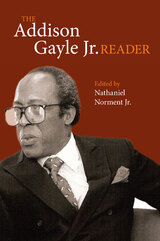
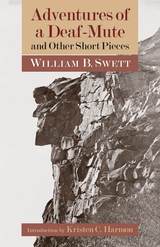
Confident in his identity as a Deaf “mute,” he notes with wry humor the varied perceptions of deafness that he encounters. As a signing Deaf person from a prominent multigenerational Deaf family, he counters negative stereotypes with generosity and a smart wit. He takes pride in his physical abilities, which he showcases through various stunts and arduous treks in the wilderness. However, Swett’s writing also reveals a deep awareness of the fragility and precariousness of life. This is a portrait of a man testing his physical and emotional limits, written from the vantage point of someone who is no longer a young man but is still very much in the prime of his life.
This collection also includes “Mr. Swett and His Diorama,” an article from 1859 in which Swett describes his miniature recreation of the Battle of Lexington, as well as Manual Alphabets, a pamphlet published in 1875 on the history of manual alphabets that includes short biographies of Thomas Hopkins Gallaudet and Laurent Clerc, two pioneers of Deaf education in the United States. The work is accompanied by a new introduction that offers a reflection on Swett’s life and the time in which he lived.

Ben Edwin Perry's Aesopica remains the definitive edition of all fables reputed to be by Aesop. The volume begins traditionally with a life of Aesop, but in two different and previously unedited Greek versions, with collations that record variations in the major recensions. It includes 179 proverbs attributed to Aesop and 725 carefully organized fables, for which Perry also provides their eldest known sources. To better evaluate the place of Aesop in literary history, Perry includes testimonies about Aesop made by Greek and Latin authors, from Herodotus to Maximus Planudes.
During the past twenty years, the world’s most renowned critical theorist—the scholar who defined the field of postcolonial studies—has experienced a radical reorientation in her thinking. Finding the neat polarities of tradition and modernity, colonial and postcolonial, no longer sufficient for interpreting the globalized present, she turns elsewhere to make her central argument: that aesthetic education is the last available instrument for implementing global justice and democracy.
Spivak’s unwillingness to sacrifice the ethical in the name of the aesthetic, or to sacrifice the aesthetic in grappling with the political, makes her task formidable. As she wrestles with these fraught relationships, she rewrites Friedrich Schiller’s concept of play as double bind, reading Gregory Bateson with Gramsci as she negotiates Immanuel Kant, while in dialogue with her teacher Paul de Man. Among the concerns Spivak addresses is this: Are we ready to forfeit the wealth of the world’s languages in the name of global communication? “Even a good globalization (the failed dream of socialism) requires the uniformity which the diversity of mother-tongues must challenge,” Spivak writes. “The tower of Babel is our refuge.”
In essays on theory, translation, Marxism, gender, and world literature, and on writers such as Assia Djebar, J. M. Coetzee, and Rabindranath Tagore, Spivak argues for the social urgency of the humanities and renews the case for literary studies, imprisoned in the corporate university. “Perhaps,” she writes, “the literary can still do something.”
Folktales from the African American Appalachian tradition. Told by Lyn Ford, one of America’s busiest touring storytellers. The power of Lyn's storytelling comes straight out of her family heritage, which is the content of this, her first book. Here she tells how she learned stories from her father and grandfather—and she includes many of the stories they told her.
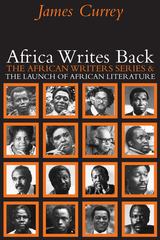
June 17, 2008, is the fiftieth anniversary of the publication of Chinua Achebe’s Things Fall Apart by Heinemann. This publication provided the impetus for the foundation of the African Writers Series in 1962 with Chinua Achebe as the editorial adviser.
Africa Writes Back: The African Writers Series and the Launch of African Literature captures the energy of literary publishing in a new and undefined field. Portraits of the leading characters and the many consultants and readers providing reports and advice to new and established writers make Africa Writes Back a stand-out book. James Currey’s voice and insights are an added bonus.
CONTENTS
Publishing and selling the African Writers Series
The African Writers Series Portfolio & George Hallett’s covers
Main dates for the African Writers Series
INTRODUCTION: The establishment of African Literature
Publishing Chinua Achebe
1. WRITERS FROM WEST AFRICA
Nigeria: The country where so much started
Negritude from Senegal to Cameroun
Magic & realism from Ghana, The Gambia & Sierra Leone
2. WRITERS FROM EASTERN AFRICA
Towards the oral & the popular in Kenya, Uganda & Tanzania
Publishing Ngugi
3. WRITERS FROM THE HORN & NORTH-EASTERN AFRICA
Emperors in Ethiopia
Publishing Nuruddin Farah
Arab authors in Egypt & Sudan
4. WRITERS FROM SOUTH AFRICA
Resistance in South Africa
Publishing Alex la Guma
Publishing Dennis Brutus
Publishing Bessie Head
Publishing Masizi Kunene
5. WRITERS FROM SOUTHERN AFRICAN
Guns & Guerrillas in Mozambique &Angola
Zambia Shall be Free
Death & detention in Malawi
The struggle to become Zimbabwe
Publishing Dambudzo Marechera
CONCLUSION: Is there still a role for the African Writers Series?
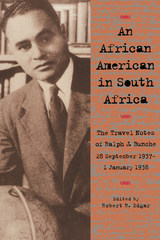
Ralph Bunche, who received the Nobel Peace Prize in 1950, traveled to South Africa for three months in 1937. His notes, which have been skillfully compiled and annotated by historian Robert R. Edgar, provide unique insights on a segregated society.
Contributors include internationally recognized authors and activists such as Wangari Maathai and Nawal El Saadawi, as well as a host of vibrant new voices from all over the African continent and from the African diaspora. Interdisciplinary in scope, this collection provides an excellent introduction to contemporary African women’s literature and highlights social issues that are particular to Africa but are also of worldwide concern. It is an essential reference for students of African studies, world literature, anthropology, cultural studies, postcolonial studies, and women’s studies.
Outstanding Book, selected by the Public Library Association
Best Books for High Schools, Best Books for Special Interests, and Best Books for Professional Use, selected by the American Association of School Libraries

Reveals a century of political solidarity uniting Asians and African Americans
As early as 1914, in his pivotal essay “The World Problem of the Color Line,” W. E. B. Du Bois was charting a search for Afro-Asian solidarity and for an international anticolonialism. In Afro-Orientalism, Bill Mullen traces the tradition of revolutionary thought and writing developed by African American and Asian American artists and intellectuals in response to Du Bois’s challenge.
Afro-Orientalism unfolds here as a distinctive strand of cultural and political work that contests the longstanding, dominant discourse about race and nation first fully named in Edward Said’s Orientalism. Mullen tracks Afro-Asian engagement with U.S. imperialism—including writings by Richard Wright, Grace and James Boggs, Robert F. Williams, and Fred Ho—and companion struggles against racism and capitalism around the globe. To this end, he offers Afro-Orientalism as an antidote to essentialist, race-based, or narrow conceptions of ethnic studies and postcolonial studies, calling on scholars in these fields to re-imagine their critical enterprises as mutually constituting and politically interdependent.

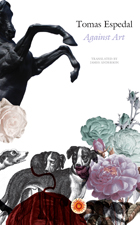
In contemporary Norwegian fiction Tomas Espedal’s work stands out as uniquely personal; it can be difficult to separate the fiction from Espedal’s own experiences. In that vein, his novel Against Art is not just the story of a boy growing up to be a writer, but it is also the story of writing. Specifically, it is about the profession of writing—the routines, responsibility, and obstacles. Yet, Against Art is also about being a father, a son, and a grandson; about a family and a family’s tales, and about how preceding generations mark their successors. It is at once about choices and changes, about motion and rest, about moving to a new place, and about living.
Abdur-Rahman brings black feminist, psychoanalytic, critical race, and poststructuralist theories to bear on literary genres from slave narratives to science fiction. Analyzing works by African American writers, including Frederick Douglass, Pauline Hopkins, Harriet Jacobs, James Baldwin, and Octavia Butler, she shows how literary representations of transgressive sexuality expressed the longings of African Americans for individual and collective freedom. Abdur-Rahman contends that those representations were fundamental to the development of African American forms of literary expression and modes of political intervention and cultural self-fashioning.
“These ingenious stories are so funny and sparkling and slyly inventive that their pain catches you by surprise, like a sunburn after a day at the beach.”—Eric Puchner
Winner, 2022 Mississippi Institute for Arts and Letters Prize for Best Fiction
In Becky Hagenston’s fourth collection, the real and the fantastic collide in stories that span from Mississippi to Europe, and from the recent past to the near future. The characters are sex-toy sellers, internet trolls, parents, students, and babysitters—all trying to make sense of a world where nothing is quite what it appears to be. A service robot makes increasingly disturbing requests. A middle school teacher is accused of witchcraft—and realizes the accusations might be true. Two college students devise a way to avoid getting hit on in bars. A baker finds bizarre anomalies in his sourdough. A librarian follows her dead ex-husband through the Atlanta airport. In these stories, men and women confront grief, danger, loneliness, and sometimes—the strangest discovery of all—unexpected joy. Hagenston delivers a collection that is, at its weird and shining heart, about people discovering what—for better or worse—they are capable of.
Alabama Afternoons is a collection of portraits of many notable Alabamians, famous and obscure, profiled by award-winning journalist and novelist Roy Hoffman. Written as Sunday feature stories for the Mobile Press-Register with additional pieces from the New York Times, Preservation, and Garden & Gun, these profiles preserve the individual stories—and the individual voices within the stories—that help to define one of the most distinctive states in the union.
Hoffman recounts his personal visits with writer Mary Ward Brown in her library in Hamburg, with photographer William Christenberry in a field in Newbern, and with storyteller Kathryn Tucker Windham and folk artist Charlie “Tin Man” Lucas at their neighboring houses in Selma. Also highlighted are the lives of numerous alumni of The University of Alabama—among them Mel Allen, the “Voice of the Yankees” from 1939 to 1964; Forrest Gump author Winston Groom; and Vivian Malone and James Hood, the two students who entered the schoolhouse door in 1963. Hoffman profiles distinguished Auburn University alumni as well, including Eugene Sledge, renowned World War II veteran and memoirist, and Neil Davis, the outspoken, nationally visible editor of the Lee County Bulletin.
Hoffman also profiles major and minor players in the civil rights movement, from Johnnie Carr, raised in segregated Montgomery and later president of the Montgomery Improvement Association; and George Wallace Jr., son of the four-time governor; to Theresa Burroughs, a Greensboro beautician trampled in the march over the Edmund Pettus Bridge; and Diane McWhorter, whose award- winning book explores the trouble- filled Birmingham civil rights experience. Juxtaposed with these are accounts of lesser-known individuals, such as Sarah Hamm, who attempts to preserve the fading Jewish culture in Eufaula; Edward Carl, who was butler and chauffeur to Bellingrath Gardens founder Walter Bellingrath in Theodore; and cousins William Bolton and Herbert Henson, caretakers of the coon dog cemetery in Russellville.
Hoffman’s compilation of life stories creates an engaging and compelling look into what it means to be from, and shaped by, Alabama. “Alabama Afternoons,” he writes in the introduction, “is a small part of the even bigger question of what it means to be an American.”
Read an article about domestic lives by Roy Hoffman in the New York Times here: http://www.nytimes.com/2010/11/25/garden/25Domestic.html
In his work De animalibus, Albert integrated the vast amount of information on nature that had come down to him in previous centuries: the exposition of Michael Scotus’s translation from the Arabic of Aristotle’s books on the natural world (Books 1–19), Albert’s own revisions to Aristotle’s teachings (Books 20–21), and a “dictionary” of animals appropriated largely from the De natura rerum of Thomas of Cantimpré (Books 22–26). Albert’s comprehensive treatise on living things was acknowledged as the reputable authority in biology for almost five hundred years.
In this translated and annotated edition, Kenneth F. Kitchell Jr. and Irven Michael Resnick illuminate the importance of this work, allowing Albert’s magnum opus to be better understood and more widely appreciated than ever before. Broken into two volumes (Books 1–10 and 11–26),Albertus Magnus On Animals is a veritable medieval scientific encyclopedia, ranging in topics from medicine, embryology, and comparative anatomy to women, hunting and everyday life, commerce, and much more—an essential work for historians, medievalists, scientists, and philosophers alike.
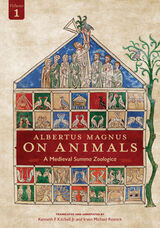
In his work De animalibus, Albert integrated the vast amount of information on nature that had come down to him in previous centuries: the exposition of Michael Scotus’s translation from the Arabic of Aristotle’s books on the natural world (Books 1–19), Albert’s own revisions to Aristotle’s teachings (Books 20–21), and a “dictionary” of animals appropriated largely from the De natura rerum of Thomas of Cantimpré (Books 22–26). Albert’s comprehensive treatise on living things was acknowledged as the reputable authority in biology for almost five hundred years.
In this translated and annotated edition, Kenneth F. Kitchell Jr. and Irven Michael Resnick illuminate the importance of this work, allowing Albert’s magnum opus to be better understood and more widely appreciated than ever before. Broken into two volumes (Books 1–10 and 11–26),Albertus Magnus On Animals is a veritable medieval scientific encyclopedia, ranging in topics from medicine, embryology, and comparative anatomy to women, hunting and everyday life, commerce, and much more—an essential work for historians, medievalists, scientists, and philosophers alike.
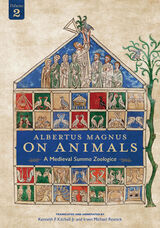
In his work De animalibus, Albert integrated the vast amount of information on nature that had come down to him in previous centuries: the exposition of Michael Scotus’s translation from the Arabic of Aristotle’s books on the natural world (Books 1–19), Albert’s own revisions to Aristotle’s teachings (Books 20–21), and a “dictionary” of animals appropriated largely from the De natura rerum of Thomas of Cantimpré (Books 22–26). Albert’s comprehensive treatise on living things was acknowledged as the reputable authority in biology for almost five hundred years.
In this translated and annotated edition, Kenneth F. Kitchell Jr. and Irven Michael Resnick illuminate the importance of this work, allowing Albert’s magnum opus to be better understood and more widely appreciated than ever before. Broken into two volumes (Books 1–10 and 11–26),Albertus Magnus On Animals is a veritable medieval scientific encyclopedia, ranging in topics from medicine, embryology, and comparative anatomy to women, hunting and everyday life, commerce, and much more—an essential work for historians, medievalists, scientists, and philosophers alike.
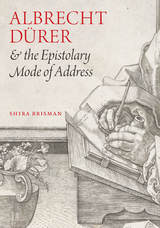
In the early modern period, before the establishment of a reliable postal system, letters faced risks of interception and delay. During the Reformation, the printing press threatened to expose intimate exchanges and blur the line between public and private life. Exploring the complex travel patterns of sixteenth-century missives, Brisman explains how these issues of sending and receiving informed Dürer’s artistic practices. His success, she contends, was due in large part to his development of pictorial strategies—an epistolary mode of address—marked by a direct, intimate appeal to the viewer, an appeal that also acknowledged the distance and delay that defers the message before it can reach its recipient. As images, often in the form of prints, coursed through an open market, and artists lost direct control over the sale and reception of their work, Germany’s chief printmaker navigated the new terrain by creating in his images a balance between legibility and concealment, intimacy and public address.
Epistolary fictions.
The Letters of Alciphron (second century AD) constitute one of the most attractive products of the Second Sophistic. They are fictitious compositions based on an astonishingly wide variety of circumstances, though the theme of erotic love is constantly sounded. The imagination shown by the author and his convincing realism win him a place of distinction in the early development of romantic prose. The letters, which are highly literary, owing much to the New Comedy of Menander, purport to give us a sketch of the social life of Athens in the fourth century BC. The collection is arranged in four divisions: Letters of Fishermen; Farmers; Parasites; Courtesans. Senders and addressees are mostly invented characters, but in the last section Alciphron presents us with several attempts at historical fiction, the most engaging being an exchange of letters between Menander and Glycera.
This volume also includes twenty Letters of Farmers ascribed to Aelian (ca. AD 170–235) and a collection of seventy-three Erotic Epistles of Philostratus (probably Flavius of that name, also born ca. AD 170). In style and subject matter these resemble those of Alciphron, by whom they may have been influenced.
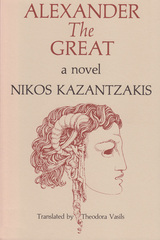
Nikos Kazantzakis is no stranger to the heroes of Greek antiquity. In this historical novel based on the life of Alexander the Great, Kazantzakis has drawn on both the rich tradition of Greek legend and the documented manuscripts from the archives of history to recreate an Alexander in all his many-faceted images—Alexander the god; Alexander the descendant of Heracles performing the twelve labors; Alexander the mystic, the daring visionary destined to carry out a divine mission; Alexander the flesh-and-blood mortal who, on occasion, is not above the common soldier’s brawling and drinking.
The novel, which resists the temptation to portray Alexander in the mantle of purely romantic legend, covers his life from age fifteen to his death at age thirty-two. It opens with Alexander’s first exploit, the taming of the horse, Bucephalas, and is seen in great part through the eyes of his young neighbor who eventually becomes an officer in his army and follows him on his campaign to conquer the world.
The book, which was written primarily as an educational adjunct for young readers, is intended for the adult mind as well, and like the legends of old, is entertaining as well as instructive for readers of all ages. It was originally published in Greece in serial form in 1940, and was republished in a complete volume in 1979.
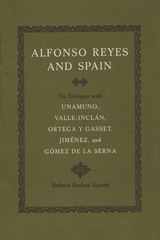
Alfonso Reyes, the great humanist and man of letters of contemporary Spanish America, began his literary career just before the outbreak of the Mexican Revolution of 1910. He spearheaded the radical shift in Mexico's cultural and philosophical orientation as a leading member of the famous "Athenaeum Generation."
The crucial years of his literary formation, however, were those he spent in Spain (1914-1924). He arrived in Madrid unknown and unsure of his future. When he left, he had achieved both professional maturity and wide acclaim as a writer. This book has, as its basis, the remarkable correspondence between Reyes and some of the leading spirits of the Spanish intellectual world, covering not only his years in Spain but also later exchanges of letters.
Although Reyes always made it clear that he was a Mexican and a Spanish American, he became a full-fledged member of the closed aristocracy of Spanish literature. It was the most brilliant period in Spain's cultural history since the Golden Age, and it is richly represented here by Reyes' association with five of its most important figures: Miguel de Unamuno and Ramón del Valle-Inclán were of the great "Generation of 98"; among the younger writers were José Ortega y Gasset, essayist and philosopher; the Nobel poet Juan Ramón Jiménez; and Ramón Gómez de la Serna, a precursor of surrealism.
Alfonso Reyes maintained lifelong friendships with these men, and their exchanges of letters are of a dual significance. They reveal how the years in Spain allowed Reyes to pursue his vocation independently, thereby prompting him to seek universal values. Coincidentally, they provide a unique glimpse into the inner world of those friends—and their dreams of a new Spain.
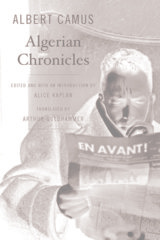
More than fifty years after Algerian independence, Albert Camus’ Algerian Chronicles appears here in English for the first time. Published in France in 1958, the same year the Algerian War brought about the collapse of the Fourth French Republic, it is one of Camus’ most political works—an exploration of his commitments to Algeria. Dismissed or disdained at publication, today Algerian Chronicles, with its prescient analysis of the dead end of terrorism, enjoys a new life in Arthur Goldhammer’s elegant translation.
“Believe me when I tell you that Algeria is where I hurt at this moment,” Camus, who was the most visible symbol of France’s troubled relationship with Algeria, writes, “as others feel pain in their lungs.” Gathered here are Camus’ strongest statements on Algeria from the 1930s through the 1950s, revised and supplemented by the author for publication in book form.
In her introduction, Alice Kaplan illuminates the dilemma faced by Camus: he was committed to the defense of those who suffered colonial injustices, yet was unable to support Algerian national sovereignty apart from France. An appendix of lesser-known texts that did not appear in the French edition complements the picture of a moralist who posed questions about violence and counter-violence, national identity, terrorism, and justice that continue to illuminate our contemporary world.

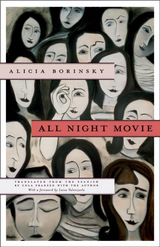
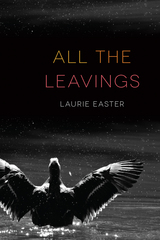
Whether recounting the home birth of her second child, encounters with cougars, the fraught dynamics of mother-daughter relationships, the destructive power of wildfires, or the community bonds challenged by a tragic suicide, Easter’s writing is firmly grounded in place. She takes readers deep into the heart of a still-wild Oregon, perilous yet rich with natural beauty.
Written from one woman’s perspective as a mother, wife, and friend, All the Leavings is ultimately a book about love—for the child who faces a health crisis, for the friend dying of AIDS, for the one entangled by addiction who then disappears. Long after the final page is turned, it will resonate with readers interested in essays, memoir, alternative lifestyles, and the literature of the West.
Nicholas Ward’s debut essay collection, All Who Belong May Enter, centers on self-exploration and cultural critique. These deeply personal essays examine whiteness, masculinity, and a Midwest upbringing through tales of sporting events, parties, posh (and not-so-posh) restaurant jobs, and the many relationships built and lost along the way. With a storyteller’s spirit, Ward recounts and evaluates the privilege of his upbringing with acumen and vulnerability. Ward’s profound affection for his friends, family, lovers, pets, and particularly for his chosen home, Chicago, shines through. This collection offers readers hope for healing that comes through greater understanding and inquiry into one’s self, relationships, and culture. Through these essays, Ward acknowledges his position within whiteness and masculinity, and he continuously holds himself and the society around him accountable.
All Who Belong May Enter was selected by Jaquira Díaz as the winner of the 2020 Autumn House Nonfiction Prize.
Nicholas Ward’s debut essay collection, All Who Belong May Enter, centers on self-exploration and cultural critique. These deeply personal essays examine whiteness, masculinity, and a Midwest upbringing through tales of sporting events, parties, posh (and not-so-posh) restaurant jobs, and the many relationships built and lost along the way. With a storyteller’s spirit, Ward recounts and evaluates the privilege of his upbringing with acumen and vulnerability. Ward’s profound affection for his friends, family, lovers, pets, and particularly for his chosen home, Chicago, shines through. This collection offers readers hope for healing that comes through greater understanding and inquiry into one’s self, relationships, and culture. Through these essays, Ward acknowledges his position within whiteness and masculinity, and he continuously holds himself and the society around him accountable.
All Who Belong May Enter was selected by Jaquira Díaz as the winner of the 2020 Autumn House Nonfiction Prize.

for everything from movies like Smokey and the Bandit to comedy acts like Larry the
Cable Guy. Even a recent president, George W. Bush, shunned his patrician pedigree in favor
of cowboy “authenticity” to appeal to voters. Whether identified with hard work and patriotism
or with narrow-minded bigotry, the Redneck and its variants have become firmly
established in American narrative consciousness.
This provocative book traces the emergence of the faux-Redneck within the context of
literary and cultural studies. Examining the icon’s foundations in James Fenimore Cooper’s
Natty Bumppo—“an ideal white man, free of the boundaries of civilization”—and the degraded
rural poor of Erskine Caldwell’s Tobacco Road, Matthew Ferrence shows how Redneck
stereotypes were further extended in Deliverance, both the novel and the film, and in
a popular cycle of movies starring Burt Reynolds in the 1970s and ’80s, among other manifestations.
As a contemporary cultural figure, the author argues, the Redneck represents
no one in particular but offers a model of behavior and ideals for many. Most important,
it has become a tool—reductive, confining, and (sometimes, almost) liberating—by which
elite forces gather and maintain social and economic power. Those defying its boundaries,
as the Dixie Chicks did when they criticized President Bush and the Iraq invasion, have
done so at their own peril. Ferrence contends that a refocus of attention to the complex
realities depicted in the writings of such authors as Silas House, Fred Chappell, Janisse Ray,
and Trudier Harris can help dislodge persistent stereotypes and encourage more nuanced
understandings of regional identity.
In a cultural moment when so-called Reality Television has turned again toward popular
images of rural Americans (as in, for example, Duck Dynasty and Moonshiners), All-
American Redneck reveals the way in which such images have long been manipulated for
particular social goals, almost always as a means to solidify the position of the powerful at
the expense of the regional.
In addition to presenting an overview of critical reactions to Estes’s oeuvre, reviews by Langdon Hammer, Julianne Buchsbaum, and Christopher Spaide also provide a helpful context for approaching a poet who claims to distrust narrative. Original essays consider the craft of Estes’s poetry and offer literary analysis. Ahren Warner uses line breaks to explore a postmodern analysis of Estes’s work. Mark Irwin looks at her poetic structure. Lee Upton employs a feminist perspective to explore Estes’s use of italics, and B. K. Fischer looks at the way she uses dance as a poetic image. Doug Rutledge considers her relationship to Dante and to the literary tradition through her use of ekphrasis. An interview with Estes herself, in which she speaks of a poem as an “arranged place . . . where experience happens,” adds her perspective to the mix, at turns resonating with and challenging her critics.
The Allure of Grammar will be useful for teachers and students of creative writing interested in the craft of non-narrative poetry. Readers of contemporary poetry who already admire Estes will find this collection insightful, while those not yet familiar with her work will come away from these essays eager to seek out her books.

Alms for Oblivion was first published in 1967. Minnesota Archive Editions uses digital technology to make long-unavailable books once again accessible, and are published unaltered from the original University of Minnesota Press editions.
This volume makes available in book form a collection of seventeen essays by Edward Dahlberg, who has been called one of the great unrecognized writers of our time. Some of the selections have never been published before; others have appeared previously only in magazines of limited circulation. There is a foreword by Sir Herbert Read.
The individual essays are on a wide range of subjects: literary, historical, philosophical, personal. The longest is a discussion of Herman Melville's work entitled "Moby-Dick - A Hamitic Dream." The fate of authors at the hands of reviewers is the subject of the essay called "For Sale." In "No Love and No Thanks" the author draws a characterization of our time. He presents a critique of the poet William Carlos Williams in "Word-Sick and Place- Crazy," and a discussion of F. Scott Fitzgerald in "Peopleless Fiction." In "My Friends Stieglitz, Anderson, and Dreiser" he discusses not only Alfred Stieglitz, Sherwood Anderson, and Theodore Dreiser but other personalities as well. He also writes of Sherwood Anderson in "Midwestern Fable." In "Cutpurse Philosopher" the subject is William James. "Florentine Codex" is about the conquistadores. Other essays in the collection are the following: "Randolph Bourne," "Our Vanishing Cooperative Colonies," "Chivers and Poe," "Domestic Manners of Americans," "Robert McAlmon: A Memoir," "The Expatriates: A Memoir," and an essay on Allen Tate.
Alternative Alcott includes works never before reprinted, including "How I Went Out to Service," "My Contraband," and "Psyche's Art." It also contains Behind a Mask, her most important sensation story; the full and correct text of her last unfinished novel, Diana and Persis; "Transcendental Wild Oats"; Hospital Sketches; and Alcott's other important texts on nineteenth-century social history. This anthology brings together for the first time a variety of Louisa May Alcott's journalistic, satiric, feminist, and sensation texts. Elaine Showalter has provided an excellent introduction and notes to the collection.
The title story presents a self-centered and captivating woman who ruthlessly steals her orphan cousin's lover. In "Circumstance," a pioneer woman returning home through the woods at night is caught by a panther; her husband, who has come to save her, can only watch from the ground as she sings for her life, pinned in a tree. A train engineer hallucinates again and again that he is running over his wife. And Mrs. Craven, who's a bit "weak" in the head, mindlessly repeats "Three men went down cellar and only two came up." These stories combine elements of the best ghost stories—timing, detail, and character —with just enough chill to make you think twice about turning out your lights at night.
American Examples: New Conversations about Religion, Volume One is the first in a series of annual anthologies published in partnership with the Department of Religious Studies at The University of Alabama. The American Examples initiative gathers scholars from around the world for a series of workshops designed to generate big questions about the study of religion in America. Bypassing traditional white Protestant narratives in favor of new perspectives on belief, social formation, and identity, American Examples fellows offer dynamic perspectives on American faith that challenge our understandings of both America and religion as categories.
In the first volume of this exciting academic project, five topically and methodologically diverse scholars vividly reimagine the potential applications of religious history. The five chapters of this inaugural volume use case studies from America, broadly conceived, to ask larger theoretical questions that are of interest to scholars beyond the subfield of American religious history.
Prea Persaud’s chapter explores the place of Hinduism among the “creole religions” of the Caribbean, while Hannah Scheidt captures what atheist parents say to each other about value systems. Travis Warren Cooper explains how the modernist church architecture of Columbus, Indiana, became central to that city’s identity. Samah Choudhury dissects how Muslim American comedians navigate Western ideas of knowledge and self to make their jokes, and their own selves legible, and Emily D. Crews uses ethnographic fieldwork to read the female reproductive body among Nigerian Pentecostal congregations. Editor Michael J. Altman also provides a brief, rich introduction assessing the state of the discipline of religious history and how the American Examples project can lead the field forward.
Visit americanexamples.ua.edu for more information on the group and news about upcoming projects.
American Examples: New Conversations about Religion, Volume Two, is the second in a series of annual anthologies produced by the American Examples workshop hosted by the Department of Religious Studies at The University of Alabama. In the latest volume from this dynamic academic project, nine scholars with diverse topics and methodologies vividly reimagine the meaning of all three words in the phrase “American religious history.” The essays use case studies from America, broadly conceived, to ask trenchant theoretical questions that are of interest to scholars and students beyond the subfield of American religious history.
Cody Musselman uses a Weberian analysis to explore questions of identity, authority, and authenticity in the world of SoulCycle while Zachary T. Smith finds commonality between the rhetoric and practices of scholarship and mixed martial arts. Erik Kline provides a new perspective on the psychedelic mysticism of the 1960s, and Brook Wilensky-Lanford takes stock of the cultural power of parody in Mark Twain’s last work of fiction. Christopher Cannon Jones examines the reciprocal relationship between religious texts and cultural contexts by comparing early Mormon missions to Hawai‘i and Jamaica and Lindsey Jackson explores what debates over circumcision can tell us about gender stereotypes and motherhood. Dana Lloyd uses the 1988 Supreme Court decision in Lyng v. Northwest Indian Cemetery Protective Association as a case study in order to consider how Indigenous religion and sovereignty have been understood and adjudicated in the American legal system. Matt Sheedy studies the identity categories of “atheist” and “ex-Muslim” and Brad Stoddard uses ethnographic fieldwork to evaluate the role of religious pluralism in regulating and policing correctional institutions. Editors Samah Choudhury and Prea Persaud provide an introduction that reconsiders the trajectory of the American Examples project in light of the siege on the US Capitol in January 2021 and the continuing COVID pandemic.
Visit americanexamples.ua.edu for more information on upcoming workshop dates and future projects.
CONTRIBUTORS
Michael J. Altman / Samah Choudhury / Lindsey Jackson / Christopher Cannon Jones / / Erik Kline / Dana Lloyd / Cody Musselman / Prea Persaud / Matt Sheedy / Zachary T. Smith / Brad Stoddard / Brook Wilensky-Lanford

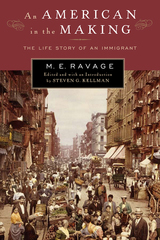
Steven G. Kellman brings Ravage's story to life again in this new edition, providing a brief biography and introduction that place the memoir within historical and literary contexts. An American in the Making contributes to a broader understanding of the global notion of "America" and remains timely, especially in an era when massive immigration, now from Latin America and Asia, challenges ideas of national identity.
American Political Plays after 9/11 is a diverse collection of bold, urgent, and provocative plays that respond to the highly charged, post 9/11 political landscape. Sparked by the terrorist attacks of September 11, 2001, and subsequently fueled by a series of controversial events—the Iraq war, the passing and enforcement of the U.S.A. Patriot Act, and the revelation of torture and other scandals at the Abu Ghraib prison—American political theater is currently experiencing a surge in activity. The plays in this collection include The Guys by Anne Nelson, At the Vanishing Point by Naomi Iizuka, The Venus de Milo Is Armed by Kia Corthron, Back of the Throat by Yusseff El Guindi, Three Nights in Prague by Allan Havis, and Question 27, Question 28 by Chay Yew.
The characters range from a New York City fire captain trying to respectfully memorialize eight of his lost comrades, to the citizens of a hog-killing Louisville neighborhood who poignantly exemplify the underside of the economic crisis, to an Arab American citizen being harshly (and possibly unfairly) interrogated by two officers as a “person of interest.” Though not all of the plays deal explicitly with the Al Qaeda attacks, they collectively reveal themes of sorrow and anxiety, moral indignation, alarmist self-preservation, and economic and social insecurity stemming from the United States’ fairly sudden shift from cold war superpower to vulnerable target.
The lively introduction by Allan Havis includes a brief history of political theater in the United States, an extensive discussion about how theater communities responded to 9/11, and an informative analysis of the six plays in the book. A collection of dramatic material framed by this significant historical event, AmericanPolitical Plays after 9/11 will be indispensable for theater and cultural studies scholars and students.
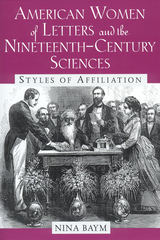
Choice Outstanding Academic Title
During the nineteenth century, the content and institutional organization of the sciences evolved dramatically, altering the public's understanding of knowledge. As science grew in importance, many women of letters tried to incorporate it into a female worldview. Nina Baym explores the responses to science displayed in a range of writings by American women. Conceding that they could not become scientists, women insisted, however, that they were capable of understanding science and participating in its discourse. They used their access to publishing to advocate the study and transmission of scientific information to the general public.
Bayms book includes biographies and a full exploration of these women's works. Among those considered are:
• Almira Phelps, author of Familiar Lectures on Botany (it sold 350,000 copies)
• Sarah Hale, who filled Godey's Lady's Book with science articles
• Catharine Esther Beecher, who based her domestic advice on scientific information
• Elizabeth Cary Agassiz, the actual ghostwriter of her husband's popular science essays
• Emily Dickinson, whose poetry is replete with scientific images.
Baym also investigates science in women's novels, writing by and about women doctors, and the scientific claims advanced by women's spiritualist movements. This book truly breaks new ground, outlining a field of inquiry that few have noted exists.
Among the more interesting incunabula preserved in the Salle de la Réserve of the Bibliothèque National in Paris are the apparently unique copies of two editions, very similar in content, of a work entitled Les Adevineaux amoureux. In much more comprehensive form Les Adevineaux amoureux is preserved in a manuscript belonging to the Musée Conde at Chantilly. All three texts, in medieval French, appear to date from the 1470s. The present work, Amorous Games, is a critical edition of Les Adevineaux amoureux.
Amorous Games is a miscellany whose principal unifying force is the compiler's aim to provide a manual of conversation and entertainment for polite society. Included are series of questions and answers belonging to the well-established medieval tradition of the "Demandes amoureuses"; a very large number of riddles, mainly folk riddles; and "venditions en amours," little poems that apparently came into bing as part of a social game.
Students of medieval French literature, particularly those with a penchant for some of the minor genres, will find new material in the Amorous Games. Folklorists will discover what is probably the largest collection of riddles bequeathed to us by medieval France and also much that is of value to specialists in the proverb and folk tale.
For this critical edition of Les Adevineaux amoureux Professor Hassell has selected the Chantilly manuscript, because it is the most complete and also because it had not yet been published. The Appendix contains the text of the more complete of the two incunabula and the significant variants appearing in the other fifteenth-century printed edition. The manuscript text has been collated with that of the incunabula, and copious notes and an index to the riddles have been supplied. In his introduction Professor Hassell discusses in detail the major classes and subclasses of the riddle, drawing on the work of Petsch, Taylor, Abrahams, and other scholars of the genre.
Ancestors, Kings, and the Dao outlines the evolution of musical performance in early China, first within and then ultimately away from the socio-religious context of ancestor worship. Examining newly discovered bamboo texts from the Warring States period, Constance A. Cook compares the rhetoric of Western Zhou (1046–771 BCE) and Spring and Autumn (770–481 BCE) bronze inscriptions with later occurrences of similar terms in which ritual music began to be used as a form of self-cultivation and education. Cook’s analysis links the creation of such classics as the Book of Odes with the ascendance of the individual practitioner, further connecting the social actors in three types of ritual: boys coming of age, heirs promoted into ancestral government positions, and the philosophical stages of transcendence experienced in self-cultivation.
The focus of this study is on excavated texts; it is the first to use both bronze and bamboo narratives to show the evolution of a single ritual practice. By viewing the ancient inscribed materials and the transmitted classics from this new perspective, Cook uncovers new linkages in terms of how the materials were shaped and reshaped over time and illuminates the development of eulogy and song in changing ritual contexts.
Completely revised and updated
James P. Allen provides a translation of the oldest corpus of ancient Egyptian religious texts from the six royal pyramids of the Fifth and Sixth Dynasties (ca. 2350–2150 BCE). Allen’s revisions take into account recent advances in the understanding of Egyptian grammar.
Features:
- Sequential translations based on all available sources, including texts newly discovered in the last decade
- Texts numbered according to the most widely used numbering system with new numbers from the latest 2013 concordance
- Translations reflect the primarily atemporal verbal system of Old Egyptian, which conveys the timeless quality that the text’s authors understood the texts to have
Craig Waddell presents essays investigating Rachel Carson’s influential 1962 book, Silent Spring. In his foreword, Paul Brooks, Carson’s editor at Houghton Mifflin, describes the process that resulted in Silent Spring. In an afterword, Linda Lear, Carson’s recent biographer, recalls the end of Carson’s life and outlines the attention that Carson’s book and Carson herself received from scholars and biographers, attention that focused so minutely on her life that it detracted from a focus on her work. The foreword by Brooks and the afterword by Lear frame this exploration within the context of Carson’s life and work.
Contributors are Edward P. J. Corbett, Carol B, Gartner, Cheryll Glotfelty, Randy Harris, M. Jimmie Killingsworth, Linda Lear, Ralph H. Lutts, Christine Oravec, Jacqueline S. Palmer, Markus J. Peterson, Tarla Rai Peterson, and Craig Waddell. Together, these essays explore Silent Spring’seffectiveness in conveying its disturbing message and the rhetorical strategies that helped create its wide influence.
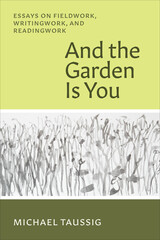
Michael Taussig’s work is known for its critical insights and bold, experimental style. In the eleven essays in this new collection, Taussig reflects on the act of writing itself, demonstrating its importance for anthropological practice and calling for the discipline to keep experiential knowledge from being extinguished as fieldnotes become scholarship.
Setting out to show how this can be done, And the Garden Is You exemplifies a form of exploratory writing that preserves the spontaneity of notes scribbled down in haste. In these essays, the author’s reflections take us from his childhood in Sydney to trips to Afghanistan, Colombia, Finland, Italy, Turkey, and Syria. Along the way, Taussig explores themes of fabulation and provocation that are central to his life’s work, in addition to the thinkers dearest to him—Bataille, Benjamin, Burroughs, and Nietzsche, among others. This collection is vintage Taussig, bound to interest longtime readers and newcomers alike.

Published during the 1990s, these essays are united through a common methodological engagement—writing that recounts a personal anecdote and then attempts to read that anecdote for the theoretical insights it affords. Gallop addresses many of the major questions of feminist theory, regularly revisiting not only ‘70s feminism, but also poststructuralism and the academy, for, as Gallop explains, the practice of anecdotal theory derives from psychoanalysis, deconstruction, and feminism. Whether addressing issues of pedagogy, the sexual position one occupies when on the academic job-market, bad-girl feminists, or the notion of sisterhood, these essays exemplify theory grappling with its own erotics, theory connected to the real. They are bold, illuminating, and—dare we say—fun.
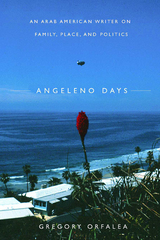
Populated with fascinating characters—the Angelenos of Orfalea’s life—these essays tell the story of the author’s trials. He returns to Los Angeles to teach, trying to reconcile the LA of his childhood with the city he now faces. He takes on progressively more difficult and painful subjects, finally confronting the memories of the shocking tragedy that took the lives of his father and sister.
With more than 400,000 Arab Americans in Los Angeles—probably surpassing Detroit as the largest contingent in America—Orfalea also explores his own community and its political and social concerns. He agonizes over another destruction of Lebanon and examines in searing detail a massacre of civilians in Iraq.
Angeleno Days takes the memoir and personal essay to rare heights. Orfalea is a deeply human writer who reveals not only what it means to be human in America now, but also what it will take to remain human in the days to come. These essays soar, confound, reveal, and strike at our senses and sensibilities, forcing us to think and feel in new ways.
Music was at once one of the most idealized and one of the most contested art forms of the Victorian period. Yet this vitally important nineteenth-century cultural form has been studied by literary critics mainly as a system of thematic motifs. Angelic Airs, Subversive Songs positions music as a charged site of cultural struggle, promoted concurrently as a transcendent corrective to social ills and as a subversive cause of those ills. Alisa Clapp-Itnyre examines Victorian constructions of music to advance patriotism, Christianity, culture, and domestic harmony, and suggests that often these goals were undermined by political tensions in song texts or “immoral sensuality” in the “spectacle” of live music-making.
Professor Clapp-Itnyre turns her focus to the novels of Elizabeth Gaskell, George Eliot, and Thomas Hardy, who present complex engagements with those musical genres most privileged by Victorian society: folk songs, religious hymns, and concert music.
Angelic Airs, Subversive Songs recovers the pervasive ambiguities of the Victorian musical period, ambiguities typically overlooked by both literary scholars and musicologists. To the literary critic and cultural historian, Professor Clapp-Itnyre demonstrates the necessity of further exploring the complete aesthetic climate behind some of the Victorian period’s most powerful literary works. And to the feminist scholar and the musicologist, Clapp-Itnyre reveals the complexities of music as both an oppressive cultural force and an expressive, creative outlet for women.
Lucius Annaeus Seneca (4 BCE–65 CE) was a Roman Stoic philosopher, dramatist, statesman, and adviser to the emperor Nero, all during the Silver Age of Latin literature. The Complete Works of Lucius Annaeus Seneca is a fresh and compelling series of new English-language translations of his works in eight accessible volumes. Edited by world-renowned classicists Elizabeth Asmis, Shadi Bartsch, and Martha C. Nussbaum, this engaging collection restores Seneca—whose works have been highly praised by modern authors from Desiderius Erasmus to Ralph Waldo Emerson—to his rightful place among the classical writers most widely studied in the humanities.
Anger, Mercy, Revenge comprises three key writings: the moral essays On Anger and On Clemency—which were penned as advice for the then young emperor, Nero—and the Apocolocyntosis, a brilliant satire lampooning the end of the reign of Claudius. Friend and tutor, as well as philosopher, Seneca welcomed the age of Nero in tones alternately serious, poetic, and comic—making Anger, Mercy, Revenge a work just as complicated, astute, and ambitious as its author.
Although women and men have different relationships to language and to each other, traditional theories of rhetoric do not foreground such gender differences. Krista Ratcliffe argues that because feminists generally have not conceptualized their language theories from the perspective of rhetoric and composition studies, rhetoric and composition scholars must construct feminist theories of rhetoric by employing a variety of interwoven strategies: recovering lost or marginalized texts; rereading traditional rhetoric texts; extrapolating rhetorical theories from such nonrhetoric texts as letters, diaries, essays, cookbooks, and other sources; and constructing their own theories of rhetoric.
Focusing on the third option, Ratcliffe explores ways in which the rhetorical theories of Virginia Woolf, Mary Daly, and Adrienne Rich may be extrapolated from their Anglo-American feminist texts through examination of the interrelationship between what these authors write and how they write. In other words, she extrapolates feminist theories of rhetoric from interwoven claims and textual strategies. By inviting Woolf, Daly, and Rich into the rhetorical traditions and by modeling the extrapolation strategy/methodology on their writings, Ratcliffe shows how feminist texts about women, language, and culture may be reread from the vantage point of rhetoric to construct feminist theories of rhetoric. She also outlines the pedagogical implications of these three feminist theories of rhetoric, thus contributing to ongoing discussions of feminist pedagogies.
Traditional rhetorical theories are gender-blind, ignoring the reality that women and men occupy different cultural spaces and that these spaces are further complicated by race and class, Ratcliffe explains. Arguing that issues such as who can talk, where one can talk, and how one can talk emerge in daily life but are often disregarded in rhetorical theories, Ratcliffe rereads Roland Barthes’ "The Old Rhetoric" to show the limitations of classical rhetorical theories for women and feminists. Discovering spaces for feminist theories of rhetoric in the rhetorical traditions, Ratcliffe invites readers not only to question how women have been located as a part of— and apart from—these traditions but also to explore the implications for rhetorical history, theory, and pedagogy.
Anglophone Poetry in Colonial India, 1780–1913: A Critical Anthology makes accessible for the first time the entire range of poems written in English on the subcontinent from their beginnings in 1780 to the watershed moment in 1913 when Rabindranath Tagore won the Nobel Prize in Literature.Mary Ellis Gibson establishes accurate texts for such well-known poets as Toru Dutt and the early nineteenth-century poet Kasiprasad Ghosh. The anthology brings together poets who were in fact colleagues, competitors, and influences on each other. The historical scope of the anthology, beginning with the famous Orientalist Sir William Jones and the anonymous “Anna Maria” and ending with Indian poets publishing in fin-de-siècle London, will enable teachers and students to understand what brought Kipling early fame and why at the same time Tagore’s Gitanjali became a global phenomenon. Anglophone Poetry in Colonial India, 1780–1913 puts all parties to the poetic conversation back together and makes their work accessible to American audiences.With accurate and reliable texts, detailed notes on vocabulary, historical and cultural references, and biographical introductions to more than thirty poets, this collection significantly reshapes the understanding of English language literary culture in India. It allows scholars to experience the diversity of poetic forms created in this period and to understand the complex religious, cultural, political, and gendered divides that shaped them.
Animal Fables of the Courtly Mediterranean is a treasure trove of stories and lessons on how to conduct oneself and succeed in life, sometimes through cleverness rather than virtue. They feature human and many animal protagonists, including the two jackals Stephanites and Ichnelates, after whom the book is named, as well as several lion kings. At the heart of this work are tales from the Sanskrit Panchatantra and Mahabharata, to which more were added, both in the original Middle Persian collection and its eighth-century Arabic translation, the widely known Kalīla wa-Dimna.
In the eleventh century, readers in Constantinople were introduced to these stories through an abbreviated Greek version, translated by Symeon Seth from the Arabic. The new Byzantine Greek text and English translation presented here is a more complete version, originating in twelfth-century Sicily and connected with Admiral Eugenius of Palermo. It contains unique prefaces and reinstates the prologues and stories omitted by Seth.
In 1654, Anna Trapnel — a Baptist, Fifth Monarchist, millenarian, and visionary from London — fell into a trance during which she prophesied passionately and at length against Oliver Cromwell and his government. The prophecies attracted widespread public attention, and resulted in an invitation to travel to Cornwall. Her Report and Plea, republished here for the first time, is a lively and engaging firsthand account of the visit, which concluded in her arrest, a court hearing, and imprisonment. Part memoir, part travelogue, and part impassioned defense of her beliefs and actions, the Report and Plea offers vivid and fascinating insight into the life and times of an early modern woman claiming her place at the center of the tumultuous political events of mid-seventeenth-century England.
A brilliant essayist and a master of the aphorism (“Our moods do not believe in each other”; “Money often costs too much”), Emerson has inspired countless writers. He challenged Americans to shut their ears against Europe’s “courtly muses” and to forge a new, distinctly American cultural identity. But he remains one of America’s least understood writers. And, by his own admission, he spawned neither school nor follower (he valued independent thought too much). Now, in this annotated selection of Emerson’s writings, David Mikics instructs the reader in a larger appreciation of Emerson’s essential works and the remarkable thinker who produced them.
Full of color illustrations and rich in archival photographs, this volume offers much for the specialist and general reader. In his running commentaries on Emerson’s essays, addresses, and poems, Mikics illuminates contexts, allusions, and language likely to cause difficulty to modern readers. He quotes extensively from Emerson’s Journal to shed light on particular passages or lines and examines Emerson the essayist, poet, itinerant lecturer, and political activist. Finally, in his Foreword, Phillip Lopate makes the case for Emerson as a spectacular truth teller—a model of intellectual labor and anti-dogmatic sanity.
Anyone who values Emerson will want to own this edition. Those wishing to discover, or to reacquaint themselves with, Emerson’s writings but who have not known where or how to begin will not find a better starting place or more reliable guide than The Annotated Emerson.
The only collection of all known letters of Christopher Smart provides the best psychological explanation to date of that complex and elusive eighteenth-century poet.
The significant characteristics that distinguish Smart’s prose letters from his poetry, Betty Rizzo and Robert Mahony note, are that his letters were requests for assistance while his verses were bequests, gifts in which he set great store. Indeed, it was Smart’s lifelong conviction that he was a poet of major importance.
As Smart biographer Karina Williamson notes, "The splendidly informative and vivaciously written accounts of the circumstances surrounding each letter, or group of letters, add up to what is in effect a miniature biography."
No American president before or since has faced the problems that confronted Abraham Lincoln when he took office in 1861. Nor has any president expressed himself with such eloquence on issues of great moment. Lincoln’s writings reveal the depth of his thought and feeling and the sincerity of his convictions as he weighed the cost of freedom and preserving the Union. Now for the first time an annotated edition of Lincoln’s essential writings examines the extraordinary man who produced them and explains the context in which they were composed.
The Annotated Lincoln spans three decades of Lincoln’s career, from his initial political campaign for state assemblyman in 1832 to his final public address on Reconstruction, delivered three days before his assassination on April 15, 1865. Included here are selections from his personal and political letters, poetry, speeches, and presidential messages and proclamations. In their generous annotations, Harold Holzer and Thomas Horrocks explore Lincoln’s thoughts on slavery, emancipation, racial equality, the legality of secession, civil liberties in wartime, and the meaning of the terrible suffering caused by the Civil War. And they bring Lincoln’s writings into the ambit of Lincoln scholarship, to offer a broader appreciation of his thoughts, words, and career.
Numerous illustrations throughout animate historical events and actors. Teachers, students, and especially Lincoln enthusiasts will treasure this elegant volume and keep it close at hand for reference and enjoyment.
Edgar Allan Poe is perhaps America’s most famous writer. Adapted many times to the stage and screen and an inspiration to countless illustrators, graphic novelists, and musicians, his tales and poems remain a singular presence in popular culture. (His most famous poem inspired the name of the NFL’s Baltimore Ravens.) And then there is the matter of Poe’s literary influence. “How many things come out of Poe?” Jorge Luis Borges once asked. And yet Poe remains misunderstood, his works easily confused with the legend of a troubled genius. Now, in this annotated edition of selected tales and poems, Kevin J. Hayes debunks the Poe myth, enables a larger appreciation of Poe’s career and varied achievements, and investigates his weird afterlives.
With color illustrations and photographs throughout, The Annotated Poe contains in-depth notes placed conveniently alongside the tales and poems to elucidate Poe’s sources, obscure words and passages, and literary, biographical, and historical allusions. Like Poe’s own marginalia, Hayes’s marginal notes accommodate “multitudinous opinion”: he explains his own views and interpretations as well as those of other writers and critics, including Poe himself. In his Foreword, William Giraldi provides a spirited introduction to the writer who produced such indelible masterpieces as “The Fall of the House of Usher,” “The Murders in the Rue Morgue,” and “The Black Cat.”
The Annotated Poe offers much for both the professional and the general reader—but it will be especially prized by those who think of themselves as Poe aficionados.
“And I? May I say nothing, my lord?” With these words, Oscar Wilde’s courtroom trials came to a close. The lord in question, High Court justice Sir Alfred Wills, sent Wilde to the cells, sentenced to two years in prison with hard labor for the crime of “gross indecency” with other men. As cries of “shame” emanated from the gallery, the convicted aesthete was roundly silenced.
But he did not remain so. Behind bars and in the period immediately after his release, Wilde wrote two of his most powerful works—the long autobiographical letter De Profundis and an expansive best-selling poem, The Ballad of Reading Gaol. In The Annotated Prison Writings of Oscar Wilde, Nicholas Frankel collects these and other prison writings, accompanied by historical illustrations and his rich facing-page annotations. As Frankel shows, Wilde experienced prison conditions designed to break even the toughest spirit, and yet his writings from this period display an imaginative and verbal brilliance left largely intact. Wilde also remained politically steadfast, determined that his writings should inspire improvements to Victorian England’s grotesque regimes of punishment. But while his reformist impulse spoke to his moment, Wilde also wrote for eternity.
At once a savage indictment of the society that jailed him and a moving testimony to private sufferings, Wilde’s prison writings—illuminated by Frankel’s extensive notes—reveal a very different man from the famous dandy and aesthete who shocked and amused the English-speaking world.
Another Way the River Has collects Robin Cody’s finest nonfiction writings, many appearing for the first time in print. Cody’s prose rings with a sense of place. He is a native speaker who probes the streams and woods and salmon that run to the heart of what it means to live and love, to work and play, in Oregon.
His characters—from loggers to fishers to cowboys to the kids on his school bus—are smart and curious, often off-beat, always vivid. Cody brings the ear of a novelist and the eye of a reporter to the people and places that make the Northwest, and Northwest literature, distinctive.
“A rock, you know, will sink like a stone in water. But a flat rock, slung spinningly near the water surface and at an angel parallel to it, will go skipping across the water in defiance of gravity and common sense. How cool is that?! The first time a boy pulls this off ranks just short of first-time sex on the scale of things he will want to do over and over whenever he can and as long as he lives.”
-from “The Clackamas River”
Lucy Pier Stevens, a twenty-one-year-old woman from Ohio, began a visit to her aunt’s family near Bellville, Texas, on Christmas Day, 1859. Little did she know how drastically her life would change on April 4, 1861, when the outbreak of the Civil War made returning home impossible. Stranded in enemy territory for the duration of the war, how would she reconcile her Northern upbringing with the Southern sentiments surrounding her?
Lucy Stevens’s diary—one of few women’s diaries from Civil War–era Texas and the only one written by a Northerner—offers a unique perspective on daily life at the fringes of America’s bloodiest conflict. An articulate, educated, and keen observer, Stevens took note seemingly of everything—the weather, illnesses, food shortages, parties, church attendance, chores, schools, childbirth, death, the family’s slaves, and political and military news. As she confided her private thoughts to her journal, she unwittingly revealed how her love for her Texas family and the Confederate soldier boys she came to care for blurred her loyalties, even as she continued to long for her home in Ohio. Showing how the ties of heritage, kinship, friendship, and community transcended the sharpest division in US history, this rare diary and Vicki Adams Tongate’s insightful historical commentary on it provide a trove of information on women’s history, Texas history, and Civil War history.
Never before has there been a single-volume anthology of modern Irish poetry so significant and groundbreaking as An Anthology of Modern Irish Poetry.
Collected here is a comprehensive representation of Irish poetic achievement in the twentieth and twenty-first centuries, from poets such as Austin Clarke and Samuel Beckett who were writing while Yeats and Joyce were still living; to those who came of age in the turbulent ’60s as sectarian violence escalated, including Seamus Heaney and Michael Longley; to a new generation of Irish writers, represented by such diverse, interesting voices as David Wheatley (born 1970) and Sinéad Morrissey (born 1972). Scholar and editor Wes Davis has chosen work by more than fifty leading modern and contemporary Irish poets. Each poet is represented by a generous number of poems (there are nearly 800 poems in the anthology). The editor’s selection includes work by world-renowned poets, including a couple of Nobel Prize winners, as well as work by poets whose careers may be less well known to the general public; by poets writing in English; and by several working in the Irish language (Gaelic selections appear in translation). Accompanying the selections are a general introduction that provides a historical overview, informative short essays on each poet, and helpful notes—all prepared by the editor.
The Other Voice in Early Modern Women: The Toronto Series volume 70

From award-winning author Barrie Jean Borich comes Apocalypse, Darling, a narrative, lyric exploration of the clash between old and new. Set in the steel mill regions of Chicago and in Northwest Indiana, the story centers on Borich’s return to a decimated landscape for a misbegotten wedding in which her spouse’s father marries his high school sweetheart. The book is a lilting journey into an ill-fated moment, where families attempt to find communion in tense gathering spaces and across their most formative disappointments. Borich tells the story of the industrial heartland that produced the steel that made American cities, but also one of the most toxic environmental sites in the world.
As concise as a poem and as sweeping as an epic novel, Apocalypse, Darling explores the intersection of American traditional and self-invented social identities and the destruction and re-greening of industrial cityscapes. Borich asks: can toxic landscapes actually be remediated and can patriarchal fathers ever really be forgiven? In a political climate where Borich is forced to daily re-enter the toxic wastelands she thought she’d long left behind, Apocalypse, Darling is an urgent collision of broken spaces, dysfunctional affections, and the reach toward familial and environmental repair.
Oratory and philosophy from a Latin novelist.
Apuleius, one of the great stylists of Latin literature, was born ca. AD 125 in Madauros to a politically prominent family and received an elite education in the provincial capital Carthage and at Athens, where he began a lifelong allegiance to Platonic philosophy. In the later 150s, he married Pudentilla of Oea, a wealthy widow, and seems to have enjoyed a distinguished public career in Africa and perhaps as an advocate in Rome.
Although Apuleius is best known for his picaresque novel Metamorphoses or The Golden Ass (LCL 44, 453), he also wrote and declaimed on a wide variety of subjects. This edition contains the other surviving works of Apuleius that are considered genuine. Apologia is a speech delivered probably in 158/59 in which Apuleius defends himself against in-laws who had accused him of having used sinister means, including magic, to induce Pudentilla to marry him. The Florida is a collection of twenty-three excerpts from speeches by Apuleius, probably all of them delivered in Africa; the title refers either to their florid style or to their resemblance to an anthology, perhaps both. De Deo Socratis (On Socrates’ God) takes the form of a speech addressed to a cultured, nonspecialist Latin-speaking audience that locates Socrates’ invisible guide and protector (daimonion) within the more general concept of daimones as forces intermediary between gods and humans.
The Loeb Classical Library edition of Apuleius is in three volumes.
2020 American Book Award winner, Walter & Lillian Lowenfels Criticism Award
Weatherford Award winner, nonfiction
With hundreds of thousands of copies sold, a Ron Howard movie in the works, and the rise of its author as a media personality, J. D. Vance’s Hillbilly Elegy: A Memoir of a Family and Culture in Crisis has defined Appalachia for much of the nation. What about Hillbilly Elegy accounts for this explosion of interest during this period of political turmoil? Why have its ideas raised so much controversy? And how can debates about the book catalyze new, more inclusive political agendas for the region’s future?
Appalachian Reckoning is a retort, at turns rigorous, critical, angry, and hopeful, to the long shadow Hillbilly Elegy has cast over the region and its imagining. But it also moves beyond Hillbilly Elegy to allow Appalachians from varied backgrounds to tell their own diverse and complex stories through an imaginative blend of scholarship, prose, poetry, and photography. The essays and creative work collected in Appalachian Reckoning provide a deeply personal portrait of a place that is at once culturally rich and economically distressed, unique and typically American. Complicating simplistic visions that associate the region almost exclusively with death and decay, Appalachian Reckoning makes clear Appalachia’s intellectual vitality, spiritual richness, and progressive possibilities.
The image of the archaeologist as adventurous explorer of foreign lands, part spy, part foreigner, eternally alluring, solidified during this period. That legacy continues, undimmed, today.
In addition to its breadth, Archaic Greek Poetry stands alone as the only volume of its kind translated by a contemporary published poet. Perhaps the most elegant translator of ancient Greek poetry into modern English, Barbara Hughes Fowler offers translations true to the original Greek while providing modern readers with superb examples of the beauty of lyric poetry. Students and scholars of classical and comparative literature, ancient history, and art history, as well as lovers of lyric poetry, will enthusiastically welcome this volume.
READERS
Browse our collection.
PUBLISHERS
See BiblioVault's publisher services.
STUDENT SERVICES
Files for college accessibility offices.
RECENTLY PUBLISHED


UChicago Accessibility Resources
home | accessibility | search | about | contact us
BiblioVault ® 2001 - 2024
The University of Chicago Press