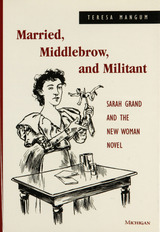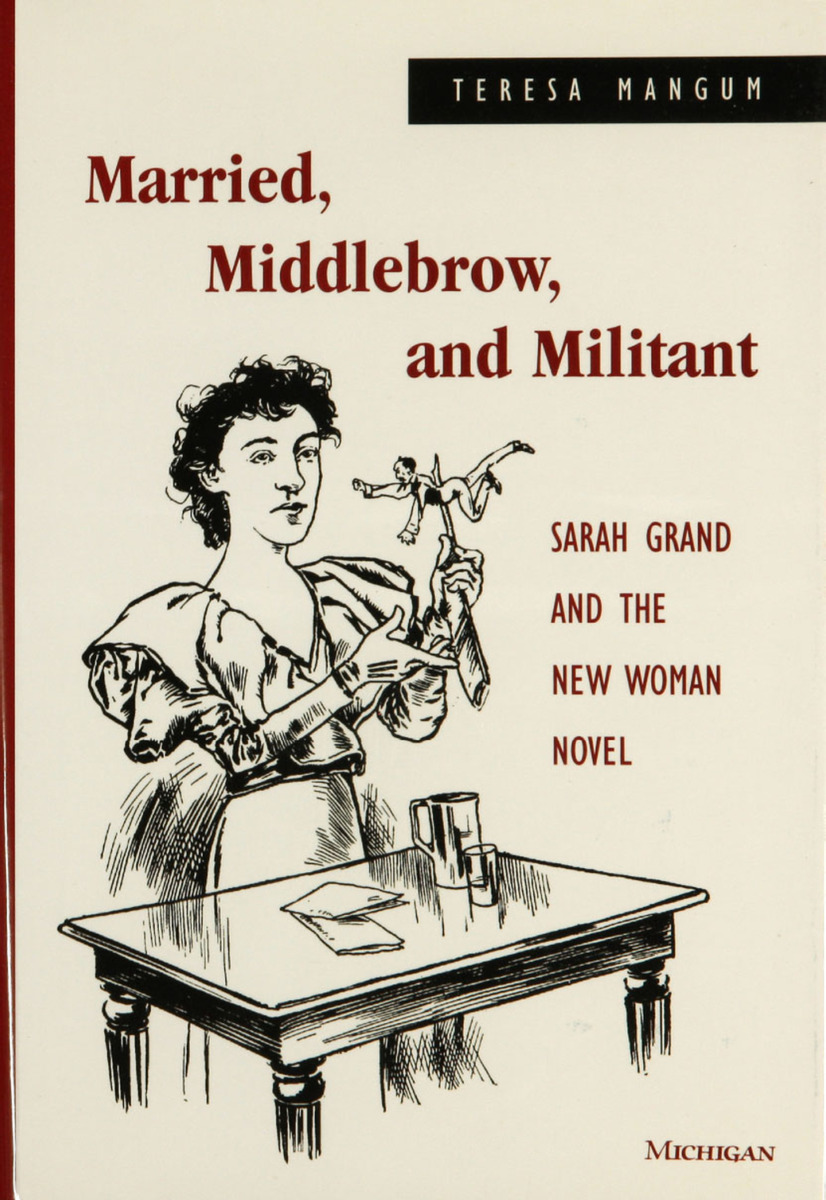
Married, Middlebrow, and Militant: Sarah Grand and the New Woman Novel
University of Michigan Press, 1998
Cloth: 978-0-472-10977-7 | eISBN: 978-0-472-22554-5 (standard)
Library of Congress Classification PR4728.G112Z78 1998
Dewey Decimal Classification 823.8
Cloth: 978-0-472-10977-7 | eISBN: 978-0-472-22554-5 (standard)
Library of Congress Classification PR4728.G112Z78 1998
Dewey Decimal Classification 823.8
ABOUT THIS BOOK | AUTHOR BIOGRAPHY | REVIEWS | REQUEST ACCESSIBLE FILE
ABOUT THIS BOOK
Between 1880 and 1920, the New Woman novel outraged "ladies," rallied women's rights activists, and inspired women readers and writers to harness an emerging popular literary market to their own political purposes. British author and activist Sarah Grand (1854-1943) took center stage, popularizing the term "New Woman," marching for suffrage, lecturing from platforms in Britain and America, and publishing fiction and essays that challenged the most powerful obstacle to middle-class militancy-marriage. Married, Middlebrow, and Militant indicates that Grand's dedication to reforming rather than abandoning marriage was based on the belief that changing the institution would lead to the legal, social, and personal transformation of both men and women. Writing across a range of sub-genres, she sought to loosen the hold of the marriage plot in fiction that called for New Women, New Men, and new social and literary plots. For her, and those like her, the middle-brow novel held militant potential to inspire immediate, intimate, and electric change. Teresa Mangum has examined a range of primary materials, including Grand's correspondence and the cartoons and periodical literature of the day, and further illuminates Grand's work by considering how it relates to women's history and feminist theories of narrative and desire. Deftly combining biography and criticism, the book also documents the antagonism of conventional critics to both the New Woman and new and popular forms of fiction that are still denigrated as middlebrow.
See other books on: Feminism and literature | Married | Married women in literature | Sex role in literature | Women's rights in literature
See other titles from University of Michigan Press