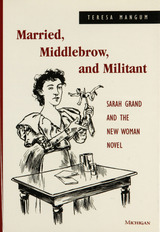

front cover of Married, Middlebrow, and Militant
Married, Middlebrow, and Militant
Sarah Grand and the New Woman Novel
Teresa Mangum
University of Michigan Press, 1998
Between 1880 and 1920, the New Woman novel outraged "ladies," rallied women's rights activists, and inspired women readers and writers to harness an emerging popular literary market to their own political purposes. British author and activist Sarah Grand (1854-1943) took center stage, popularizing the term "New Woman," marching for suffrage, lecturing from platforms in Britain and America, and publishing fiction and essays that challenged the most powerful obstacle to middle-class militancy-marriage. Married, Middlebrow, and Militant indicates that Grand's dedication to reforming rather than abandoning marriage was based on the belief that changing the institution would lead to the legal, social, and personal transformation of both men and women. Writing across a range of sub-genres, she sought to loosen the hold of the marriage plot in fiction that called for New Women, New Men, and new social and literary plots. For her, and those like her, the middle-brow novel held militant potential to inspire immediate, intimate, and electric change. Teresa Mangum has examined a range of primary materials, including Grand's correspondence and the cartoons and periodical literature of the day, and further illuminates Grand's work by considering how it relates to women's history and feminist theories of narrative and desire. Deftly combining biography and criticism, the book also documents the antagonism of conventional critics to both the New Woman and new and popular forms of fiction that are still denigrated as middlebrow.
[more]

front cover of Taking Her Seriously
Taking Her Seriously
Penelope and the Plot of Homer's Odyssey
Richard Heitman
University of Michigan Press, 2005
"[Heitman] provides a sensitive critical study of the Odyssey in which he strives to better appreciate the poem by focusing on the familial interactions in Ithaca . . . Heitman's interpretations . . . are unfailingly clear and thought-provoking. Highly recommended."
---Choice
"It is an example of a neat and valuable contribution which is both intelligible to non-specialists and inspiring for psychologists and classicists. It demonstrates that research into Homer still is . . . capable of extracting ever-new exciting ideas from Homer's texts."
---Bryn Mawr Classical Review
Taking Her Seriously is a reevaluation of Penelope, one of the most universally admired female characters in Western classical literature. Casting her in a new light, Richard Heitman emphasizes the courage, steadfastness, and integrity of this iconic figure while she faces potentially tragic decisions.
Homer's treatment of events in Ithaca and the motivations of Penelope throughout the denser books of the Odyssey reveals a complicated, serious, independent, and insightful thinker whose actions are crucial to guaranteeing the well-being of her home and a safe future for her son, and for Odysseus as well.
Through this thematic approach to the text, Penelope comes into focus as a loving wife whose role is far more important than passive fidelity to a wandering husband. Her integrity and wisdom in Odysseus' absence set the stage for his violent and triumphant return, and secure her place as a female role model in even the most modern of contexts.
Richard Heitman is Assistant Professor of Classics and Philosophy at Carthage College.
[more]

front cover of The Virgin and the Bride
The Virgin and the Bride
Idealized Womanhood in Late Antiquity
Kate Cooper
Harvard University Press, 1996

During the last centuries of the Roman Empire, the prevailing ideal of feminine virtue was radically transformed: the pure but fertile heroines of Greek and Roman romance were replaced by a Christian heroine who ardently refused the marriage bed. How this new concept and figure of purity is connected with--indeed, how it abetted--social and religious change is the subject of Kate Cooper's lively book.

The Romans saw marital concord as a symbol of social unity--one that was important to maintaining the vigor and political harmony of the empire itself. This is nowhere more clear than in the ancient novel, where the mutual desire of hero and heroine is directed toward marriage and social renewal. But early Christian romance subverted the main outline of the story: now the heroine abandons her marriage partner for an otherworldly union with a Christian holy man. Cooper traces the reception of this new ascetic literature across the Roman world. How did the ruling classes respond to the Christian claim to moral superiority, represented by the new ideal of sexual purity? How did women themselves react to the challenge to their traditional role as matrons and matriarchs? In addressing these questions, Cooper gives us a vivid picture of dramatically changing ideas about sexuality, family, and morality--a cultural revolution with far-reaching implications for religion and politics, women and men.

The Virgin and the Bride offers a new look at central aspects of the Christianization of the Roman world, and an engaging discussion of the rhetoric of gender and the social meaning of idealized womanhood.

[more]

front cover of
"The Yellow Wall-Paper" by Charlotte Perkins Gilman
A Dual-Text Critical Edition
Charlotte Perkins Gilman
Ohio University Press, 2006
Scholars have argued for decades over which constitutes the best possible version of Charlotte Perkins Gilman’s frequently anthologized story “The Yellow Wall-Paper.”

Most editions have been based on the 1892 New England Magazine publication rather than the handwritten manuscript at Radcliffe College. Publication of the unedited manuscript in 1994 sparked controversy over which of the two was definitive. Since then, scholars have discovered half a dozen parent texts for later twentieth-century printings, including William Dean Howells’s version from 1920 and the 1933 Golden Book version.

While traditional critical editions gather evidence and make an argument for adopting one text as preferable to others,“The Yellow Wall-Paper” by Charlotte Perkins Gilman: A Dual-Text Critical Edition, edited by Shawn St. Jean, offers both manuscript and magazine versions, critically edited and printed in parallel for the first time. New significance appears in such facets as the magazine’s accompanying illustrations, its lineation and paragraphing, Gilman’s choice of pronouns, and her original handwritten ending.

This critical edition of “The Yellow Wall-Paper” includes a full and nontraditional apparatus, making it easy for students and scholars to study the more than four hundred variants between the two texts. Four new essays, written especially for this volume, explore the implications of this multitext model.
[more]


Send via email Share on Facebook Share on Twitter