
 A SCHOLARLY BOOK REPOSITORY
Taking as a starting point the Italian crisis over immigration in the early 1990s, Merrill examines grassroots interethnic spatial politics among female migrants and Turin feminists in Northern Italy. Using rich ethnographic material, she traces the emergence of Alma Mater—an anti-racist organization formed to address problems encountered by migrant women. Through this analysis, Merrill reveals the dynamics of an alliance consisting of women from many countries of origin and religious and class backgrounds.
Highlighting an interdisciplinary approach to migration and the instability of group identities in contemporary Italy, An Alliance of Women presents migrants grappling with spatialized boundaries amid growing nativist and anti-immigrant sentiment in Western Europe.
Heather Merrill is assistant professor of geography and anthropology at Dickinson College.

Carly Inghram’s poems explore the day-to-day experiences of a Black queer woman who is ceaselessly bombarded with images of mass-consumerism, white supremacy, and sexism, and who is forced, often reluctantly, back indoors and away from this outside chaos. The poems in The Animal Indoors seek to understand and define the boundaries between our inside and outside lives, critiquing the homogenization and increasing insincerity of American culture and considering what safe spaces exist for Black women. The speaker in these poems seeks refuge, working to keep the interior safe until we can reckon with the world outside, until the speaker is able to “unleash the indoor news onto the unclean water elsewhere.”
The Animal Indoors won the 2020 CAAPP Book Prize, selected by Terrance Hayes.
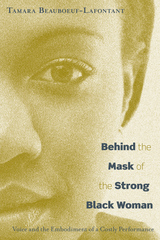
The author, a noted sociologist, interviews 58 Black women about being strong and proud, to illustrate their “performance” of invulnerability. Beauboeuf-Lafontant explains how such behavior leads to serious symptoms for these women, many of whom suffer from eating disorders and depression.
Drawing on Black feminist scholarship, cultural studies, and women’s history, Behind the Mask of the Strong Black Woman traces the historical and social influences of normative Black femininity, looking at how notions of self-image and strength create a distraction from broader forces of discrimination and power.
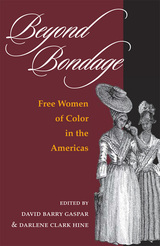
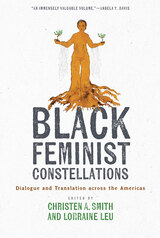
A collection of essays, interviews, and conversations by and between scholars, activists, and artists from Latin America and the Caribbean that paints a portrait of Black women's experiences across the region.
Black women in Latin America and the Caribbean suffer a triple erasure: as Black people, as women, and as non-English speakers in a global environment dominated by the Anglophone North. Black Feminist Constellations is a passionate and necessary corrective. Focused on and written by Black women of the southern Americas, the original works composing this volume make legible the epistemologies that sustain radical scholarship, art, and political organizing by Black women everywhere.
In essays, poems, and dialogues, the writers in Black Feminist Constellations reimagine liberation from the perspectives of radical South American and Caribbean Black women thinkers. The volume’s methodologically innovative approach reflects how Black women come together to theorize the world and challenges the notion that the university is the only site where knowledge can emerge. A major work of intellectual history, Black Feminist Constellations amplifies rarely heard voices, centers the uncanonized, and celebrates the overlooked work of Black women.
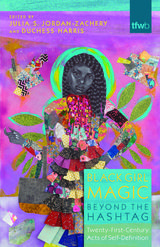
The essays in this volume move us beyond social media. They offer critical analyses and representations of the multiplicities of Black femmes’, girls’, and women’s lived experiences. Together the chapters demonstrate how Black girl magic is embodied by four elements enacted both on- and offline: building community, challenging dehumanizing representations, increasing visibility, and offering restorative justice for violence.
Black Girl Magic Beyond the Hashtag shows how Black girls and women foster community, counter invisibility, engage in restorative acts, and create spaces for freedom. Intersectional and interdisciplinary, the contributions in this volume bridge generations and collectively push the boundaries of Black feminist thought.
How Black women’s reproduction became integral to white supremacy, capitalism, and heteropatriarchy—and remains key to their dismantling
In the United States, slavery relied on the reproduction and other labors of unfree Black women. Nearly four centuries later, Black reproductivity remains a vital technology for the creation, negotiation, and transformation of sexualized and gendered racial categories. Yet even as Black reproduction has been deployed to resolve the conflicting demands of white supremacy, capitalism, and heteropatriarchy, Sara Clarke Kaplan argues that it also holds the potential to destabilize the oppressive systems it is supposed to maintain.
The Black Reproductive convenes Black literary and cultural studies with feminist and queer theory to read twentieth- and twenty-first-century texts and images alongside their pre-emancipation counterparts. These provocative, unexpected couplings include how Toni Morrison’s depiction of infanticide regenders Orlando Patterson’s theory of social death, and how Mary Prince’s eighteenth-century fugitive slave narrative is resignified through the representational paradoxes of Gayl Jones’s blues novel Corregidora. Throughout, Kaplan offers new perspectives on Black motherhood and gendered labor, from debates over the relationship between President Thomas Jefferson and Sally Hemings, to the demise of racist icon Aunt Jemima, to discussions of Black reproductive freedom and abortion.
The Black Reproductive gives vital insight into the historic and ongoing conditions of Black unfreedom, and points to the possibilities for a Black feminist practice of individual and collective freedom.
Recognizing that Black women have been living in pandemics as far back as colonialism and enslavement, this volume acknowledges that records of the past—from the 1918 flu pandemic to the onset of the HIV/AIDS epidemic—often erase the existence and experiences of Black women as a whole. Writing against this archival erasure, this collection consciously recenters the real-time experiences and perspectives of care, policy concerns, grief, and joy of Black women throughout the COVID-19 pandemic.
Nineteen contributors from interdisciplinary fields and diverse backgrounds explore Black feminine community, consciousness, ethics of care, spirituality, and social critique. They situate Black women’s multidimensional experiences with COVID-19 and other violences that affect their lives. The stories they tell are connected and interwoven, bound together by anti-Black gendered COVID necropolitics and commitments to creating new spaces for breathing, healing, and wellness.
Ultimately, this time-warping analysis shows how Black women imagine a more just society, rapidly adapt to changing experiences, and innovate ethics of care even in the midst of physical distancing, which can be instructive for thinking of new ways of living both during and beyond the era of COVID-19.
Contributors
Shamara Wyllie Alhassan
Sharnnia Artis
Keisha L. Bentley-Edwards
Candace S. Brown
Jenny Douglas
Kaja Dunn
Onisha Etkins
Rhonda M. Gonzales
Endia Hayes
Ashley E. Hollingshead
Kendra Jason
Julia S. Jordan-Zachery
Stacie LeSure
Janaka B. Lewis
Michelle Meggs
Nitya Mehrotra
Sherine Andreine Powerful
Marjorie Shavers
Breauna Marie Spencer
Tehia Starker Glass
Amber Walker
In Black Women, Identity, and Cultural Theory, Kevin Everod Quashie explores the metaphor of the “girlfriend” as a new way of understanding three central concepts of cultural studies: self, memory, and language. He considers how the work of writers such as Toni Morrison, Ama Ata Aidoo, Dionne Brand, photographer Lorna Simpson, and many others, inform debates over the concept of identity. Quashie argues that these authors and artists replace the notion of a stable, singular identity with the concept of the self developing in a process both communal and perpetually fluid, a relationship that functions in much the same way that an adult woman negotiates with her girlfriend(s). He suggests that memory itself is corporeal, a literal body that is crucial to the process of becoming. Quashie also explores the problem language poses for the black woman artist and her commitment to a mastery that neither colonizes nor excludes.
The analysis throughout interacts with schools of thought such as psychoanalysis, postmodernism, and post-colonialism, but ultimately moves beyond these to propose a new cultural aesthetic, one that ultimately aims to center black women and their philosophies.
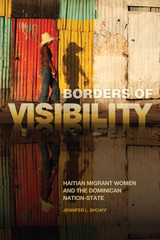
Borders of Visibility offers extremely timely insight into the Dominican Republic’s racist treatment of Haitian descendants within its borders. Jennifer L. Shoaff employs multisited feminist research to focus on the geographies of power that intersect to inform the opportunities and constraints that migrant women must navigate to labor and live within a context that largely denies their human rights, access to citizenship, and a sense of security and belonging.
Paradoxically, these women are both hypervisible because of the blackness that they embody and invisible because they are marginalized by intersecting power inequalities. Haitian women must contend with diffuse legal, bureaucratic and discursive state-local practices across “border” sites that situate them as a specific kind of threat that must be contained. Shoaff examines this dialectic of mobility and containment across various sites in the northwest Dominican Republic, including the official border crossing, transborder and regional used-clothing markets, migrant settlements (bateyes), and other rural-urban contexts.
Shoaff combines ethnographic interviews, participant observation, institutional analyses of state structures and nongovernmental agencies, and archival documentation to bring this human rights issue to the fore. Although primarily grounded in critical ethnographic practice, this work contributes to the larger fields of transnational feminism, black studies, migration and border studies, political economy, and cultural geography. Borders of Visibility brings much needed attention to Haitian migrant women’s economic ingenuity and entrepreneurial savvy, their ability to survive and thrive, their often impossible choices whether to move or to stay, returning them to a place of visibility, while exposing the very structures that continue to render them invisible and, thus, expendable over time.
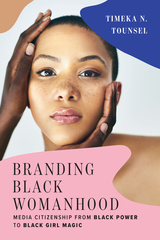
Beginning with the inception of the Essence brand in the late 1960s, Timeka N. Tounsel examines the individuals and institutions that have reconfigured Black women’s empowerment as a business enterprise. Ultimately, these commercial gatekeepers have constructed an image economy that operates as both a sacred space for Black women and an easy hunting ground for their dollars.

Instead of offering a linear narrative, Christiansë renders the poems as if they were emerging from the pages of imaginary books, documents now disrupted and scattered. An emperor’s point of view is juxtaposed with the perspectives of various explorers, sailors, and unknown slaves until finally they all open upon the book’s “castaway,” the authorial female voice that negotiates a way to write about love and desire after centuries of oppression and exploitation.
Daring and sophisticated, Castaway challenges and captivates the reader with not only its lyrical richness and conceptual depth but also its implicit and haunting reflections on diaspora and postcolonialism. It will be highly regarded by readers and writers of poetry and will appeal to those engaged with issues of race, gender, exile, multiculturalism, colonialism, and history.
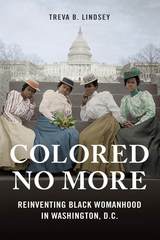
Treva B. Lindsey presents New Negro womanhood as a multidimensional space that included race women, blues women, mothers, white collar professionals, beauticians, fortune tellers, sex workers, same-gender couples, artists, activists, and innovators. Drawing from these differing but interconnected African American women's spaces, Lindsey excavates a multifaceted urban and cultural history of struggle toward a vision of equality that could emerge and sustain itself. Upward mobility to equal citizenship for African American women encompassed challenging racial, gender, class, and sexuality status quos. Lindsey maps the intersection of these challenges and their place at the core of New Negro womanhood.
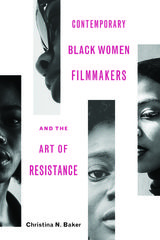
Analyzing the cultural texts of filmmakers such as Ava DuVernay, Tanya Hamilton, Kasi Lemmons, Gina Prince-Bythewood, and Dee Rees—and including interviews she conducted with three of the filmmakers—Baker emphasizes the importance of applying an intersectional perspective that centers on the shared experiences of Black women and the role of film as a form of artistic expression and a tool of social resistance.
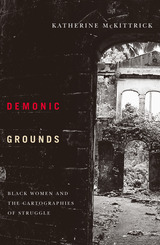
Demonic Grounds moves between past and present, archives and fiction, theory and everyday, to focus on places negotiated by black women during and after the transatlantic slave trade. Specifically, the author addresses the geographic implications of slave auction blocks, Harriet Jacobs’s attic, black Canada and New France, as well as the conceptual spaces of feminism and Sylvia Wynter’s philosophies.
Central to McKittrick’s argument are the ways in which black women are not passive recipients of their surroundings and how a sense of place relates to the struggle against domination. Ultimately, McKittrick argues, these complex black geographies are alterable and may provide the opportunity for social and cultural change.
Katherine McKittrick is assistant professor of women’s studies at Queen’s University.

Elizabeth Schroeder Schlabach examines the complexities of Black women’s work in policy gambling. Policy provided Black women with a livelihood for themselves and their families. At the same time, navigating gender expectations, aggressive policing, and other hazards of the infromal economy led them to refashion ideas about Black womanhood and respectability. Policy earnings also funded above-board enterprises ranging from neighborhood businesses to philanthropic institutions, and Schlabach delves into the various ways Black women straddled the illegal policy business and reputable community involvement.
Vivid and revealing, Dream Books and Gamblers tells the stories of Black women in the underground economy and how they used their work to balance the demands of living and laboring in Black Chicago.
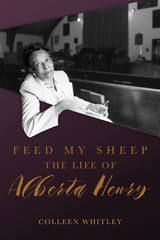
Henry endured intolerance by leaning on her faith and her commitment to a cause that she believed God had called her to follow. When she came to Utah in 1949 she thought it would be a brief stay, but she ended up making it her home for more than fifty years. In Utah, Henry committed herself to helping all races, religions, and ethnic groups coexist in appreciation of each other. While Martin Luther King Jr., Medgar Evers, and Malcolm X led the struggle for civil rights at a national level, Alberta Henry campaigned tirelessly for equality at a local level, talking at school board meetings, before city councils, and in the homes of her neighbors.
Henry was a member or officer of more than forty civic organizations and served for twelve years as president of the Salt Lake City branch of the NAACP, where she lobbied for civil rights, education, and justice. The dozens of awards and commendations she received speak to her accomplishments. While much of Henry’s story is told in her own words, Colleen Whitley provides expert and personal context to her speeches, writing, and interviews. The result is an exceptional first-person account of an African American woman leader and her role in the Civil Rights Movement in Utah.
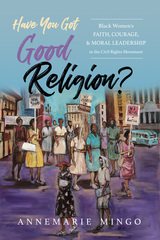
A depiction of moral imagination that resonates today, Have You Got Good Religion? reveals how Black Churchwomen’s understanding of God became action and transformed a nation.

2021 Finalist for the Harriet Tubman Book Prize
2020 Finalist Berkshire Conference of Women Historians Book Prize
Details how African-descended women’s societal, marital, and sexual decisions forever reshaped the racial makeup of Argentina
Argentina promotes itself as a country of European immigrants. This makes it an exception to other Latin American countries, which embrace a more mixed—African, Indian, European—heritage. Hiding in Plain Sight: Black Women, the Law, and the Making of a White Argentine Republic traces the origins of what some white Argentines mischaracterize as a “black disappearance” by delving into the intimate lives of black women and explaining how they contributed to the making of a “white” Argentina. Erika Denise Edwards has produced the first comprehensive study in English of the history of African descendants outside of Buenos Aires in the late colonial and early republican periods, with a focus on how these women sought whiteness to better their lives and that of their children.
Edwards argues that attempts by black women to escape the stigma of blackness by recategorizing themselves and their descendants as white began as early as the late eighteenth century, challenging scholars who assert that the black population drastically declined at the end of the nineteenth century because of the whitening or modernization process. She further contends that in Córdoba, Argentina, women of African descent (such as wives, mothers, daughters, and concubines) were instrumental in shaping their own racial reclassifications and destinies.
This volume makes use of a wealth of sources to relate these women’s choices. The sources consulted include city censuses and notarial and probate records that deal with free and enslaved African descendants; criminal, ecclesiastical, and civil court cases; marriages and baptisms records and newsletters. These varied sources provide information about the day-to-day activities of cordobés society and how women of African descent lived, formed relationships, thrived, and partook in the transformation of racial identities in Argentina.
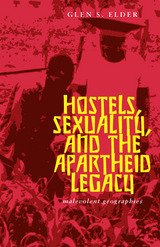
In the last decade, the South African state has been transformed dramatically, but the stubborn, menacing geography of apartheid still stands in the way of that country’s visions of change. Environmentally degraded old homelands still scar the rural geography of South Africa.
Formerly segregated, now gated, neighborhoods still inhibit free movement. Hostels, Sexuality, and the Apartheid Legacy is a study of another such space, the converted “male” migrant worker hostel.
Professor Glen Elder identifies hostels as sites of public and domestic violence, literal destruction and rebuilding, and as an important node in the spread of HIV/AIDS.
Hostels have also become home to increasing numbers of “invisible” female residents. Finding that one way to understand hostel space is through women’s experiences, Professor Elder turned to thirty black migrant women living in an East Rand hostel to map the everyday geographies of South Africa’s time of change.
By following the lives of these women, Elder identifies spatialized forms of marginalization, impoverishment, infection, and disempowerment. But, as he points out, the women’s survival strategies may provide signposts to the way out of apartheid’s malevolent geography.
Hostels, Sexuality, and the Apartheid Legacy argues that the gendered geography of the migrant labor system developed in South Africa was premised upon sexual assumptions about men, women, and their bodies, and that feminist and queer analyses of space can inform public policy decisions.
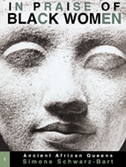
Volume 1: Ancient African Queens weaves together oral tradition, folk legends and stories, songs and poems, historical accounts, and travelers’ tales from Egypt to southern Africa, from prehistory to the nineteenth century. These women rulers, warriors, and heroines include Amanirenas, the queen of Kush who battled Roman armies and defeated them at Aswan; Daurama, mother of the seven Hausa kingdoms; Amina Kulibali, founder of the Gabu dynasty in Senegal; Ana de Sousa Nzinga, who resisted the Portuguese conquest of Angola; Beatrice Kimpa Vita, a Kongo prophet burned at the stake by Christian missionaries; Nanda, mother of the famous warrior-king Shaka Zulu; and many others.
These extraordinary women's stories, narrated in the style of African oral tradition, are absorbing, informative, and accessible. The abundant illustrations, many of them rare archival images, depict the diversity among Black women and make this volume a unique treasure for every art lover, every school, and every family.
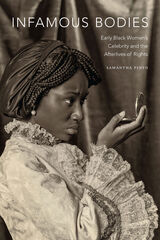

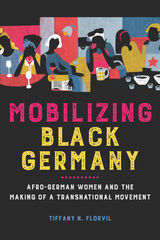
Tiffany N. Florvil examines the role of queer and straight women in shaping the contours of the modern Black German movement as part of the Black internationalist opposition to racial and gender oppression. Florvil shows the multifaceted contributions of women to movement making, including Audre Lorde’s role in influencing their activism; the activists who inspired Afro-German women to curate their own identities and histories; and the evolution of the activist groups Initiative of Black Germans and Afro-German Women. These practices and strategies became a rallying point for isolated and marginalized women (and men) and shaped the roots of contemporary Black German activism.
Richly researched and multidimensional in scope, Mobilizing Black Germany offers a rare in-depth look at the emergence of the modern Black German movement and Black feminists’ politics, intellectualism, and internationalism.
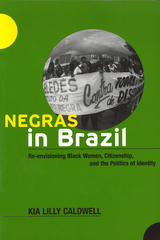
In Negras in Brazil, Kia Lilly Caldwell examines the life experiences of Afro-Brazilian women whose stories have until now been largely untold. This pathbreaking study analyzes the links between race and gender and broader processes of social, economic, and political exclusion. Drawing on ethnographic research with social movement organizations and thirty-five life history interviews, Caldwell explores the everyday struggles Afro-Brazilian women face in their efforts to achieve equal rights and full citizenship. She also shows how the black women's movement, which has emerged in recent decades, has sought to challenge racial and gender discrimination in Brazil. While proposing a broader view of citizenship that includes domains such as popular culture and the body, Negras in Brazil highlights the continuing relevance of identity politics for members of racially marginalized communities. Providing new insights into black women's social activism and a gendered perspective on Brazilian racial dynamics, this book will be of interest to students and scholars of Latin American Studies, African diaspora studies, women's studies, politics, and cultural anthropology.

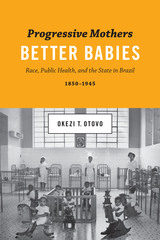
In Bahia, Brazil, the decades following emancipation saw the rise of reformers who sought to reshape the citizenry by educating Bahian women in methods for raising “better babies.” The idealized Brazilian would be better equipped to contribute to the labor and organizational needs of a modern nation. Backed by many physicians, politicians, and intellectuals, the resulting welfare programs for mothers and children mirrored complex debates about Brazilian nationality. Examining the local and national contours of this movement, Progressive Mothers, Better Babies investigates families, medical institutions, state-building, and social stratification to trace the resulting policies, which gathered momentum in the aftermath of abolition (1888) and the declaration of the First Republic (1889), culminating during the administration of President Getúlio Vargas (1930–1945).
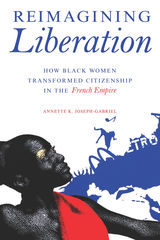
Exploring the cultural discourses on race, gender, and poverty that permeated medical knowledge and the public health system for almost a century, Okezi T. Otovo draws on extensive archival research to reconstruct the implications for Bahia, where family patronage politics governed poor women’s labor as the mothers who were the focus of medical interventions were often the nannies and nursemaids of society’s wealthier families. The book reveals key transition points as the state of Bahia transformed from being a place where poor families could expect few social services to becoming the home of numerous programs targeting the poorest mothers and their children. Negotiating crucial questions of identity, this history sheds new light on larger debates about Brazil’s past and future.

Contributors. Paula Aymer, John Burdick, Judith Casselberry, Deidre Helen Crumbley, Elizabeth McAlister, Laura Premack, Elizabeth A. Pritchard, Jane Soothill, Linda van de Kamp
A unique and important study, Stepping Forward examines the experiences of nineteenth- and twentieth-century black women in Africa and African diaspora communities from a variety of perspectives in a number of different settings.
This wide-ranging collection designed for classroom use explores the broad themes that have shaped black women’s goals, options, and responses: religion, education, political activism, migration, and cultural transformation. Essays by leading scholars in the field examine the lives of black women in the United States and the Caribbean Basin; in the white settler societies of Kenya, Zimbabwe, and South Africa; and in the black settler societies of Liberia and Sierra Leone.
Among the contributors to this volume are historians, political scientists, and scholars of literature, music, and law. What emerges from their work is an image of black women’s agency, self-reliance, and resiliency. Despite cultural differences and geographical variations, black women have provided foundations on which black communities have not only survived, but also thrived. Stepping Forward is a valuable addition to our understanding of women’s roles in these diverse communities.
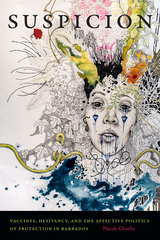
Duke University Press Scholars of Color First Book Award recipient
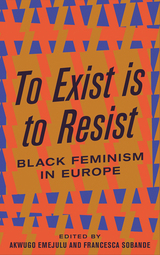
Deeply aware that they are constructed as “others” living in a racialized and hierarchical continent, the contributors explore gender, class, sexuality, and legal status to show that they are both invisible—presumed to be absent from and irrelevant to European societies—and hyper-visible, assumed to be passive and sexualized, angry and irrational.
In imagining a future outside the neocolonial frames and practices of contemporary Europe, this book explores a variety of critical spaces including motherhood and the home, friendships and intimate relationships, activism and community, and literature, dance, and film.
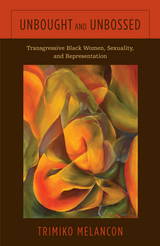
Drawing from black feminist and critical race theories, historical discourses on gender and sexuality, and literary criticism, Melancon explores the variety and complexity of black female identity. She illuminates how authors including Ann Allen Shockley, Alice Walker, and Gayl Jones engage issues of desire, intimacy, and independence to shed light on a more complex black identity, one ungoverned by rigid politics over-determined by race, gender and sexuality.
READERS
Browse our collection.
PUBLISHERS
See BiblioVault's publisher services.
STUDENT SERVICES
Files for college accessibility offices.
RECENTLY PUBLISHED





UChicago Accessibility Resources
home | accessibility | search | about | contact us
BiblioVault ® 2001 - 2024
The University of Chicago Press