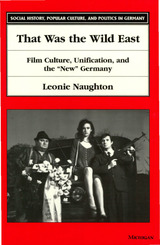

front cover of That Was the Wild East
That Was the Wild East
Film Culture, Unification, and the "New" Germany
Leonie Naughton
University of Michigan Press, 2002
That Was the Wild East presents critical insight into popular film culture and art house cinema in Germany from 1990-1999. It examines box-office hits and cult films, such as the "Trabi comedies" and unification farces, which delighted local and international audiences, but which have been granted scarce critical attention up to this point. The first detailed account of the representation of German unification on film to appear, either in English or German, this work provides valuable and engaging source material otherwise inaccessible to non-German readers. In her focus on a range of "unification films," Leonie Naughton analyzes impressions of unification fostered in films from the East and West, along with the comic and tragic anxieties these films attribute to life in the "new" Germany. The ways in which German filmmakers represented unification throughout the 1990s are discussed with reference to a broad range of recent German films, and Naughton examines both divergent and convergent cinematic impressions of life in a recently unified Germany by 1990s filmmakers. Those interested in film studies and film history, German history and culture, as well as German unification and recent developments in German cinema, will find this book especially appealing.
[more]

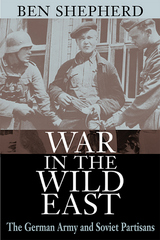
front cover of War in the Wild East
War in the Wild East
The German Army and Soviet Partisans
Ben Shepherd
Harvard University Press, 2004

In Nazi eyes, the Soviet Union was the “wild east,” a savage region ripe for exploitation, its subhuman inhabitants destined for extermination or helotry. An especially brutal dimension of the German army’s eastern war was its anti-partisan campaign. This conflict brought death and destruction to thousands of Soviet civilians, and has been held as a prime example of ordinary German soldiers participating in the Nazi regime’s annihilation policies.

Ben Shepherd enters the heated debate over the wartime behavior of the Wehrmacht in a detailed study of the motivation and conduct of its anti-partisan campaign in the Soviet Union. He investigates how anti-partisan warfare was conducted, not by the generals, but by the far more numerous, average Germans serving as officers in the field. What shaped their behavior was more complex than Nazi ideology alone. The influence of German society, as well as of party and army, together with officers’ grueling yet diverse experience of their environment and enemy, made them perceive the anti-partisan war in varied ways. Reactions ranged from extreme brutality to relative restraint; some sought less to terrorize the native population than to try to win it over. The emerging picture does not dilute the suffering the Wehrmacht’s eastern war inflicted. It shows, however, that properly judging ordinary Germans’ role in that war is more complicated than is indicated by either wholesale condemnation or wholesale exoneration.

This valuable study offers a nuanced discussion of the diversity of behaviors within the German army, as well as providing a compelling exploration of the war and counterinsurgency operations on the eastern front.
[more]

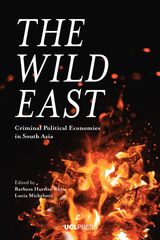
front cover of The Wild East
The Wild East
Criminal Political Economies in South Asia
Edited by Barbara Harriss-White and Lucia Michelutti
University College London, 2019
Through eleven case studies conducted across India, Pakistan, and Bangladesh, The Wild East examines a variety of economic sectors and business enterprises that regularly flout the law, such as coal, oil, real estate, and industrial labor. Bridging anthropology and political economy, the case studies explore how state regulative law is ignored or selectively manipulated and reveal the workings of regulated criminal economic systems in which politicians, police, judges, and bureaucrats are closely intertwined. Disrupting the existing literature on South Asia’s informal economy, The Wild East also suggests avenues for future research that will be of critical value to students and scholars of economics, anthropology, sociology, criminology, comparative politics, political science, and international relations.

 
[more]


Send via email Share on Facebook Share on Twitter