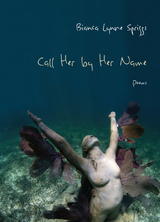
University of Wisconsin Press, 2025 Paper: 978-0-299-35554-8 Library of Congress Classification PS3619.N53B58 2025 Dewey Decimal Classification 811.6
ABOUT THIS BOOK | AUTHOR BIOGRAPHY | REVIEWS | TOC | REQUEST ACCESSIBLE FILE
ABOUT THIS BOOK
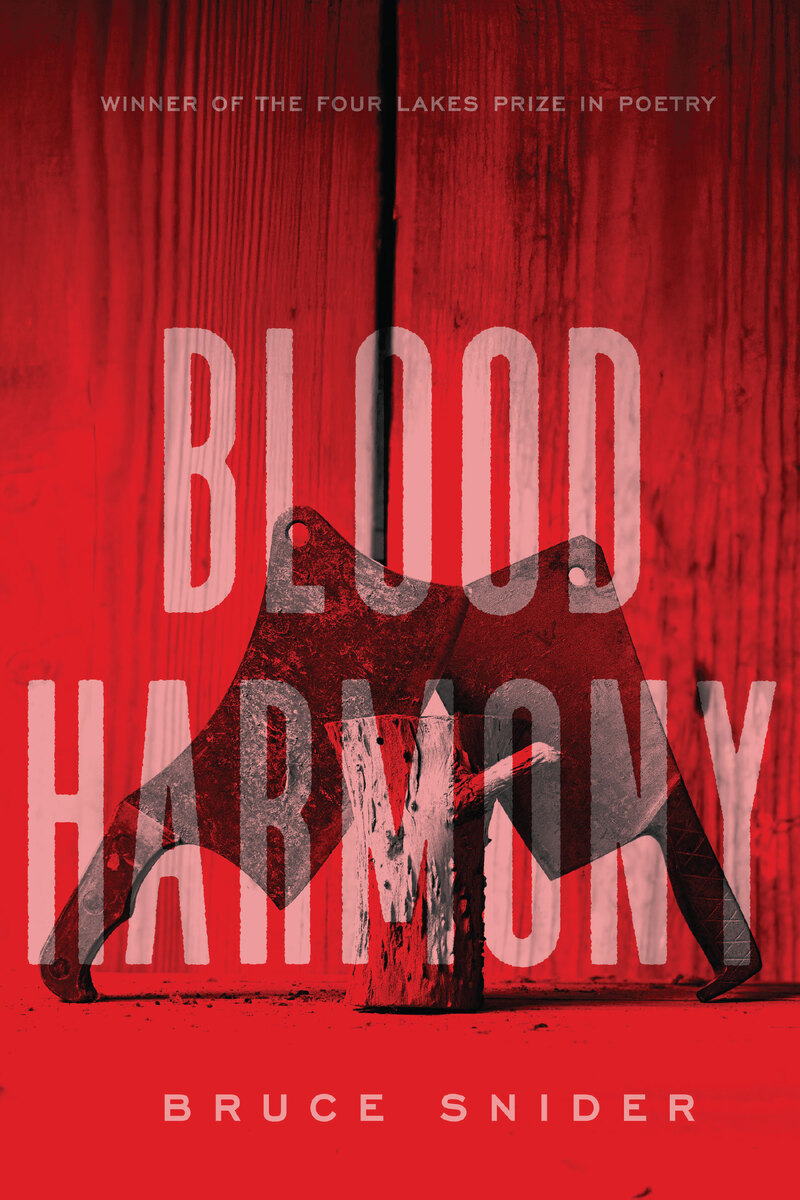
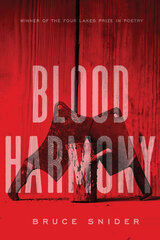
An unflinching tale of selfishness and sacrifice, guilt and resentment, hope and despair, Bruce Snider’s fourth collection tells the story of two brothers torn apart by opioid addiction. These sublime poems paint a singular portrait of rural working-class America populated by shuttered tool factories and country gay bars, hidden fishing holes and Dolly Parton drag queens. Drawing on music and myth, science and history, Snider interrogates the bonds of family, exploring themes of masculinity, devotion, sexuality, and the biology of addiction. Yet for all its competing tensions, Blood Harmony leaves us with an enduring portrait of brotherhood defined as much by tenderness as by pain.
AUTHOR BIOGRAPHY
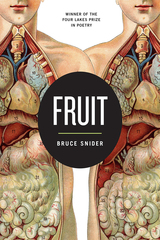
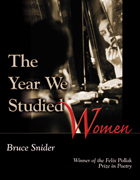
Bruce Snider’s previous collections include Fruit; Paradise, Indiana; and The Year We Studied Women, winner of the Felix Pollak Prize in Poetry. He is a coeditor of The Poem’s Country: Place & Poetic Practice. Snider’s awards include an NEA fellowship, a Wallace Stegner Fellowship, a James A. Michener Fellowship, and the Jenny McKean Writer-in-Washington award. He lives in Baltimore and teaches in the Writing Seminars at Johns Hopkins University.
REVIEWS
“There is a mythic precision in Blood Harmony, a collection of the limits of recovery and language (‘There was always need in the needle’); heartbreaking elegy; and always Indiana, a place of ice and kerosene but also ‘unmown grass, sweetness, rain.’ No American poet is as empathetic as Bruce Snider.”
— Randall Mann
“In Blood Harmony, ‘the truck stop / is the ghost of a truck stop’ and songs of George Strait strike lightning. Snider’s devastating love poems for a ‘brother of Indiana tattooed on his calf’ show the body alive in itself, in this battle of desire and blood’s machinery.”
— Jan Beatty
TABLE OF CONTENTS
Part I
Reading That Johnny Cash Suffered from Autonomic Neuropathy when He Recorded “Hurt”
Factory
[He said he was sorry, said he wouldn’t do it again, again. . . .]
[When the doctor put her hand to the prescription pad. . .]
[Brother of the free-throw shot. . . .]
When My Boyfriend Says He Hates Country Music
At the Rainbow Cattle Company
To a Dolly Parton Drag Queen
[An older boy asks: What are you, fags? . . .]
[Because my brother was a man among men . . .]
Today. To Be. To Do.
[In the parable of the prodigal son . . .]
Our Father and the Machines
When Our Father Forgets the Last Verse of George Strait’s “Fool Hearted Memory”
[The drinking game starts because . . .]
Dueling Banjos
Part II
About the Calf-Skin Head on Earl Scruggs’s Banjo
[The ghost that is my brother . . .]
[At the coffee shop my brother . . .]
[—I kept . . .]
[Because a man doesn’t wince at a needle, . . .]
Trio
[The casket is closed. . . .]
[When a sober brother falls, he falls . . .]
[In the story of Esau . . .]
[When I look into our father’s eye, . . .]
Listening to “I’m So Lonesome I Could Cry” on My iPhone
Trio
[My brother watches Bugs Bunny. . . .]
[And the skies saw his need, calling it Indiana. . . .]
[and hadn’t I poured gin straight . . .]
Part III
“The Silence Is Unusually Loud Tonight,”
Overture
[Dear Brother, . . .]
[In the story of Abel and Cain, . . .]
[if brother is the map I keep reading . . .]
[Afterwards, I saw him walking . . .]
Self-Portrait as Midwest Dawn
Listening to Waylon Jennings’s “Where Corn Don’t Grow,”
[In the passenger’s seat, my boyfriend said: why didn’t . . .]
[I tell my brother about a guy I love. . . .]
[When I looked at him across the table, . . .]
[Had the lake been frozen forever, . . .]
[When I step inside, my brother asks: How’d it go?” . . .]
Reading The Book of American Murder Ballads,
Tracks
[For weeks I practiced surrender, . . .]
[because I knew surrender was the crack . . .]
[I believe our father: Did you see his eyes?]
Because America Is a Place the Brain Makes
Acknowledgments
REQUEST ACCESSIBLE FILE
If you are a student who cannot use this book in printed form, BiblioVault may be able to supply you
with an electronic file for alternative access.
Please have the accessibility coordinator at your school fill out this form.