
 A SCHOLARLY BOOK REPOSITORY
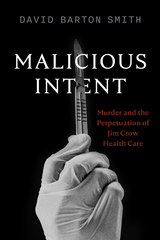
Race-related disparities in American death rates, exacerbated once again by the COVID-19 pandemic, have persisted since the birth of the modern US medical system a century ago. A unique but perpetually unequal history has prevented the United States from providing the kind of health care assurances that are taken for granted in other industrialized nations. The underlying story is one of political, medical, and bureaucratic machinations, all motivated by a deliberate Jim Crow systemic design. In Malicious Intent, David Barton Smith traces the Jean Cowsert story and the cold case of her death as a through line to explain the construction and fulfillment of an unequal health care system that would rather sacrifice many than provide for Black Americans.
Cowsert’s suspicious death came at a key moment in the struggle for universal health care in the wealthiest country on earth. Malicious Intent is a history of those failed efforts and a story of selective amnesia about one doctor’s death and the movement she fought for.

The book draws the reader into the struggles of the unsung heroes of the transformation, black medical leaders whose stubborn courage helped shape the larger civil rights movement. They demanded an end to federal subsidization of discrimination in the form of Medicare payments to hospitals that embraced the "separate but equal" creed that shaped American life during the Jim Crow era. Faced with this pressure, the Kennedy and Johnson Administrations tried to play a cautious chess game, but that game led to perhaps the biggest gamble in the history of domestic policy. Leaders secretly recruited volunteer federal employees to serve as inspectors, and an invisible army of hospital workers and civil rights activists to work as agents, making it impossible for hospitals to get Medicare dollars with mere paper compliance. These triumphs did not come without casualties, yet the story offers lessons and hope for realizing this transformational dream.
This book is the recipient of the Norman L. and Roselea J. Goldberg Prize from Vanderbilt University Press for the best book in the area of medicine.

In Reinventing Care, David Barton Smith offers brilliant insights into those questions by examining the realities of assisted living in New York City. Encompassing the largest, most concentrated population of elderly in the United States, New York spends more per person caring for its seniors than any other urban center. Yet, while the size of the city's care system boggles the mind, it nevertheless contains the same elements that exist in other metropolitan areas and thus provides valuable lessons for the nation as a whole.
Smith's study draws on twenty-five years of research, including hundreds of interviews and visits to representative facilities. He provides a succinct overview of how care is presently organized for New York's aging population and traces the history of the system up to the present. Among the key issues he addresses are the role of market forces and government regulation, the impact of class differences on access to quality care, and the ways in which perceptions of community affect the creation and management of assisted living programs. At the heart of the book are ten fascinating case studies, half of them focused on private-pay facilities and the other half on public-pay institutions.
While finding that the actualities of assisted living rarely match the rhetoric of its proponents, Smith sees much to admire in its goals. He suggests tactics and strategies--such as promoting family- and community-based models of assisted living and adopting a standard of licensure for certain facilities--that could point the way to a better future.
READERS
Browse our collection.
PUBLISHERS
See BiblioVault's publisher services.
STUDENT SERVICES
Files for college accessibility offices.
RECENTLY PUBLISHED






UChicago Accessibility Resources
home | accessibility | search | about | contact us
BiblioVault ® 2001 - 2025
The University of Chicago Press