
 A SCHOLARLY BOOK REPOSITORY
Results by Title
3 books about Siczek, Megan M.
3 books about Siczek, Megan M.
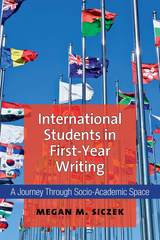
International Students in First-Year Writing
A Journey Through Socio-Academic Space
Megan M. Siczek
University of Michigan Press, 2018
The book explores the journey of 10 international students to better understand their experiences at a U.S. educational institution and how they constructed and revealed these experiences in this particular socio-academic space. The study features a series of three interviews during the semester that the participants were enrolled in a mainstream first-year writing course; their stories not only capture their experiences but reveal inspiring stories that “give voice” to students outside the dominant cultural and linguistic community.
This study raises questions about how to support international students:
This study raises questions about how to support international students:
- In what ways can it inform our practices and policies relative to the internationalization of education and the development of global perspectives and competencies?
- What does it reveal that could impact daily instruction of L2 writing, particularly when it comes to international students’ need to meet the expectations of “university-level writing” in U.S. institutions of higher education?
- On an individual level, what can we learn from these students and about ourselves as a result of our interactions?
[more]
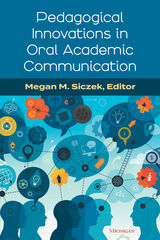
Pedagogical Innovations in Oral Academic Communication
Megan M. Siczek, Editor
University of Michigan Press, 2022
Oral communication is key to students’ classroom success and a skill that is highly valued in both academic and professional contexts, yet there are few resources for developing courses on oral academic communication. This edited collection gathers TESOL scholars and practitioners in exploring the theories, principles, and pedagogical practices that shape and help innovate the teaching of oral communication in higher education.
Pedagogical Innovations in Oral Academic Communication is grounded in four key principles: academic discourse socialization; context-responsive instruction; instructional approaches of English for Academic Purposes and English for Specific Purposes; and asset-oriented pedagogy. In the chapters in this collection, the authors share their teaching context, the details and underlying principles of their pedagogical approach, and recommendations for practitioners. Readers will develop a deeper understanding of the communicative contexts their students inhabit, including the types of speaking situations they are likely to encounter, and understand how to innovate their approach to teaching oral communication to students from diverse cultural, linguistic, educational, and disciplinary backgrounds. Such innovations prepare students for more effective communication during their academic studies and professional career, a goal that is of central importance in our globally interconnected society.
Pedagogical Innovations in Oral Academic Communication is grounded in four key principles: academic discourse socialization; context-responsive instruction; instructional approaches of English for Academic Purposes and English for Specific Purposes; and asset-oriented pedagogy. In the chapters in this collection, the authors share their teaching context, the details and underlying principles of their pedagogical approach, and recommendations for practitioners. Readers will develop a deeper understanding of the communicative contexts their students inhabit, including the types of speaking situations they are likely to encounter, and understand how to innovate their approach to teaching oral communication to students from diverse cultural, linguistic, educational, and disciplinary backgrounds. Such innovations prepare students for more effective communication during their academic studies and professional career, a goal that is of central importance in our globally interconnected society.
[more]
Using a Genre-Based and Multimodal Approach to Teach Oral Academic Communication
Megan M. Siczek
University of Michigan Press, 2026
Effective oral academic communication is central to multilingual students’ engagement as learners and their success in academic and professional domains. This Brief Instructional Guide provides readers with an established set of principles and a pedagogical toolkit for teaching oral academic communication to multilingual international students with a specific focus on genre-based instruction and multimodality. It covers standard oral genres such as presentations and class discussions, as well as a wide variety of communicative genres that enable students to gain rhetorical awareness and communicative competence.
This book introduces a model course design and its guiding principles, then explicitly describes a variety of oral communication assignments that promote engaged learning, including steps in the instructional sequence, tips for teaching, and sample guidance to be shared with students. It emphasizes the importance of leveraging students’ cultural and linguistic strengths and global experiences to promote their agency as learners. The principles and practices described in this book are grounded in an English for Academic Purposes (EAP) context but are easily adaptable to other instructional settings and teaching modalities. Implementing a genre-based and multimodal approach helps build students’ rhetorical awareness, increases their communicative capacity, and enables them to participate actively in their academic discourse communities.
This book introduces a model course design and its guiding principles, then explicitly describes a variety of oral communication assignments that promote engaged learning, including steps in the instructional sequence, tips for teaching, and sample guidance to be shared with students. It emphasizes the importance of leveraging students’ cultural and linguistic strengths and global experiences to promote their agency as learners. The principles and practices described in this book are grounded in an English for Academic Purposes (EAP) context but are easily adaptable to other instructional settings and teaching modalities. Implementing a genre-based and multimodal approach helps build students’ rhetorical awareness, increases their communicative capacity, and enables them to participate actively in their academic discourse communities.
[more]
READERS
Browse our collection.
PUBLISHERS
See BiblioVault's publisher services.
STUDENT SERVICES
Files for college accessibility offices.
RECENTLY PUBLISHED




UChicago Accessibility Resources
home | accessibility | search | about | contact us
BiblioVault ® 2001 - 2026
The University of Chicago Press