
 A SCHOLARLY BOOK REPOSITORY
258 start with A start with A
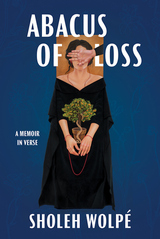
lbert Einstein said, “Not everything that can be counted counts, and not everything that counts can be counted.” It is in this vein that Sholeh Wolpé’s mesmerizing memoir in verse unfolds. In this lyrical and candid work, her fifth collection of poems, Wolpé invokes the abacus as an instrument of remembering. Through different countries and cultures, she carries us bead by bead on a journey of loss and triumph, love and exile. In the end, the tally is insight, not numbers, and we arrive at a place where nothing is too small for gratitude.

Winner, 2015 Colorado Book Award
Finalist, 2015 National Book Critics Circle Award
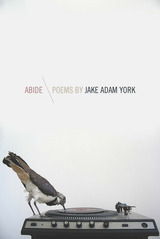
In the years leading up to his recent passing, Alabama poet Jake Adam York set out on a journey to elegize the 126 martyrs of the civil rights movement, murdered in the years between 1954 and 1968. Abide is the stunning follow-up to York’s earlier volumes, a memorial in verse for those fallen. From Birmingham to Okemah, Memphis to Houston, York’s poems both mourn and inspire in their quest for justice, ownership, and understanding.
Within are anthems to John Earl Reese, a sixteen-year-old shot by Klansmen through the window of a café in Mayflower, Texas, where he was dancing in 1955; to victims lynched on the Oklahoma prairies; to the four children who perished in the Birmingham church bombing of 1963; and to families who saw the white hoods of the Klan illuminated by burning crosses. Juxtaposed with these horrors are more loving images of the South: the aroma of greens simmering on the stove, “tornado-strong” houses built by loved ones long gone, and the power of rivers “dark as roux.”
Throughout these lush narratives, York resurrects the ghosts of Orpheus, Sun Ra, Howlin’ Wolf, Thelonious Monk, Woody Guthrie, and more, summoning blues, jazz, hip-hop, and folk musicians for performances of their “liberation music” that give special meaning to the tales of the dead.
In the same moment that Abide memorializes the fallen, it also raises the ethical questions faced by York during this, his life’s work: What does it mean to elegize? What does it mean to elegize martyrs? What does it mean to disturb the symmetries of the South’s racial politics or its racial poetics?
A bittersweet elegy for the poet himself, Abide is as subtle and inviting as the whisper of a record sleeve, the gasp of the record needle, beckoning us to heed our history.
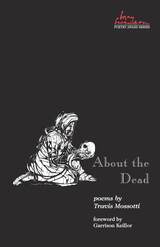
Travis Mossotti writes with humor, gravity, and humility about subjects grounded in a world of grit, where the quiet mortality of working folk is weighed. To Mossotti, the love of a bricklayer for his wife is as complex and simple as life itself: “ask him to put into words what that sinking is, / that shudder in his chest, as he notices / the wrinkles gathering at the corners of her mouth.” But not a whiff of sentiment enters these poems, for Mossotti has little patience for ideas of the noble or for sympathetic portraits of hard-used saints. His vision is clear, as clear as the memory of how scarecrows in the rearview, “each of them, stuffed / into a body they didn’t choose, resembled / your own plight.” His poetry embraces unsanctimonious life with all its wonder, its levity, and clumsiness. About the Dead is an accomplished collection by a writer in control of a wide range of experience, and it speaks to the heart of any reader willing to catch his “drift, and ride it like the billowed / end of some cockamamie parachute all the way / back to the soft, dysfunctional, waiting earth.”
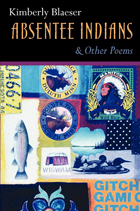
Absentee Indians and Other Poems evokes personal yet universal experiences of the places that Native Americans call home, their family and national histories, and the emotional forces that help forge Native American identities. These are poems of exile, loss, and the celebration of that which remains. Anchored in the physical landscape, Blaeser’s poetry finds the sacred in those ordinary actions that bind a community together. As Blaeser turns to the mysterious passage from sleeping to wakefulness, or from nature to spirit, she reveals not merely the movement from one age or place to another, but the movement from experience to vision.
Absinthe 24 pushes and prods Hellenism beyond its geographic and cultural comfort zones, and sets it tumbling off beyond both internal and external borders of its nation-state, in a wide-ranging but always site-specific and localized itinerary. At each stop along the way, this Greekness finds its plurals—hence the “Hellenisms” of the title. While they present no unified topography, tongue or even topic, these Hellenisms map out the contours of a shared conversation. Today’s Hellenism isn’t limited to Hellas, nor to the Hellenic language. The selected texts in this volume explore Greece from the perspective of visitors, displaced persons, and marginalized people looking in, or, conversely, from the perspective of locals striving to break out.
Absinthe: A Journal of World Literature in Translation publishes foreign literature in English translation, with a particular focus on previously untranslated contemporary fiction, poetry, and creative non-fiction by living authors. The magazine has its home in the Department of Comparative Literature at the University of Michigan and is edited by graduate students in the Department, as well as by occasional guest editors.
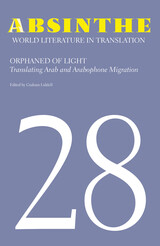
Absinthe 28: Orphaned of Light features contemporary literature of migration translated from and to Arabic. In short stories, creative nonfiction essays, poetry, and selections from novels, a multiplicity of migration experiences is brought to the fore: life in diaspora, undocumented labor, refugeehood, human trafficking, internal displacement, exile.
This issue brings together names familiar to readers of Arabic literature in translation, such as Ghassan Kanafani and Saadi Youssef, with writers making their English-language debuts, such as Dearborn, MI-based Kurdish Iraqi poet Gulala Nouri and Libyan novelist Mohamad Alasfar. Likewise, the issue includes veteran translators Marilyn Booth, Nancy Roberts, and Khaled Mattawa alongside newcomers, several of them graduate students at the University of Michigan.
Each piece is accompanied by a translator’s reflection that meditates on the work’s themes as well as the creative process of translation, and the issue’s poetry is presented in a side-by-side Arabic-English format.
Absinthe 28 comes to us at a time when, according to the UN, one in every 78 people on earth is displaced. This collection serves as a reminder that translation and migration are inextricably linked.
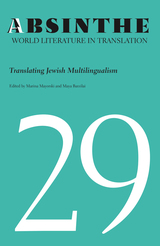
Absinthe 29: Translating Jewish Multilingualism showcases the variety of languages and genres in which modern Jewish writers have expressed themselves. Spanning short stories, essays, poetry, and selections from novels, the selection of literary works featured in this issue of Absinthe cuts across distinctions between European and non-European literary traditions and addresses diverse themes, including social class, gender, immigration, religious traditions, love and marriage, and the act of writing itself.
Rather than consider disparate Jewish languages and histories in isolation, we bring them into conversation within an open-ended framework that explores Jewish multilingualism in the modern world. The multilingual narrative of Jewish modernity told through them, in seven languages, spans from the 1880s to the 2020s.
Its wide geographical distribution ranges from Tel Aviv to São Paulo through Buenos Aires, Istanbul, Thessaloniki, Livorno, Warsaw, Prague, and Chicago. Each text and context exhibits different aspects of the Jewish encounter with the conditions of modern society, exemplifying the ways in which Jewish writing engages and negotiates different cultures and traditions.
The new volume of Absinthe foregrounds the multilingual legacy of Jewish migration and diasporic life that has become ubiquitous in modern Jewish writing, and it is evident in the enriching and disruptive presence of multiple languages and literary traditions in each of these texts. The title of this volume, Translating Jewish Multilingualism, refers both to the English translations of these texts and to the processes of translation, mediation, and hybridization encapsulated in the works themselves.
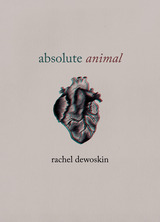
Experimenting with time, language, and transgressing boundaries, the poems in absolute animal lean into Nabokov’s notion that precision belongs to poetry and intuition to science.
Rachel DeWoskin’s new collection navigates the chaos of societal and mortal uncertainty. Through formal poetry, DeWoskin finds sense amid disorder and unearths connections between the animal and the human, between the ancient and the contemporary, and between languages, incorporating translations from poems dating as far back as the Tang dynasty. From sonnet sequences about heart surgeries to examinations of vole romance and climate change, absolute animal investigates and moves across boundaries and invites us to consider what holds life, what lasts, what dies, and what defines and enriches the experience of being human.
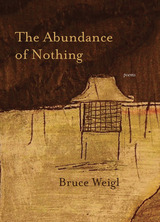
Finalist, 2013 Pulitzer Prize for Poetry
Throughout his award-winning career, Bruce Weigl has proven himself to be a poet of extraordinary emotional acuity and consummate craftsmanship. In The Abundance of Nothing, these qualities are on full display, animating and informing poems that combine rich, metaphoric imagery with direct, powerful language. Deftly weaving history and everyday experience, Weigl transports readers from the front lines of the Vietnam War and all the tangled cultural and emotional scenes of that time to the slow winds of the American Midwest that softly ease the voice of the veteran returning home. Though the poems struggle with themes of mortality and illness, violence and forgiveness, the poet’s voice never wavers in its meditative calm, poise, and compassion. Elegiac yet agile, ethereal yet embodied, The Abundance of Nothing is a work of searching openness, generous insight, and remarkable grace.
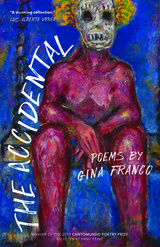
Cascading through each of the poems in Gina Franco’s The Accidental is a question: What does it mean to be human in a world where the soul is exalted but the body brutalized? Franco explores the terrain of the borderlands—not just the physical space of the American southwest, but the spaces where lines are drawn between body and soul, God and self, violence and ecstasy. Unfolding along these borders in a torrent of deep contemplation, Franco’s poems bring the reader to the line between accident and choice, delving into the role each plays in creating the lives we are born into and in determining how those lives end. A body caught in a tree after a flood—an accident—calls to mind deliberate violences: crucifixion and lynching.
Guided, even so, by a stark hopefulness, The Accidental makes a character of the soul and traces its pilgrimage from suffering toward transcendence. “The soul saw,” Franco writes, “that it saw through the wound.” This book tenders a creation myth steeped in existential philosophy and shimmering with the vernacular of the ecstatic.

The master of Old Comedy.
Aristophanes of Athens, one of the world’s greatest comic dramatists, has been admired since antiquity for his iridescent wit and beguiling fantasy, exuberant language, and brilliant satire of the social, intellectual, and political life of Athens at its height. The Loeb Classical Library edition of his plays is in four volumes.
The Introduction to the edition is in Volume I. Also in the first volume is Acharnians, in which a small landowner, tired of the Peloponnesian War, magically arranges a personal peace treaty; and Knights, perhaps the most biting satire of a political figure (Cleon) ever written.
Three plays are in Volume II. Socrates’ “Thinkery” is at the center of Clouds, which spoofs untraditional techniques for educating young men. Wasps satirizes Athenian enthusiasm for jury service. In Peace, a rollicking attack on war-makers, the hero travels to heaven on a dung beetle to discuss the issues with Zeus.
The enterprising protagonists of Birds create a utopian counter-Athens ruled by birds. Also in Volume III is Lysistrata, in which our first comic heroine organizes a conjugal strike of young wives until their husbands end the war between Athens and Sparta. Women again take center stage in Women at the Thesmophoria, this time to punish Euripides for portraying them as wicked.
Frogs, in Volume IV, features a contest between the traditional Aeschylus and the modern Euripides, yielding both sparkling comedy and insight on ancient literary taste. In Assemblywomen Athenian women plot to save Athens from male misgovernance—with raucously comical results. Here too is Wealth, whose gentle humor and straightforward morality made it the most popular of Aristophanes’ plays from classical times to the Renaissance.

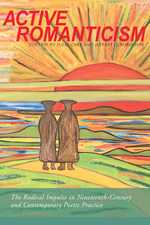
Literary history generally locates the primary movement toward poetic innovation in twentieth-century modernism, an impulse carried out against a supposedly enervated “late-Romantic” poetry of the nineteenth century. The original essays in Active Romanticism challenge this interpretation by tracing the fundamental continuities between Romanticism’s poetic and political radicalism and the experimental movements in poetry from the late nineteenth century to the present day.
According to editors July Carr and Jeffrey C. Robinson, “active romanticism” is a poetic response, direct or indirect, to pressing social issues and an attempt to redress forms of ideological repression; at its core, “active romanticism” champions democratic pluralism and confronts ideologies that suppress the evidence of pluralism. “Poetry fetter’d, fetters the human race,” declared poet William Blake at the beginning of the nineteenth century. No other statement from the era of the French Revolution marks with such terseness the challenge for poetry to participate in the liberation of human society from forms of inequality and invisibility. No other statement insists so vividly that a poetic event pushing for social progress demands the unfettering of traditional, customary poetic form and language.
Bringing together work by well-known writers and critics, ranging from scholarly studies to poets’ testimonials, Active Romanticism shows Romantic poetry not to be the sclerotic corpse against which the avant-garde reacted but rather the wellspring from which it flowed.
Offering a fundamental rethinking of the history of modern poetry, Carr and Robinson have grouped together in this collection a variety of essays that confirm the existence of Romanticism as an ongoing mode of poetic production that is innovative and dynamic, a continuation of the nineteenth-century Romantic tradition, and a form that reacts and renews itself at any given moment of perceived social crisis.
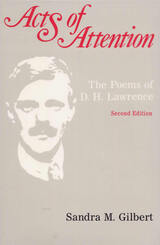
In the Preface to this second edition of her first book, Sandra M. Gilbert addresses the inevitable question: "How can you be a feminist and a Lawrentian?" The answer is intellectually satisfying and historically revealing as she traces an array of early twentieth-century women of letters, some of them proto-feminists, who revered Lawrence despite his countless statements that would today be condemned as "sexist."
H.D. regarded him as one of her "initiators" whose words "flamed alive, blue serpents on the page." Anais Nin insisted that he "had a complete realization of the feelings of women."
By focusing on Lawrence’s own definition of a poem as an "act of attention," Gilbert demonstrates how he developed the mature style of Birds, Beasts and Flowers, his finest collection of poetry. She discusses this volume at length, examines many of his later poems in detail, including the hymns from The Plumed Serpent, Pansies, Nettles, and More Pansies, and ends with a close look at Last Poems. Her detailed examination provides a clearer image of Lawrence as an artist—an artist whose poetry complements his novels and whose fiction enriches but does not outshine his poetry.
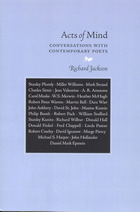
Acts of Mind grew out of interviews conducted by the author for Poetry Miscellany. The aim of which was to help develop a method for talking about the work of contemporary poets.
The poets whose views appear in this volume represent a fair cross-section of the more important tendencies and impulses to be found in contemporary poetry and poetics.
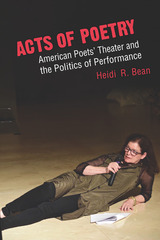
American poets’ theater emerged in the postwar period alongside the rich, performance-oriented poetry and theater scenes that proliferated on the makeshift stages of urban coffee houses, shared apartments, and underground theaters, yet its significance has been largely overlooked by critics. Acts of Poetry shines a spotlight on poets’ theater’s key groups, practitioners, influencers, and inheritors, such as the Poets’ Theatre, the Living Theatre, Gertrude Stein, Bunny Lang, Frank O’Hara, Amiri Baraka, Carla Harryman, and Suzan-Lori Parks. Heidi R. Bean demonstrates the importance of poets’ theater in the development of twentieth-century theater and performance poetry, and especially evolving notions of the audience’s role in performance, and in narratives of the relationship between performance and everyday life. Drawing on an extensive archive of scripts, production materials, personal correspondence, theater records, interviews, manifestoes, editorials, and reviews, the book captures critical assessments and behind-the-scenes discussions that enrich our understanding of the intertwined histories of American theater and American poetry in the twentieth century.
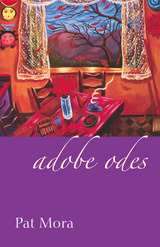
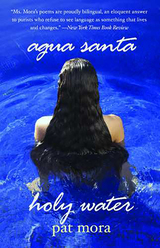
From family gossip and beauty secrets, to women darning hand-me-downs, to reluctant hands carrying bodies across borders, Mora traverses the tangled threads of culture, community, family, gender, and injustice. Her vivid observations together with her deft handling of symmetry and meter make her poetry uniquely insightful, subtle, and elegant. Sprinkled with Spanish and plenty of spice, each ode is a sensory flurry of mind and body. Together they make a cauldron of flavorful, simmering language. They are meant to be savored as they slowly stir the soul.
The paperback and e-book editions include a new introduction by Richard F. Thomas, along with a new glossary of names that makes the book even more accessible for students and for general readers coming to the Aeneid for the first time who may need help acclimating to Virgil’s world.
“The classic of all Europe.” —T. S. Eliot
Virgil (Publius Vergilius Maro) was born in 70 BC near Mantua and was educated at Cremona, Milan, and Rome. Slow in speech, shy in manner, thoughtful in mind, weak in health, he went back north for a quiet life. Influenced by the group of poets there, he may have written some of the doubtful poems included in our Virgilian manuscripts. All his undoubted extant work is written in his perfect hexameters. Earliest comes the collection of ten pleasingly artificial bucolic poems, the Eclogues, which imitated freely Theocritus’ idylls. They deal with pastoral life and love. Before 29 BC came one of the best of all didactic works, the four books of Georgics on tillage, trees, cattle, and bees. Virgil’s remaining years were spent in composing his great, not wholly finished, epic the Aeneid, on the traditional theme of Rome’s origins through Aeneas of Troy. Inspired by the Emperor Augustus’ rule, the poem is Homeric in metre and method but influenced also by later Greek and Roman literature, philosophy, and learning, and deeply Roman in spirit. Virgil died in 19 BC at Brundisium on his way home from Greece, where he had intended to round off the Aeneid. He had left in Rome a request that all its twelve books should be destroyed if he were to die then, but they were published by the executors of his will.
The Loeb Classical Library edition of Virgil is in two volumes.
In this new translation Edward McCrorie has performed the difficult task of rendering Virgil's compact, dense Latin into fine, readable, modern English verse. The sometimes complex text is made clear and comprehensible even for first-time readers, and a glossary of names helps identify characters and place-names in the poem. The translation is well suited for students at all levels, and readers already familiar with Virgil will find many fresh images and ideas.
"A brilliant effort."--Robert Bly
"I admire the ambition of the project, and the generosity of many of the lines."--Robert Fagles
Edward McCrorie is Professor of English, Providence College. His poetry and translations of Latin verse have been widely published.
Providing unusual insights into the heart of Roman culture, these clever poems open up odd avenues of ancient lore and life as they explore social types and physical aspects of the body, regularly mocking the limitations of human nature and offering vulgar or promiscuous interpretations of the stuff of social life.
Featuring folksy proverbs and satirical anecdotes, filled with saucy naughtiness and awful puns, Aesop's Human Zoo will amuse you with its eccentricities and hit home with its shrewdly candid and red raw messages. The entertainment offered in this volume of impeccably accurate translations is truly a novelty—a good-hearted and knowing laugh courtesy of classical poetry. Beginning to advanced classicists and Latin scholars will appreciate the original Latin text provided in this bilingual edition. The splash of classic Thomas Bewick wood engravings to accompany the fables renders the collection complete.
One hundred twenty-two sonnets that touch on contemporary American popular culture, social trends, and personalities. Poet Roger Armbrust is described by some as a mystic, by others as a spiritualist, and by yet others as a guy who toys with really big thoughts, making them objects both of serious study and of humor. His sonnets will push you to laughter and meditation: a satisfying literary ride.
In The Aesthetic Astronaut, Roger Armbrust escorts readers on an insightful journey throughout Earth and beyond. We experience the loneliness and instpiration of "the Aesthetic Astronaut"; cold-blooded calculations of "The Armchair Assassin"; passion and sense of the romantic lover; reflective memories of a gentle heart growing older; ironic vision of an observer to history, and subtle--and sometimes not so subtle--humor of a fellow human involved in our day-to-day challenge of living a worthwhile life. The poet's imagery and attitude. . . may fascinate, thrill, sadden, anger, or push you to laughter or meditation. But you'll find the trip a fascinating literary ride.
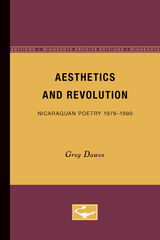
In Aesthetics and Revolution, Dawes demonstrates that there is an objective grounding for cultural studies found in the aesthetic means of production. By analyzing the relations and forces of production in this realm we inevitably cross over into the economic means of production as well as the struggle for political representation. Ultimately, aesthetics is at the intersection of class and gender interests and their struggle for hegemony.
In Aesthetics and Revolution, Dawes has chosen a group of writers of different theoretical sympathies, class, gender, and social positions to reveal the conflictual interests of the social classes and genders as a whole. Through close readings of their work, Dawes examines the thematic nodes that are expressed in positions as diverse as Ernesto Cardenal’s liberation theology, Pablo Antonio Cuadra’s populism, the campesino’s oral tradition, and Gioconda Belli’s erotic verses in relation to the changes taking place in revolutionary Nicaragua.
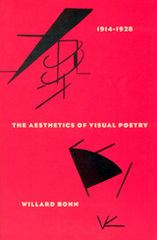
"An important contribution. Highly sophisticated, the study tends to raise its reader's impression of visual poetry in the twentieth century from trivial pastime to serious preoccupation."—Eric Sellin, Journal of Modern Literature
"With his definitive analyses full of quotable observations and sharp critical insights, Bohn has provided a model, pioneering study, one from which current and future studies of visual poetry will most certainly benefit."—Gerald J. Janacek, Romance Quarterly
"Bohn substantiates his thesis with thoughtful and often ingenious explications of texts both well known and hard to find. . . . Aesthetics of Visual Poetry is a thoroughly researched, beautifully written and fascinating introduction to an infinitely intriguing genre."—Mechthild Cranston, French Review
Callimachus of Cyrene, born ca. 310 BCE, after studying philosophy at Athens, became a teacher of grammar and poetry at Alexandria. Ptolemy II Philadelphus of Egypt (reigned 285–247) made him when still young a librarian in the new library at Alexandria; he prepared a great catalogue of its books.
Callimachus was author of much poetry and many works in prose, but not much survives. His hymns and epigrams are given with works by Aratus and Lycophron in another volume (no. 129) of the Loeb Classical Library. In the present volume are included fragments of the Aetia (Causes), aetiological legends concerning Greek history and customs; fragments of a book of Iambi; 147 fragments of the epic poem Hecale, which described Theseus’s victory over the bull which infested Marathon; and other fragments.
We have no explicit information about the poet Musaeus, author of the short epic poem on Hero and Leander, except that he is given in some manuscripts the title Grammatikos, a teacher learned in the rhetoric, poetry and philosophy of his time. He was obviously a follower of the Egyptian poet Nonnus of Panopolis, of the fifth century AD, and his poem seems also to presuppose the Paraphrase of the Psalms of Pseudo-Apollinarius which can be dated to the period 460–470.
Musaeus takes up a subject whose first detailed treatment is preserved in Ovid’s Heroides (Epistles 18 and 19), but he presents it in a quite different manner. Among the literary antecedents to which this learned grammatikos expressly alludes, the most prominent are Books 5 and 6 of the Odyssey and Plato’s Phaedrus. He draws too on the Hymns of Proclus and the Metaphrasis of the Gospel of St. John by Nonnus. He was most probably a Christian Neoplatonist writing a Christian allegory.
The premier scholar-poet of the Hellenistic age.
Callimachus (ca. 303–ca. 235 BC), a proud and well-born native of Cyrene in Libya, came as a young man to the court of the Ptolemies at Alexandria, where he composed poetry for the royal family; helped establish the Library and Museum as a world center of literature, science, and scholarship; and wrote an estimated 800 volumes of poetry and prose on an astounding variety of subjects, including the Pinakes, a descriptive bibliography of the Library’s holdings in 120 volumes. Callimachus’ vast learning richly informs his poetry, which ranges broadly and reworks the language and generic properties of his predecessors in inventive, refined, and expressive ways. The “Callimachean” style, combining learning, elegance, and innovation and prizing brevity, clarity, lightness, and charm, served as an important model for later poets, not least at Rome for Catullus, Virgil, Horace, Ovid, and the elegists, among others.
This edition, which replaces the earlier Loeb editions by A. W. Mair (1921) and C. A. Trypanis (1954, 1958), presents all that currently survives of and about Callimachus and his works, including the ancient commentaries (Diegeseis) and scholia. Volume I contains Aetia, Iambi, and lyric poems; Volume II Hecale, Hymns, and Epigrams; and Volume III miscellaneous epics and elegies, other fragments, and testimonia, together with concordances and a general index. The Greek text is based mainly on Pfeiffer’s but enriched by subsequently published papyri and the judgment of later editors, and its notes and annotation are fully informed by current scholarship.
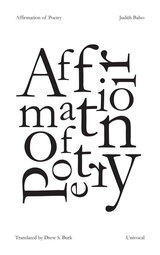
Since the times of Plato and Aristotle, the relation of poetry to philosophy has been controversial. For certain scholars, poetry should in no way be confused with philosophy. For others, poetry is at the heart of the possibility of thinking itself. In Affirmation of Poetry, Judith Balso defends the significance of poetry as a necessary practice for thinking. For Balso, if reading poetry properly has become an obscure task, poetry itself still carries with it a power of thinking: the efforts of the poets must continue. In analyzing the affirmation of thought found within the work of such poets as Osip Mandelstam, Wallace Stevens, Alberto Caeiro, and Giacomo Leopardi, Balso reestablishes poetry’s place as a site of thought.

from first editions and are annotated in detail.
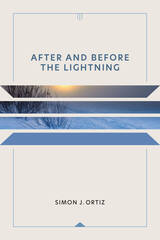
Acoma Pueblo poet Ortiz spent a winter in South Dakota, teaching at Sinte Gleska College on the Rosebud Lakota Sioux Reservation. The bitter cold and driving snow of a prairie winter were a reality commanding his attention through its absolute challenge to survival and the meaning of survival.
Ortiz's way of dealing with the hard elements of winter was to write After and Before the Lightning, prose and verse poems that were his response to that long season between the thunderstorms of autumn and spring. "I needed a map of where I was and what I was doing in the cosmos," he writes. In these poems, which he regards as a book-length poetic work, he charts the vast spaces of prairie and time that often seem indistinguishable. As he faces the reality of winter on the South Dakota reservation, he also confronts the harsh political reality for its Native community and culture and for Indian people everywhere.
"Writing this poetry reconnected me to the wonder and awe of life," Ortiz states emphatically. Readers will feel the reality of that wonder and awe—and the cold of that South Dakota winter—through the gentle ferocity of his words.
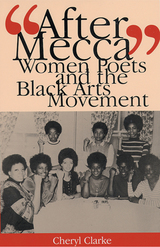
In "After Mecca," Cheryl Clarke explores the relationship between the Black Arts Movement and black women writers of the period. Poems by Gwendolyn Brooks, Ntozake Shange, Audre Lorde, Nikki Giovanni, Sonia Sanchez, Jayne Cortez, Alice Walker, and others chart the emergence of a new and distinct black poetry and its relationship to the black community's struggle for rights and liberation. Clarke also traces the contributions of these poets to the development of feminism and lesbian-feminism, and the legacy they left for others to build on.
She argues that whether black women poets of the time were writing from within the movement or writing against it, virtually all were responding to it. Using the trope of "Mecca," she explores the ways in which these writers were turning away from white, western society to create a new literacy of blackness.
which is like trying to teach
The cat to waltz, so much awkwardness, so many tender
advances, and I’m shocked when it actually learns,
When it minces toward me in a tiny cocktail gown, offering a martini,
asking for this dance, insisting on hearing me refuse
To reply, debating all along, in the chorus of its interior mewing, who
are you really, peculiar animal, who taught you to call you you.
In exemplary case studies, Shetley identifies the very different ways in which three postwar poets—Elizabeth Bishop, James Merrill, and John Ashbery—try to restore some of the challenge and risk that characterized modernist poetry's relation to its first readers. Sure to be controversial, this cogent analysis offers poets and readers a clear sense of direction and purpose, and so, the hope of reaching each other again.
"Powerful. . . . That a young poet can handle this subject so well in a first book is . . . a pleasure in itself."—Robert von Hallberg, Contemporary Literature, 1981
In his twelfth volume of poetry, Bruce Weigl continues his quest for emotional and spiritual enlightenment. Quiet and moving, these poems combine an intimate voice with a searingly direct look at suffering and senseless violence, at human desire and love, and at man's relationship with nature.
The study focuses on Melville’s vision of the purpose and function of language from Moby-Dick through Billy Budd with a special emphasis on how language—in function and form—follows and depends on the function and form of the body, how Melville’s attitude toward words echoes his attitude toward fish. Davis begins by locating and describing the fundamental dialectic formulated in Moby-Dick in the characters of Ahab and Ishmael. This dialectic produces two visions of bodily reality and two corresponding visions of language: Ahab’s, in which language is both weapon and substitute body, and Ishmael’s, in which language is an extension of the body—a medium of explanation, conversation, and play. These two forms of language provide a key to understanding the difficult relationships and formal changes in Melville’s writings after Moby-Dick.
By following each work’s attitude toward the dialectic, we can see the contours of the later career more clearly and so begin a movement away from weakly contextualized readings of individual novels and short stories to a more complete consideration of Melville’s career. Since the rediscovery of Herman Melville in the early decades of this century, criticism has been limited to the prose in general and to a few major works in particular.
Those who have given significant attention to the short fiction and poetry have done so frequently out of context, that is, in multi-author works devoted exclusively to these genres. The result has been a criticism with large gaps, most especially for works from Melville’s later career. The relative lack of interest in the poetry has left us with little understanding of how Melville’s later voices developed, of how the novels evolved into tales, the tales into poetry, and the poetry back into prose. In short, the development of Melville’s art during the final three decades of his life remains a subject of which we have been afforded only glimpses, rarely a continuous attention. After the Whale provides a new, more comprehensive understanding of Melville’s growth as a writer.
*
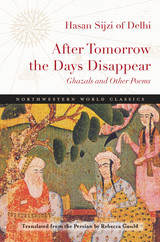
Hasan Sijzi, also known as Amir Hasan Sijzi Dehlavi, is considered the originator of the Indo-Persian ghazal, a poetic form that endures to this day—from the legacy of Hasan’s poetic descendent, Hafez, to contemporary Anglophone poets such as John Hollander, Maxine Kumin, Agha Shahid Ali, and W. S. Merwin.
As with other Persian poets, Hasan worked within a highly regulated set of poetic conventions that brought into relief the interpenetration of apparent opposites—metaphysical and material, mysterious and quotidian, death and desire, sacred and profane, fleeting time and eternity. Within these strictures, he crafted a poetics that blended Sufi Islam with non-Muslim Indic traditions. Of the Persian poets practiced the ghazal, Hafez and Rumi are best known to Western readers, but their verse represents only a small fraction of a rich tradition. This collection reveals the geographical range of the literature while introducing an Indian voice that will find a place on reader’s bookshelves alongside better known Iranian names.

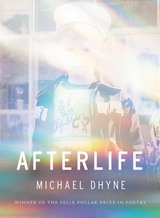
“If I tell the story in reverse, / it still ends with nothing,” he writes. Yet it is in the telling that Dhyne’s story—and the world he creates—is filled. The echoes of his childhood loss reverberate through adolescence and adulthood, his body, the bodies of those he loves, and the world around them—from Bourbon Street to dark and lonely bedrooms, from grief support groups to heartachingly beautiful sunsets.
How we are shaped by our experiences, and how we refuse to be shaped, is at the heart of the poet’s search for memory, meaning, and love—in all its forms and wonders. This bold and tender debut is a rousing reminder that poetry and art can heal.
Can I start with my birth? and I ask her if anything happened
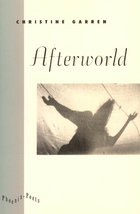
"I like Christine Garren's poetry for its fervor and idiosyncrasy. It lives in the common places of daily life but opens into mysterious invisible orders. Afterworld is a strange and compelling book by a gifted visionary artist."—W. S. Di Piero
"In Afterworld, Christine Garren calls up again and again how it feels to be touched by some relatively familiar thing that happens. A cluster of balloons rises from a birthday party, night falls, and it is left for her to sing about the separate moments with remarkable and unforced grace. Her poems confirm that there's as much at stake in evanescences as we've always suspected but not found ways to say."—James McMichael
"The language seems but a shade, a muted rendering of Garren's images, so concrete and ethereal, knowing and innocent. If this reviewer is being abstract it's because these poems do that to you—they create an arrangement of words, so that, for a while, I believed there was none other."—Harvard Review
Charles Bernstein has described conceptual poetry as "poetry pregnant with thought." Against Expression, the premier anthology of conceptual writing, presents work that is by turns thoughtful, funny, provocative, and disturbing. Dworkin and Goldsmith, two of the leading spokespersons and practitioners of conceptual writing, chart the trajectory of the conceptual aesthetic from early precursors including Samuel Beckett and Marcel Duchamp to the most prominent of today’s writers. Nearly all of the major avant-garde groups of the past century are represented here, including Dada, OuLiPo, L=A=N=G=U=A=G=E, and Flarf to name just a few, but all the writers are united in their imaginative appropriation of found and generated texts and their exploration of nonexpressive language. Against Expression is a timely collection and an invaluable resource for readers and writers alike.
Agamemnon led a ten-year-long struggle at Troy only to return home and die a pathetic death at his wife’s hands. Yet while Agamemnon’s story exerts an outsize influence—rivalled by few epic personalities—on the poetic narratives of the Iliad and Odyssey, scholars have not adequately considered his full portrait. What was Agamemnon like as a character for Homer and his audience? More fundamentally, how should we approach the topic of characterization itself, following the discoveries of Milman Parry, Albert Lord, and their successors?
Andrew Porter explains the expression of characterization in Homer’s works, from an oral-traditional point of view, and through the resonance of words, themes, and “back stories” from both the past and future. He analyzes Agamemnon’s character traits in the Iliad, including his qualities as a leader, against events such as his tragic homecoming narrative in the Odyssey. Porter’s findings demonstrate that there is a traditional depth of characterization embedded in the written pages of these once-oral epics, providing a shared connection between the ancient singer and his listeners.
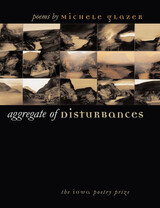
These taut lyrical poems negotiate between desire for something irrefutable and an uneasy bedrock of paradox. In the interstices, Aggregate of Disturbances breaks open language and experience to offer a glimpse of “the eye on the other side.”

The poems in Āina Hānau / Birth Land cycle through sacred and personal narratives while exposing and fighting ongoing American imperialism, settler colonialism, militarism, and social and environmental injustice to protect the ʻāina and its people. The ongoing environmental crisis in Hawaiʻi, inextricably linked to colonialism and tourism, is captured with stark intensity as McDougall writes, Violence is what we settle for / because we’ve been led to believe / green paper can feed us / more than green land. The experiences of birth, motherhood, miscarriage, and the power of Native Hawaiian traditions and self-advocacy in an often dismissive medical system is powerfully narrated by the speaker of the titular poem, written for McDougall’s daughters.
‘Āina Hānau reflects on what it means to be from and belong to an ʻāina hānau, as well as what it means to be an ‘āina hānau, as all mothers serve as the first birth lands for their children.
—Donna Stonecipher
Ancient Athens’ most successful tragedian.
Sophocles (497/6–406 BC), with Aeschylus and Euripides, was one of the three great tragic poets of Athens, and is considered one of the world's greatest poets. The subjects of his plays were drawn from mythology and legend. Each play contains at least one heroic figure, a character whose strength, courage, or intelligence exceeds the human norm—but who also has more than ordinary pride and self-assurance. These qualities combine to lead to a tragic end.
Hugh Lloyd-Jones gives us, in two volumes, a new translation of the seven surviving plays. Volume I contains Oedipus Tyrannus (which tells the famous Oedipus story), Ajax (a heroic tragedy of wounded self-esteem), and Electra (the story of siblings who seek revenge on their mother and her lover for killing their father). Volume II contains Oedipus at Colonus (the climax of the fallen hero's life), Antigone (a conflict between public authority and an individual woman's conscience), The Women of Trachis (a fatal attempt by Heracles' wife to regain her husband's love), and Philoctetes (Odysseus' intrigue to bring an unwilling hero to the Trojan War).
Of his other plays, only fragments remain; but from these much can be learned about Sophocles' language and dramatic art. The major fragments—ranging in length from two lines to a very substantial portion of the satyr play The Searchers—are collected in Volume III of this edition. In prefatory notes Lloyd-Jones provides frameworks for the fragments of known plays.
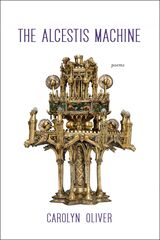
Inspired by the Greek myth of Alcestis, this poetry collection brings to life myriad voices who venture beyond the known world and exist between realities.
In Greek mythology, Alcestis descends to the mysterious kingdom of death in her beloved’s place. In The Alcestis Machine, Carolyn Oliver’s second poetry collection, loss and queer desire echo across the multiverse. “In another life, I’m a . . .” sea witch or swineherd, vampire or troubadour, florist or fossil or museum guard, Oliver writes. These parallel personas inhabit space stations and medieval villages, excavate the Devonian seabed, and plumb a subterranean Anthropocene. In possible futures and imagined pasts, they might encounter “all wrong turns and broken signs” or carry “a suitcase full of stars.”
Oliver’s poems are animated by lush, unsettling verse and forms both traditional and experimental. The Alcestis Machine demonstrates how very present absence can be and how desire knows no boundaries. In neighborhood subdivisions or the vast reaches of space, it’s impossible to know “whose time is slipping / again.” Anyone “could come loose / from gravity’s shine.”
from Bagatelles
Bagatelles,
mere gestures
in dry air,
each pluck a dot,
strokes marked on silence
reaching into the dark.
Beauty is strict,
it passes:
an echo, a wedge
of harmony, sudden,
broken—Who goes there?
An Algebra is an interwoven collection of eight sequences and sixteen individual poems, where images and phrases recur in new contexts, connecting and suspending thoughts, emotions and insights. By turns, the poems leap from the public realm of urban decay and outsourcing to the intimacies of family life, from a street mime to a haunting dream, from elegy to lyric evocation. Wholeness and brokenness intertwine in the book; glimpsed patterns and startling disjunctions drive its explorations.
An Algebra is a work of changing equivalents, a search for balance in a world of transformation and loss. It is a brilliantly constructed, moving book by a poet who has achieved a new level of imaginative expression and skill.
Praise for After the Splendid Display
“In his best work . . . conscience and craft fuse seamlessly, and the result is original and arresting."—The Nation

Alibi, in Latin, meant “elsewhere,” and “lullaby”—from lull, to soothe, and bye, near, close by—has elements linguistic elements that appear across cultures. Music, from ancient songs recorded on tables to contemporary compositions, share related framing elements that have persisted across time: formal patterns and rhythms, peaceful and hypnotic movements, and elements of terror arising from the moving frontier of “thrill, dread, certainty.”
In this collection, Norma Cole considers the ancient and transcendent patterns of music, finding them through nature, heart sounds, the spectral elegance of blood flow, the murmur of melody, and many diverse patterns and beats. Sounds of summer, massacres, “empathy through distress,” unknowing, energy, suspense, and fragility echo throughout the poems and other writings. Drawing on a poetics that embraces formal freefall and looks forward while holding up the shifting mirror of memory, Alibi Lullaby is a lyrical montage at the edges of musicality.
The political sublime of Caribbean poetics ebb and flood in this contagious new voice of borrowings, hijacking the trap house. This is an original collection, daring to assume the voice of the system and its death drives, having fun, mixing it up, throwing hands too. If old pirates rob I, then Shane Book has stolen back something from them. All Black Everything is a redemption song.
The skeleton of this fine collection is a series of direct addresses to the author’s fourteen-year-old self, caught at the moment between girlhood and womanhood, when her perspective on everything suddenly changes. Swearingen-Steadwell’s poetic adventures through worlds within and without reveal the restlessness of the seeker. They offer unabashed tenderness to anyone who reckons with solitude, and chases joy.
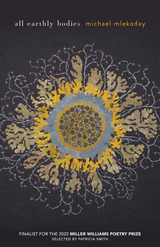
Finalist, 2022 Miller Williams Poetry Prize
From cities and cross-country bus rides to swamps and fern forests, Michael Mlekoday’s All Earthly Bodies celebrates the ungentrifiable, ungovernable wildness of life. This is anarchist ecology, nonbinary environmentalism, an earthbound theology against empire in all its forms. These poems ask how our lives and language, our prayers and politics, might evolve if we really listened to the world and its more-than-human songs.
“Sometimes I wish I could / peel myself from myself / without discarding the shell,” Mlekoday writes. Through a kind of lyric dreamwork, Mlekoday sounds the depths—of ancestry and identity, race and gender, earth and self—to track the unbecoming and re-membering of the body.
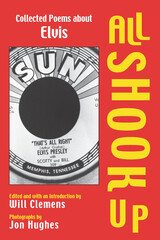
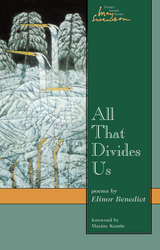



In 2012 Matthew Wimberley took a two-month journey, traveling and living out of his car, during which time he had planned to spread his father’s ashes. By trip’s end, the ashes remained, but Wimberley had begun a conversation with his deceased father that is continued here in his debut collection.
All the Great Territories is a book of elegies for a father as well as a confrontation with the hostile, yet beautiful landscape of southern Appalachia. In the wake of an estranged father’s death, the speaker confronts that loss while celebrating the geography of childhood and the connections formed between the living and the dead. The narrative poems in this collection tell one story through many: a once failed relationship, the conversations we have with those we love after they are gone. In an attempt to make sense of the father-son relationship, Wimberley embraces and explores the pain of personal loss and the beauty of the natural world.
Stitching together sundered realms—from Idaho to the Blue Ridge Mountains and from the ghost of memory to the iron present of self—Wimberley produces a map for reckoning with grief and the world’s darker forces. At once a labor of love and a searing indictment of those who sensationalize and dehumanize the people and geography of Appalachia, All the Great Territories sparks the reader forward, creating a homeland all its own. “Because it’s my memory I can give it to you,” Wimberley’s speaker declares, and it’s a promise well kept in this tender and remarkable debut.
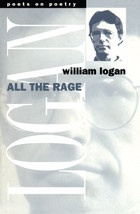
Logan was among the first critics to review a generation of poets now in creative maturity, and his comments on the early works of Jorie Graham, Gjertrud Schnackenberg, and the late Amy Clampitt show the enthusiasm of fresh discovery. But he is no respecter of old reputation, as his reviews of John Ashbery and Robert Penn Warren demonstrate. In total, his criticism considers virtues with their defects and always speaks its author's mind. Some contemporary poetry has had few better friends, and some few greater enemies, than William Logan.
William Logan is the author of Sad-Faced Men, Difficulty, Sullen Weedy Lakes, and Vain Empires. He is Alumni/ae Professor of English, University of Florida.
With clarity and precise detail, Dan Masterson creates a narrative of how we live, love, and die. In blank verse and rhymed stanzas, in free verse and taut lyrics, he delivers the story of a woman trap ped in an avalanche, a husband daring himself to death in an ocean swim, or a son arranging the final affairs of his parents. There is always an edge to Masterson’s characters—they are everyday people, but we meet them on the one day when the stakes are highest.
He holds a reverence for the particulars of a place, for gardens and homes, for dresser drawers and work benches, for cabins in the Adirondacks, ponds, tree houses, and ornamental stones. The leavings of loved ones—strong boxes, pajamas, rosaries—are passed on as relics that both heal and trouble. In Masterson’s world, characters learn how to lose, how to change, and even how to survive their most painful memories.
Selected from thirty years of work, and including an eclectic selection of new poems, this book unfurls Masterson’s full canvas of abilities: his penchant for startling descriptions, his keen insight into our nobility and fallibility, and his skill at making us live his poems.

In the early 1140s, the Bavarian princess Bertha von Sulzbach arrived in Constantinople to marry the Byzantine emperor Manuel Komnenos. Wanting to learn more about her new homeland, the future empress Eirene commissioned the grammarian Ioannes Tzetzes to compose a version of the Iliad as an introduction to Greek literature and culture. He drafted a lengthy dodecasyllable poem in twenty-four books, reflecting the divisions of the Iliad, that combined summaries of the events of the siege of Troy with allegorical interpretations. To make the Iliad relevant to his Christian audience, Tzetzes reinterpreted the pagan gods from various allegorical perspectives. As historical allegory (or euhemerism), the gods are simply ancient kings erroneously deified by the pagan poet; as astrological allegory, they become planets whose position and movement affect human life; as moral allegory Athena represents wisdom, Aphrodite desire.
As a didactic explanation of pagan ancient Greek culture to Orthodox Christians, the work is deeply rooted in the mid-twelfth-century circumstances of the cosmopolitan Comnenian court. As a critical reworking of the Iliad, it must also be seen as part of the millennia-long and increasingly global tradition of Homeric adaptation.

Matthews' particular attention is given to "Lauda Sion," and he breaks it down, verse by verse, providing an analysis of the Latin text and commentary on its poetic structure, but also illuminates the doctrinal references to Aquinas' other scholarly works and Scripture. His approach is both technical and intermittently personal, and as such this book might serve as a two-week source of daily meditations.
The Alleluias of the Mind is a wonderful contribution to the body of Thomistic commentary and will appear before the close of the 750th anniversary of the death of Thomas Aquinas. It is also a wonderful complement to the year devoted to Eucharistic revival in the American Catholic Church.
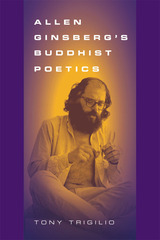
The book also considers the place of Ginsberg’s poetry in the cultural and aesthetic contexts of his career, covering the rise of an “American Buddhism”; the antiwar, drug decriminalization, and gay civil rights movements; and the shift from modern to postmodern strategies in contemporary U.S. poetry.
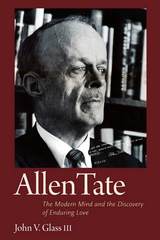

Allen Tate and His Work was first published in 1972. Minnesota Archive Editions uses digital technology to make long-unavailable books once again accessible, and are published unaltered from the original University of Minnesota Press editions.
The thirty-five essays and memoirs about Allen Tate which are collected in this volume along with the introduction by Radcliffe Squires provide a perceptive, many-windowed view of Tate's work and his life. Poet, critic, novelist -- Tate is all of these, and the selections, reflecting these various aspects of his career, are arranged in sections entitled "The Man," "The Essayist," "The Novelist," and "The Poet." As Professor Squires points out, the last three divisions take cognizance of the astounding diversity of Tate's achievement. "But in a last analysis," he continues, "the divisions are an Aristotelian nicety, an arbitrary convenience. His work is really all of a piece. It has all derived from the same energy, the same insights. It has all had a single aim."
What is that aim? Squires compares it to a simple physics experiment in which students are taught the principles of pressure, and he goes on to explain: "The synergy of Allen Tate's poetry, fiction, and essays has had the aim of applying pressure—think of the embossed, bitterly stressed lines, his textured metaphors—until it brings up before our eyes a blanched parody of the human figure, which is our evil, the world's evil, so that we begin to long for God. That has seemed to him a worthwhile task to perform for modern man threatened by such fatal narcissism, such autotelic pride that he is in danger of disappearing into a glassy fantasy of his own concoction. We shall need his help for a long time to come."
The selections were first published in a variety of periodicals and books over the years. The volume includes a substantial bibliography.
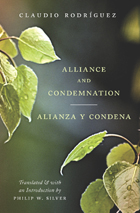
Of all his creations, the radiant poems in Alliance and Condemnation offer the best imaginable introduction to his extraordinary life and work.
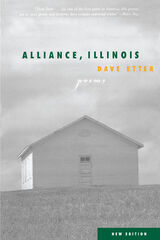

Poets of every age deal with roughly the same human emotions, and for the experienced reader poetry is interesting or not depending upon the moment-by-moment intensity of its appeal. This skillful rendering by John Gardner of seven Middle English poems into sparklingly modern verse translation—most of them for the first time—represents a selection of poems that, generally, have real artistic value but are so difficult to read in the original that they are not as well known as they deserve to be. The seven poems are: The Alliterative Morte Arthure, Winner and Waster, The Parliament of the Three Ages, Summer Sunday, The Debate of Body and Soul, The Thrush and the Nightingale,and The Owl and the Nightingale.
The first four poems represent high points in the alliterative renaissance of the fourteenth century. Morte Arthure,here translated for the first time in its entirety into modern verse, is the only heroic romance in Middle English—a work roughly in the same genre as the French Song of Roland. The other three poems have been included in the anthology as further poetic examples.
With his employment of extensive comments and notes on the poems, Gardner provides a wealth of aids to appreciation and understanding of his outstanding translations. The anthology will be of interest to general readers as well as to students.
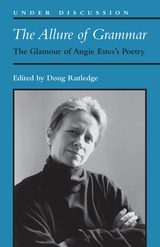
In addition to presenting an overview of critical reactions to Estes’s oeuvre, reviews by Langdon Hammer, Julianne Buchsbaum, and Christopher Spaide also provide a helpful context for approaching a poet who claims to distrust narrative. Original essays consider the craft of Estes’s poetry and offer literary analysis. Ahren Warner uses line breaks to explore a postmodern analysis of Estes’s work. Mark Irwin looks at her poetic structure. Lee Upton employs a feminist perspective to explore Estes’s use of italics, and B. K. Fischer looks at the way she uses dance as a poetic image. Doug Rutledge considers her relationship to Dante and to the literary tradition through her use of ekphrasis. An interview with Estes herself, in which she speaks of a poem as an “arranged place . . . where experience happens,” adds her perspective to the mix, at turns resonating with and challenging her critics.
The Allure of Grammar will be useful for teachers and students of creative writing interested in the craft of non-narrative poetry. Readers of contemporary poetry who already admire Estes will find this collection insightful, while those not yet familiar with her work will come away from these essays eager to seek out her books.
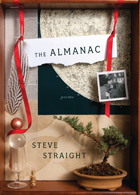
While the poems in Steve Straight’'s new collection lead the reader "into the dark forest of memory / or onto the carnival ride of hypothesis, / or even right off the cliff of surprise," they maintain a sure course through the din and distraction of modern life. Bits of news from the natural sciences, chance encounters, and even convicted felon and crafting queen Martha Stewart all fall under Straight’s observant eye. The result is a collection of conversational poems that lend a sense of wonder to the commonplace.
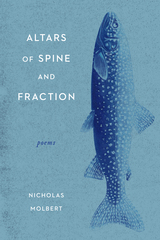
A debut poetry collection set in and around Louisiana’s fishing village of Cocodrie
Altars of Spine and Fraction follows its protagonist through the joys and dangers of childhood on the rural Gulf Coast, through familial loss, and into adulthood. Refusing to romanticize what has been lost, Molbert instead interrogates how nostalgia is most often enjoyed by those with the privilege to reject or indulge it.
Violent hurricanes sweep across the landscapes of the poems, and Molbert probes the class inequalities that these climate crises lay bare. Moving from outdoor rural spaces in its first half to indoor domestic spaces in its second half, the collection explores family history, generational trauma, and the toxic masculinity that is shouldered by boys raised in the Deep South.
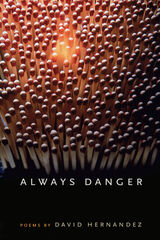
Always Danger offers a lyrical and highly imaginative exploration into the hazards that surround people’s lives—whether it’s violence, war, mental illness, car accidents, or the fury of Mother Nature. In his second collection of poems, David Hernandez embraces the element of surprise: a soldier takes refuge inside a hollowed-out horse, a man bullies a mountain, and a giant pink donut sponsors age-old questions about beliefs. Hernandez typically eschews the politics that often surround the inner circle of contemporary literature, but in this volume he quietly sings a few bars with a political tone: one poem shadows the conflict in Iraq, another reflects our own nation’s economic and cultural divide. Always Danger parallels Hernandez’s joy of writing: unmapped, spontaneous, and imbued with nuanced revelation.
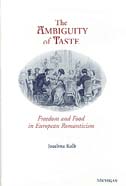
In The Ambiguity of Taste, Jocelyne Kolb attempts to define changes in genre and metaphorical usage by undertaking close readings of six authors. She looks first at Molière and Fielding, whose culinary allusions herald poetic revolution but whose works do not themselves escape the limits of a neoclassical aesthetic. Byron and Heine, known as renegades, are treated in separate chapters and in the greatest detail. The penultimate chapter joins Goethe and Hugo as champions of poetic freedom, and in the final chapter Kolb briefly considers Thomas Mann and Proust, whose works display the gains of poetic revolution.
This book will be savored by students of comparative literature and European Romanticism. Its accessible style will tempt nonspecialists and food enthusiasts as well.
Jocelyne Kolb is Professor of German Studies, Smith College. This book was the winner of the 1995 American Conference on Romanticism Book Prize.
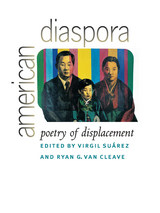
Diaspora constitutes a powerful descriptor for the modern condition of the contemporary poet, the spokesperson for the psyche of America. The poems in American Diaspora: Poetry of Displacement focus on the struggles and pleasures of creating a home-physical and mental-out of displacement, exile, migration, and alienation.
To fully explore the concept of diaspora, the editors have broadened the scope of their definition to include not only the physical act of moving and immigration but also the spiritual and emotional dislocations that can occur-as for Emily Dickinson and other poets-even in a life spent entirely in one location.
v
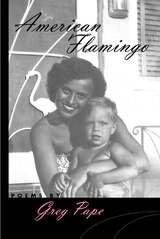
Taking its title from an Audubon painting, American Flamingo shares with the artist an exquisite attention to detail and the suggestion of a larger sense of time and place through depictions of the intimate interactions between creatures and their habitats. In his fifth collection of poetry, Greg Pape melds memorable images from the natural world with the drama of ordinary experience to capture small transformations of human character in American settings from Arizona’s Sonora Desert to the icy streets of Washington, D.C. Through elegies, character sketches, and lyric and narrative evocations of family and place, Pape offers lucid and startling poems that bridge the spaces between the past and the present, men and women, and urban and rural landscapes.
READERS
Browse our collection.
PUBLISHERS
See BiblioVault's publisher services.
STUDENT SERVICES
Files for college accessibility offices.
RECENTLY PUBLISHED




UChicago Accessibility Resources
home | accessibility | search | about | contact us
BiblioVault ® 2001 - 2024
The University of Chicago Press