front cover of Practices of Coexistence
Practices of Coexistence
Constructions of the Other in Early Modern Perceptions
Marianna D. Birnbaum
Central European University Press, 2017
The essays in this book provide interesting contributions to the ongoing debate concerning the representation of differing cultures, i.e., the “image of the Other” in the early modern period . They deal with images, projections, and perceptions, based on various experiences of coexistence. Although the individual contributions contain sources and references of iconography, this is not just another volume of art history or visual studies. As examples of practices in diverse historical contexts, the book includes a variety of textual material, such as literary productions, rhetorical exercises, dramatic applications, chronicles, epistles, and diary-like historical accounts that express ethnographic sensitivities. Thus, supported by a thorough research apparatus, these studies propose a new cultural history of the early modern coexistence of various communities, as identified in current research by young scholars. Another novel feature of the volume is the deliberate digression of traditional scholars’ focus and the investigation of rarely examined regions and practices. This approach allows the contributors to spotlight their special areas of research and to share a fresh new look at “the Renaissance.”
[more]

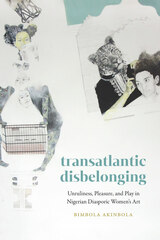
front cover of Transatlantic Disbelonging
Transatlantic Disbelonging
Unruliness, Pleasure, and Play in Nigerian Diasporic Women's Art
Bimbola Akinbola
Duke University Press, 2025
In Transatlantic Disbelonging, Bimbola Akinbola redirects the focus in diaspora studies from questions of loss and longing to acts of unapologetic self-definition through the study of Nigerian diasporic women artists navigating disparate geographies, allegiances, and identities. Drawing on the work of contemporary visual and performance artists, experimental filmmakers, and writers—including Wura-Natasha Ogunji, Njideka Akunyili Crosby, Zina Saro-Wiwa, ruby onyinyechi amanze, and Nnedi Okorafor—Akinbola articulates how these artists use their experiences as cultural outsiders to redefine home and national belonging on their own terms. Taking a capacious interdisciplinary approach, she explores how these women employ anti-respectability, taboo, the erotic, and play to challenge oppressive colonial legacies and expectations pertaining to gender and morality. For the artists in this book, their artmaking is a form of homemaking that embraces ambivalence and reinvents alienation as possibility. Theorizing these practices as acts of “disbelonging,” Akinbola radically reimagines diasporic identity formation, illustrating how artists use creative practices to enact and embody belonging and community in expansive ways.
[more]


front cover of Victorian Lessons in Empathy and Difference
Victorian Lessons in Empathy and Difference
Rebecca N. Mitchell
The Ohio State University Press, 2011


Send via email Share on Facebook Share on Twitter