
 A SCHOLARLY BOOK REPOSITORY
Results by Title
2 books about New Middle Class
2 books about New Middle Class
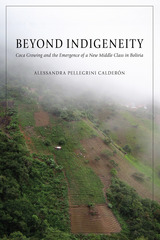
Beyond Indigeneity
Coca Growing and the Emergence of a New Middle Class in Bolivia
Alessandra Pellegrini Calderón
University of Arizona Press, 2016
In Bolivia, the discourse on indigenous peoples intensified in the last few decades, culminating in the election of Evo Morales as president in 2005. Indigenous people are portrayed by the Morales government as modest, communitarian, humble, poor, anticapitalist, and economically marginalized. In his 2006 inaugural speech, Morales famously described indigenous people as “the moral reserve of humanity.” His rhetoric has reached all levels of society—most notably the new political constitution of 2009. This constitution initiated a new regime of considerable ethnic character by defining thirty-six indigenous nations and languages.
Beyond Indigeneity offers new analysis into indigenous identity and social mobility that changes the discourse in Latin American social anthropology. Author Alessandra Pellegrini Calderón points out that Morales’s presidency has led to heightened publicity of coca issues and an intensification of indigeneity discourse, echoing a global trend of increased recognition of indigenous peoples’ claims. The “living well” attitude (vivir bien) enshrined in the new political constitution is generally represented as an indigenous way of life, one based on harmony and reciprocity, in sharp contrast to the capitalist logic of “living better” that is based on accumulation and expansion.
In this ethnography, Pellegrini explores the positioning of coca growers in Bolivia and their reluctance to embrace the politics of indigeneity by rejecting the “indigenous peoples’ slot,” even while they emerge as a new middle class. By staying in a space between ethnic categories and also between social classes, the coca growers break with the traditional model of social mobility in Latin America and create new forms of political positioning that challenge the dominant culturalist framework about indigeneity and peasants.
Beyond Indigeneity offers new analysis into indigenous identity and social mobility that changes the discourse in Latin American social anthropology. Author Alessandra Pellegrini Calderón points out that Morales’s presidency has led to heightened publicity of coca issues and an intensification of indigeneity discourse, echoing a global trend of increased recognition of indigenous peoples’ claims. The “living well” attitude (vivir bien) enshrined in the new political constitution is generally represented as an indigenous way of life, one based on harmony and reciprocity, in sharp contrast to the capitalist logic of “living better” that is based on accumulation and expansion.
In this ethnography, Pellegrini explores the positioning of coca growers in Bolivia and their reluctance to embrace the politics of indigeneity by rejecting the “indigenous peoples’ slot,” even while they emerge as a new middle class. By staying in a space between ethnic categories and also between social classes, the coca growers break with the traditional model of social mobility in Latin America and create new forms of political positioning that challenge the dominant culturalist framework about indigeneity and peasants.
[more]
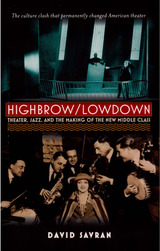
Highbrow/Lowdown
Theater, Jazz, and the Making of the New Middle Class
David Savran
University of Michigan Press, 2010
Highbrow/Lowdown explores the twentieth century's first culture war and the forces that permanently transformed American theater into the art form we know today. The arrival of jazz in the 1920s sparked a cultural revolution that was impossible to contain. The music affected every stratum of U.S. society and culture, confusing and challenging long-entrenched hierarchies based on class, race, and ethnicity. But jazz was much more than the music -- it was also a powerful cultural force that brought African American, Jewish, and working-class culture into the white Protestant mainstream. When the influence of jazz spread to legitimate theater, playwrights, producers, and critics rushed to distinguish the newly emerging literary theater from its illegitimate cousins. The efforts to defeat the democratizing influences of jazz and to canonize playwrights like Eugene O'Neill triumphed, giving birth to American theater as we know it today.
[more]
READERS
Browse our collection.
PUBLISHERS
See BiblioVault's publisher services.
STUDENT SERVICES
Files for college accessibility offices.
RECENTLY PUBLISHED



UChicago Accessibility Resources
home | accessibility | search | about | contact us
BiblioVault ® 2001 - 2026
The University of Chicago Press