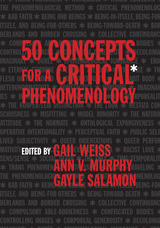
front cover of 50 Concepts for a Critical Phenomenology
50 Concepts for a Critical Phenomenology
Edited by Gail Weiss, Ann V. Murphy, and Gayle Salamon
Northwestern University Press, 2020

Phenomenology, the philosophical method that seeks to uncover the taken-for-granted presuppositions, habits, and norms that structure everyday experience, is increasingly framed by ethical and political concerns. Critical phenomenology foregrounds experiences of marginalization, oppression, and power in order to identify and transform common experiences of injustice that render “the familiar” a site of oppression for many. In Fifty Concepts for a Critical Phenomenology, leading scholars present fresh readings of classic phenomenological topics and introduce newer concepts developed by feminist theorists, critical race theorists, disability theorists, and queer and trans theorists that capture aspects of lived experience that have traditionally been neglected. By centering historically marginalized perspectives, the chapters in this book breathe new life into the phenomenological tradition and reveal its ethical, social, and political promise. This volume will be an invaluable resource for teaching and research in continental philosophy; feminist, gender, and sexuality studies; critical race theory; disability studies; cultural studies; and critical theory more generally.

[more]

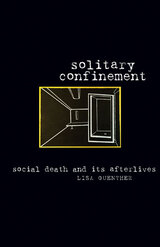
front cover of Solitary Confinement
Solitary Confinement
Social Death and Its Afterlives
Lisa Guenther
University of Minnesota Press, 2013

Prolonged solitary confinement has become a widespread and standard practice in U.S. prisons—even though it consistently drives healthy prisoners insane, makes the mentally ill sicker, and, according to the testimony of prisoners, threatens to reduce life to a living death. In this profoundly important and original book, Lisa Guenther examines the death-in-life experience of solitary confinement in America from the early nineteenth century to today’s supermax prisons. Documenting how solitary confinement undermines prisoners’ sense of identity and their ability to understand the world, Guenther demonstrates the real effects of forcibly isolating a person for weeks, months, or years.

Drawing on the testimony of prisoners and the work of philosophers and social activists from Edmund Husserl and Maurice Merleau-Ponty to Frantz Fanon and Angela Davis, the author defines solitary confinement as a kind of social death. It argues that isolation exposes the relational structure of being by showing what happens when that structure is abused—when prisoners are deprived of the concrete relations with others on which our existence as sense-making creatures depends. Solitary confinement is beyond a form of racial or political violence; it is an assault on being.

A searing and unforgettable indictment, Solitary Confinement reveals what the devastation wrought by the torture of solitary confinement tells us about what it means to be human—and why humanity is so often destroyed when we separate prisoners from all other people.


[more]


Send via email Share on Facebook Share on Twitter