 A SCHOLARLY BOOK REPOSITORY
Results by Title
2 books about Four Women
2 books about Four Women
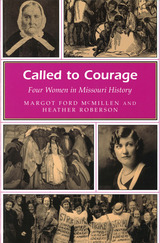
Called to Courage
Four Women in Missouri History
Margot Ford McMillen & Heather Roberson
University of Missouri Press, 2002
While there are many accessible biographies of important Missouri men, there are few such biographies of Missouri women, which might suggest that they did not count in history. This book, written by a mother-and-daughter team, helps to correct that misconception by tracing the lives of four women who played important roles in their eras. These women were exceptional because they had the courage to make the best of their abilities, forging trails and breaking the barriers that separated women’s spheres from those of men:
· A Native American woman the French newspapers called “Ignon Ouaconisen,” and the people of Paris called the “Missouri princess,” lived from about 1700 to after 1751. She traveled with adventurer Etienne de Bourgmont and bore his child. Although much of her life remains a mystery, her story gives us insights into the lives of Missouri Indian women in the days of the fur trade.
· Pioneer Olive Boone (1783–1858) came to the Louisiana Territory as the teenage bride of Nathan Boone, guiding a skiff and their horses across the Missouri River to join the Daniel Boone family near St. Charles. For much of her married life, she stayed alone with her fourteen children while her husband traveled on lengthy hunting expeditions, supervised the Boone saltworks in present-day Howard County, and spent years in the military.
· Martha Jane Chisley, born a slave in 1833, was brought to northeast Missouri as a young woman. During the Civil War, Martha Jane escaped with her children to Illinois. She overcame many obstacles so that her son Augustine was able to enter school and get an education. Augustine studied in Rome and became the first nationally known African American priest.
· Nell Donnelly of Kansas City was a pioneering businesswoman who founded a dress company that became the world’s largest, brightening the wardrobe of the “housewife” while also creating fair working conditions for her employees. Born into an ordinary middle-class family in 1889, she achieved a success and high profile that brought its own problems.
Using Missouri and Illinois archives, Margot Ford McMillen and Heather Roberson have compiled well-known and obscure materials to describe the lives of both women and men, showing how roles changed as Missouri and America matured. Bringing together family insights and the rare writings of observers who almost never mention women in their journals, Called to Courage will be welcomed by anyone interested in women’s history or Missouri history.
[more]
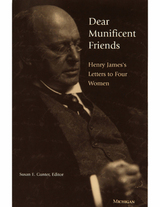
Dear Munificent Friends
Henry James's Letters to Four Women
Susan E. Gunter, Editor
University of Michigan Press, 2000
Henry James was not only a prolific novelist but also a prolific letter writer. This edition of 150 previously unpublished letters to four of his female contemporaries reveals James to be a warm, witty, and astute commentator on a world now lost. The James revealed in these engaging letters is a vital, clever, and lively man with an intense interest in affairs of his day. The letters present a delightful picture of Victorian-Edwardian culture, including health cures (Fletcherizing and going to health spas), literary scandals (he feared writer Edith Wharton would be destroyed by her mad husband Teddy), domestic affairs (the marriage market, child rearing, antiquing, decorating, and gardening), and historical events (the Civil War, Queen Victoria's funeral, England's great Coal Strike, the Dreyfus case, and World War I).Susan Gunter has selected and annotated correspondence between James and four women in his social milieu: Alice Howe Gibbens James, wife of William James; Mary Cadwalader Jones, wife of Frederic Rhinelander Jones (New York socialite and Edith Wharton's brother); Mary Frances Prothero, wife of Cambridge academic Sir George Prothero; and Lady Louisa Wolseley, wife of Viscount Garnet Wolseley, commander-in-chief of the British Forces. Of the 10,000 extant letters by James, over two-thirds of them have never been published. The selection presented here is designed to reveal the writer's human side, his humorous and warm views of Anglo-American life over a fifty-year span, as well as his intimate participation in nineteenth-century women's daily lives. Editor Susan Gunter has provided an introduction that offers a helpful historical overview of nineteenth-century women's roles, a biographical register of people mentioned in the letters, a chronology, and brief biographies of the four women correspondents. Readers interested in gender studies, biography, intellectual and cultural history, and literary history will find this book fascinating.
[more]
READERS
Browse our collection.
PUBLISHERS
See BiblioVault's publisher services.
STUDENT SERVICES
Files for college accessibility offices.
RECENTLY PUBLISHED





UChicago Accessibility Resources
home | accessibility | search | about | contact us
BiblioVault ® 2001 - 2026
The University of Chicago Press