
 A SCHOLARLY BOOK REPOSITORY
Do contemporary big-budget blockbuster films like Gravity move something in us that is fundamentally the same as what avant-garde and experimental films have done for more than a century? In a powerful challenge to mainstream film theory, Cinema’s Bodily Illusions demonstrates that this is the case.
Scott C. Richmond bridges genres and periods by focusing, most palpably, on cinema’s power to evoke illusions: feeling like you’re flying through space, experiencing 3D without glasses, or even hallucinating. He argues that cinema is, first and foremost, a technology to modulate perception. He presents a theory of cinema as a proprioceptive technology: cinema becomes art by modulating viewers’ embodied sense of space. It works primarily not at the level of the intellect but at the level of the body. Richmond develops his theory through examples of direct perceptual illusion in cinema: hallucinatory flicker phenomena in Tony Conrad’s The Flicker, eerie depth effects in Marcel Duchamp’s Anémic Cinéma, the illusion of bodily movement through onscreen space in Stanley Kubrick’s 2001, Godfrey Reggio’s Koyaanisqatsi, and Alfonso Cuarón’s Gravity. In doing so he combines insights from Maurice Merleau-Ponty’s phenomenology of perception and James J. Gibson’s ecological approach to perception. The result is his distinctive ecological phenomenology, which allows us to refocus on the cinema’s perceptual, rather than representational, power.
Arguing against modernist habits of mind in film theory and aesthetics, and the attendant proclamations of cinema’s death or irrelevance, Richmond demonstrates that cinema’s proprioceptive aesthetics make it an urgent site of contemporary inquiry.

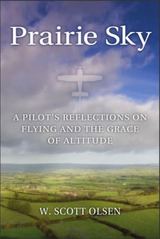
“It’s almost like ballet. Preflight. Starting. Warm-up. The voices from the control tower—the instructions. Taxiing. The rush down the runway. Airborne. There are names for every move. The run-up. Position and hold. Every move needs to be learned, practiced, made so familiar you feel the patterns in every other thing you do. It’s technical, yes. But there is a grace to getting metal and bone into the sky.”
Prairie Sky is a celebration of curiosity and a book for explorers. In this collection of contemplative essays, Scott Olsen invites readers to view the world from a pilot’s seat, demonstrating how, with just a little bit of altitude, the world changes, new relationships become visible, and new questions seem to rise up from the ground.
Whether searching for the still-evident shores of ancient lakes, the dustbowl-era shelterbelt supposed to run the length of the country, or the even more elusive understandings of physics and theology, Olsen shares the unique perspective and insight allowed to pilots.
Prairie Sky explores the reality as well as the metaphor of flight: notions of ceaseless time and boundless space, personal interior and exterior vision, social history, meteorology, and geology. Olsen takes readers along as he chases a new way of looking at the physical world and wonders aloud about how the whole planet moves in interconnected ways not visible from the ground. While the northern prairie may call to mind images of golden harvests and summer twilight such images do not define the region. The land bears marks left by gut-shaking thunderstorms, hard-frozen rivers, sweeping floods, and hurricane-size storms. Olsen takes to the midwestern sky to confront the ordinary world and reveals the magic--the wondrous and unique sights visible from the pilot’s seat of a Cessna.
Like Antoine de Saint-Exupery’s classic work Wind, Sand and Stars, Olsen’s Prairie Sky reveals the heart of what it means to fly. In the grand romantic tradition of the travel essay, it opens the dramatic paradoxes of self and collective, linear and circular, the heart and the border.
READERS
Browse our collection.
PUBLISHERS
See BiblioVault's publisher services.
STUDENT SERVICES
Files for college accessibility offices.
RECENTLY PUBLISHED


UChicago Accessibility Resources
home | accessibility | search | about | contact us
BiblioVault ® 2001 - 2026
The University of Chicago Press