
 A SCHOLARLY BOOK REPOSITORY
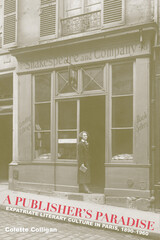
A Publisher's Paradise explores the political and literary dynamics that gave rise to this expatriate cultural flourishing, which included everything from Victorian pornography to the most daring and controversial modernist classics. Colette Colligan tracks the British and French politicians and diplomats who policed Paris editions of banned books and uncovers offshore networks of publishers, booksellers, authors, and readers. She looks closely at the stories the "dirty books" told about this publishing haven and the smut peddlers and literary giants it brought together in transnational cultural formations. The book profiles an eclectic group of expatriates living and publishing in Paris, from relatively obscure figures such as Charles Carrington, whose list included both The Picture of Dorian Gray and the pornographic novel Randiana, to bookshop owner Sylvia Beach, famous for publishing James Joyce's Ulysses in 1922.
A Publisher's Paradise is a compelling exploration of the little-known history of foreign pornography in Paris and the central role it played in turning the city into a modernist outpost for literary and sexual vanguardism, a reputation that still lingers today in our cultural myths of midnight in Paris.

With this important new book, Susan Suleiman lays the foundation for a postmodern feminist poetics and theory of the avant-garde. She shows how the figure of Woman, as fantasy, myth, or metaphor, has functioned in the work of male avant-garde writers and artists of this century. Focusing also on women's avant-garde artistic practices, Suleiman demonstrates how to read difficult modern works in a way that reveals their political as well as their aesthetic impact.
Suleiman directly addresses the subversive intent of avant-garde movements from Surrealism to postmodernism. Through her detailed readings of provocatively transgressive works by André Breton, Georges Bataille, Roland Barthes, Alain Robbe-Grillet, Marcel Duchamp, Max Ernst, and others, Suleiman demonstrates the central role of the female body in the male erotic imagination and illuminates the extent to which masculinist assumptions have influenced modern art and theory. By examining the work of contemporary women avantgarde artists and theorists--including Hélène Cixous, Marguerite Duras, Monique Wittig, Luce Irigaray, Angela Carter, Jeanette Winterson, Leonora Carrington, Barbara Kruger, Jenny Holzer, and Cindy Sherman--Suleiman shows the political power of feminist critiques of patriarchal ideology, and especially emphasizes the power of feminist humor and parody.
Central to Suleiman's revisionary theory of the avant-garde is the figure of the playful, laughing mother. True to the radically irreverent spirit of the historical avant-gardes and their postmodernist successors, Suleiman's laughing mother embodies the need for a link between symbolic innovation and political and social change.
Newman describes this psychodrama of narrative engagement as that of exile and return, an experience in which narrative becomes a type of homeland, beckoning and elusive, endlessly defining and disrupting the borders of a reader's identity. Within this paradigm, he considers a fascinating variety of narrative texts: from the Jim Jones episode in Guyana to Freud's repression of personal history in his story of Moses; from a surrealistic collage novel by Max Ernst to the horror films of Alfred Hitchcock; from the works of James Joyce, Ariel Dorfman, Milan Kundera, and D. M. Thomas to the tales of abjection in pornography.
Transgressions of Reading is itself an engaging work, as interesting for its provocative readings of particular works as for its theoretical insights. It will appeal to readers from all fields in which narrative plays a crucial role, in the study of film and art, modern and contemporary literature, popular culture, and feminist, psychoanalytic, and reader response theory.
READERS
Browse our collection.
PUBLISHERS
See BiblioVault's publisher services.
STUDENT SERVICES
Files for college accessibility offices.
RECENTLY PUBLISHED


UChicago Accessibility Resources
home | accessibility | search | about | contact us
BiblioVault ® 2001 - 2024
The University of Chicago Press