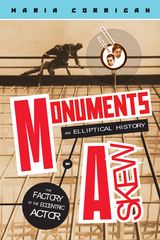
front cover of Monuments Askew
Monuments Askew
An Elliptical History of the Factory of the Eccentric Actor
Maria Corrigan
Rutgers University Press, 2025
Monuments Askew: An Elliptical History of the Factory of the Eccentric Actor presents a cultural history of the Factory of the Eccentric Actor (FEKS), an avant-garde collective of Ukrainian artists whose unique approach to monumental history generated a new kind of cinema for a modernizing Soviet era. Often lost in the shuffle of this period, FEKS’s vibrant and experimental cinematic output initiated a youthful and cheeky overhaul of Soviet revolutionary culture. Monuments Askew reveals the foundational role of this understudied group of artists—including Grigori Kozintsev and Leonid Trauberg—and uses their own theoretical contributions to undo the “foundations” of our understanding of Soviet media and arts. As a counter to a solely cinema-focused conceptualization of this era, Corrigan develops a transnational media theory of eccentricity. Defining eccentric circles as warped, irregular orbits that force a realignment of centers, Monuments Askew shows how FEKS’s body of work inspires an eccentric realignment of the pillars of Soviet visual culture, and indeed of monumentality itself.
 
[more]

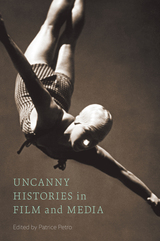
front cover of Uncanny Histories in Film and Media
Uncanny Histories in Film and Media
Patrice Petro
Rutgers University Press, 2022
Uncanny Histories in Film and Media brings together a stellar lineup of established and emergent scholars who explore the uncanny twists and turns that are often occluded in larger accounts of film and media. Prompted by fresh archival research and new conceptual approaches, the works included here probe the uncanny as a mode of historical analysis that reveals surprising connections and unsettling continuities.  The uncanny stands for what often eludes us, for what remains unfamiliar or mysterious or strange.  Whether writing about film movements, individual works, or the legacies of major or forgotten critics and theorists, the contributors remind us that at the heart of the uncanny, and indeed the writing of history, is a troubling of definitions, a challenge to our inherited narratives, and a disturbance of what was once familiar in the uncanny histories of our field.
 
[more]


Send via email Share on Facebook Share on Twitter