
 A SCHOLARLY BOOK REPOSITORY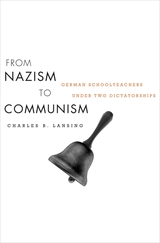
Tracing teachers' experiences in the Third Reich and East Germany, Charles Lansing analyzes developments in education of crucial importance to both dictatorships. Lansing uses the town of Brandenburg an der Havel as a case study to examine ideological reeducation projects requiring the full mobilization of the schools and the active participation of a transformed teaching staff. Although lesson plans were easily changed, skilled teachers were neither quickly made nor easily substituted. The men and women charged in the postwar era with educating a new “antifascist” generation were, to a surprising degree, the same individuals who had worked to “Nazify” pupils in the Third Reich. But significant discontinuities existed as well, especially regarding the teachers' professional self-understanding and attitudes toward the state-sanctioned teachers' union. The mixture of continuities and discontinuities helped to stabilize the early GDR as it faced its first major crisis in the uprising of June 17, 1953.
This uniquely comparative work sheds new light on an essential story as it reconceptualizes the traditional periodization of postwar German and European history.

For the past hundred years, “vulgar Marxism” has been the go-to insult among socialist and communist intellectuals, a shorthand for the ways Marxist theory could go wrong. But why would thinkers advocating for working-class emancipation use “vulgarity” as an epithet?
In Vulgar Marxism, Edward Baring seeks an answer by delving into debates over Marxism in the first decades of the twentieth century. He shows that this common phrase wasn’t aimed primarily at popular understandings of Marx. Rather, it was used to attack intellectuals for failing to teach Marx’s theory to the working masses correctly. His history of “vulgar Marxism” homes in on the project of mass worker education at a time when the project was both widely pursued and fiercely contested.
Worker education offered a mechanism through which Marxist theory was meant to promote large-scale social and political change, and it drew on a massive infrastructure of schools, publishing houses, and educational bureaus that stretched across Europe and reached millions. By centering this project, Baring radically recasts the history of Marxism from the Second International to World War II. He challenges classic oppositions between “economistic” and “cultural” versions of Marxism; rereads many of the most significant Marxist theorists of the time, including Karl Kautsky, Rosa Luxemburg, Georg Lukács, and Antonio Gramsci; and offers new resources for understanding how Marxist ideas transformed as they traveled around Europe and then spread throughout the world.
READERS
Browse our collection.
PUBLISHERS
See BiblioVault's publisher services.
STUDENT SERVICES
Files for college accessibility offices.
RECENTLY PUBLISHED




UChicago Accessibility Resources
home | accessibility | search | about | contact us
BiblioVault ® 2001 - 2025
The University of Chicago Press