
 A SCHOLARLY BOOK REPOSITORY
Addressing a wide range of issues beyond the academy, the authors present a rich and under-studied archive of personal reflections, in-depth interviews, creative works, and scholarly essays. Their trandsdisciplinary approach highlights the need for queer, transgressive, and utopian practices that render visible histories of migration, empire building, settler colonialism, and globalization.
Timely, urgent, and fascinating, Diasporic Intimacies offers an accessible entry point for readers who seek to pursue critically engaged community work, arts education, curatorial practice, and socially inflected research on sexuality, gender, and race in this ever-changing world.

How Indigenous communities are transforming the idea and practice of reparations through their laws and leadership
In recent decades, a growing number of Indigenous groups across Canada have initiated movements for colonial reparations. Too often, the settler state has responded by attempting to enfold their work into a narrative of reconciliation that consigns colonialism to “sad chapters” of history. In this book, Pauline Wakeham calls attention to the ways that Indigenous reparations movements exceed state reconciliatory frameworks and prompt a deeper reckoning with the enduring structures of settler colonialism.
To expose and redress colonial injustices, Indigenous reparations movements draw upon long local traditions of political organizing as well as transformations on the global stage since World War II. As international law formulated new instruments regarding gross human rights violations, atrocity crimes, and the reparative obligations of states, colonized peoples across the world have sought to mobilize these mechanisms in their struggles for decolonization and reparations. While international law has provided strategic tools for this work, the colonial foundations of the field continue to limit how it conceptualizes and shapes access to justice. Indigenous Reparations and Settler Colonial Reckoning traces the specific implications for Indigenous nations whose land is occupied by settler states—nations whose legal orders remain subordinated to both settler “domestic” and international legal systems.
Amid this complex multijurisdictional terrain, how are Indigenous peoples carving out space to articulate their own visions of justice? To answer this question, Wakeham learns from the Inuit-led Qikiqtani Truth Commission as well as reparations movements for residential schools and the High Arctic Relocations of 1953 and 1955. These movements offer powerful lessons about the importance of centering Indigenous leadership and laws in redress processes, thereby connecting reparations to the living enactment of Indigenous rights.
Retail e-book files for this title are screen-reader friendly with images accompanied by short alt text and/or extended descriptions.
Canada has a deep layer of medievalism embedded in its architecture, governance structures, and sociocultural bedrock. This volume distinguishes between Canadian medievalism and its closest neighbours, British and American medievalism, and argues that the ignored or unnoticed medievalism of English Canada derives from its foundation by United Empire Loyalists escaping to the north in the late eighteenth century.
The book considers particular literary and cultural expressions of medievalism—including Gothic architecture, heraldry, ice hockey, and Samuel de Champlain’s lost astrolabe; and the work of Guy Gavriel Kay, Earle Birney, Robertson Davies, Louise Penny, Alice Munro, Margaret Atwood, and George Longmore—arguing that medievalism remains a potent force in Canadian national identity.
In contrast to past studies that focus narrowly on war and massacre, treat Native peoples as victims, and consign violence safely to the past, this interdisciplinary collection of essays opens up important new perspectives. While recognizing the long history of genocidal violence against Indigenous peoples, the contributors emphasize the agency of individuals and communities in genocide’s aftermath and provide historical and contemporary examples of activism, resistance, identity formation, historical memory, resilience, and healing. The collection also expands the scope of violence by examining the eyewitness testimony of women and children who survived violence, the role of Indigenous self-determination and governance in inciting violence against women, and settler colonialism’s promotion of cultural erasure and environmental destruction.
By including contributions on Indigenous peoples in the United States, Canada, the Pacific, Greenland, Sápmi, and Latin America, the volume breaks down nation-state and European imperial boundaries to show the value of global Indigenous frameworks. Connecting the past to the present, this book confronts violence as an ongoing problem and identifies projects that mitigate and push back against it.
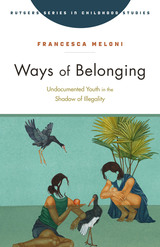
Ways of Belonging examines the experiences of undocumented young people who are excluded from K–12 schools in Canada and are rendered invisible to the education system. Canadian law doesn’t mention the existence of undocumented children, and thus their access to education rests on discretionary practices and is often denied altogether. This book brings the stories of undocumented young people vividly alive, putting them into conversation with the perspectives of the different actors in schools and courts who fail to include these young people.
Drawing on long-term ethnographic fieldwork, Francesca Meloni shows how ambivalence shapes the lives of young people who are caught between the desire to belong and the impossibility of fully belonging. Meloni pays close attention to these young people’s struggles and hopes, showing us what it means to belong and to endure in contexts of social exclusion. Ways of Belonging reveals the opacities and failures of a system that excludes children from education and puts their lives in invisibility mode.
An interview with the author (https://www.qmul.ac.uk/clpn/news-views/book-interviews/items/interview-with-francesca-meloni-about-her-book-ways-of-belonging-undocumented-youth-in-the-shadow-of-illegality.html)
READERS
Browse our collection.
PUBLISHERS
See BiblioVault's publisher services.
STUDENT SERVICES
Files for college accessibility offices.
RECENTLY PUBLISHED




UChicago Accessibility Resources
home | accessibility | search | about | contact us
BiblioVault ® 2001 - 2026
The University of Chicago Press