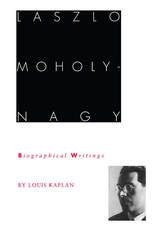
front cover of Laszlo Moholy-Nagy
Laszlo Moholy-Nagy
Biographical Writings
Louis Kaplan
Duke University Press, 1995
Marking the centenary of the birth of Laszlo Moholy-Nagy (1895–1946), this book offers a new approach to the Bauhaus artist and theorist’s multifaceted life and work—an approach that redefines the very idea of biographical writing.
In Laszlo Moholy-Nagy, Louis Kaplan applies the Derridean deconstructivist model of the "signature effect" to an intellectual biography of a Constructivist artist. Inhabiting the borderline between life and work, the book demonstrates how the signature inscribed by "Moholy" operates in a double space, interweaving signified object and signifying matter, autobiography and auto-graphy. Through interpretative readings of over twenty key artistic and photographic works, Kaplan graphically illustrates Moholy’s signature effect in action. He shows how this effect plays itself out in the complex of relations between artistic originality and plagiarism, between authorial identity and anonymity, as well as in the problematic status of the work of art in the age of technical reproduction. In this way, the book reveals how Moholy’s artistic practice anticipates many of the issues of postmodernist debate and thus has particular relevance today. Consequently, Kaplan clarifies the relationship between avant-garde Constructivism and contemporary deconstruction.
This new and innovative configuration of biography catalyzed by the life writing of Moholy-Nagy will be of critical interest to artists and writers, literary theorists, and art historians.
[more]

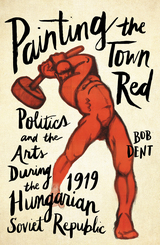
front cover of Painting the Town Red
Painting the Town Red
Politics and the Arts During the 1919 Hungarian Soviet Republic
Bob Dent
Pluto Press, 2018
In 1919, in the wake of World War I, for a brief period Hungary was a Soviet Republic. The republic didn’t last, but the incredible effusion of art, music, film, theater, and literature that it generated did. Painting the Town Red offers an in-depth exploration of the incredible artistic flourishing brought about by the 1919 republic, showing how art and politics were intertwined—and how, for a brief time, artists saw themselves as playing a crucial part in the establishment of a new way of living and governing. Through close analyses of the works of a number of creators and a careful recounting of the history and politics of the 1919 republic, Bob Dent brings a largely forgotten moment back to life, with all its glory and, ultimately, disillusion.

 
[more]


Send via email Share on Facebook Share on Twitter