
 A SCHOLARLY BOOK REPOSITORY
Results by Title
2 books about Arms race
2 books about Arms race

The Killing Age
How Violence Made the Modern World
Clifton Crais
University of Chicago Press, 2025
A bracing account of how our current planetary crisis emerged from the worst cataclysmic destruction in human history, which Clifton Crais terms the Mortecene—the killing age.
We are used to speaking of the Anthropocene and the outsized impact humans have had on the planet. But we sometimes lose sight of a fundamental truth at the heart of modern world history: the legacy of human predation, slavery, and imperialism that has devastated the natural world and led us to our present moment. As historian Clifton Crais shows in this magisterial work, the period that we most associate with human progress—which gave us the Enlightenment, the rise of democracies, the Industrial Revolution, and more—was at the same time catastrophically destructive.
In this bracing, landmark book, Crais urges us to view the growth of global capitalism between 1750 and the early 1900s not as the Anthropocene, but as the Mortecene: the Killing Age. Killing brought the world together and tore it apart, as profiteering warlords committed mass-scale slaughter of humans and animals across Africa, Asia, and the Americas. The newfound ease and profitability of killing created a disturbing network of global connections and economies, eliminating tens of millions of people and sparking an environmental crisis that remains the most urgent catastrophe facing the world today.
Drawing on years of scholarship and marshaling myriad sources across world history, The Killing Age turns our vision of past and present on its head, illuminating the Mortecene in all its horror—how it shaped who we are, what we value and fear, and the precarious present we inhabit today.
We are used to speaking of the Anthropocene and the outsized impact humans have had on the planet. But we sometimes lose sight of a fundamental truth at the heart of modern world history: the legacy of human predation, slavery, and imperialism that has devastated the natural world and led us to our present moment. As historian Clifton Crais shows in this magisterial work, the period that we most associate with human progress—which gave us the Enlightenment, the rise of democracies, the Industrial Revolution, and more—was at the same time catastrophically destructive.
In this bracing, landmark book, Crais urges us to view the growth of global capitalism between 1750 and the early 1900s not as the Anthropocene, but as the Mortecene: the Killing Age. Killing brought the world together and tore it apart, as profiteering warlords committed mass-scale slaughter of humans and animals across Africa, Asia, and the Americas. The newfound ease and profitability of killing created a disturbing network of global connections and economies, eliminating tens of millions of people and sparking an environmental crisis that remains the most urgent catastrophe facing the world today.
Drawing on years of scholarship and marshaling myriad sources across world history, The Killing Age turns our vision of past and present on its head, illuminating the Mortecene in all its horror—how it shaped who we are, what we value and fear, and the precarious present we inhabit today.
[more]
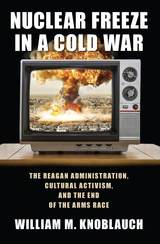
Nuclear Freeze in a Cold War
The Reagan Administration, Cultural Activism, and the End of the Arms Race
William M. Knoblauch
University of Massachusetts Press, 2017
The early 1980s were a tense time. The nuclear arms race was escalating, Reagan administration officials bragged about winning a nuclear war, and superpower diplomatic relations were at a new low. Nuclear war was a real possibility and antinuclear activism surged. By 1982 the Nuclear Freeze campaign had become the largest peace movement in American history. In support, celebrities, authors, publishers, and filmmakers saturated popular culture with critiques of Reagan's arms buildup, which threatened to turn public opinion against the president.
Alarmed, the Reagan administration worked to co-opt the rhetoric of the nuclear freeze and contain antinuclear activism. Recently declassified White House memoranda reveal a concerted campaign to defeat activists' efforts. In this book, William M. Knoblauch examines these new sources, as well as the influence of notable personalities like Carl Sagan and popular culture such as the film The Day After, to demonstrate how cultural activism ultimately influenced the administration's shift in rhetoric and, in time, its stance on the arms race.
Alarmed, the Reagan administration worked to co-opt the rhetoric of the nuclear freeze and contain antinuclear activism. Recently declassified White House memoranda reveal a concerted campaign to defeat activists' efforts. In this book, William M. Knoblauch examines these new sources, as well as the influence of notable personalities like Carl Sagan and popular culture such as the film The Day After, to demonstrate how cultural activism ultimately influenced the administration's shift in rhetoric and, in time, its stance on the arms race.
[more]
READERS
Browse our collection.
PUBLISHERS
See BiblioVault's publisher services.
STUDENT SERVICES
Files for college accessibility offices.
RECENTLY PUBLISHED



UChicago Accessibility Resources
home | accessibility | search | about | contact us
BiblioVault ® 2001 - 2025
The University of Chicago Press