
 A SCHOLARLY BOOK REPOSITORY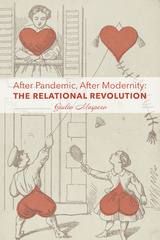
Without Trinitarian framework ancient and new idols emerge, as the Covid-19 tragedies have shown. Yet post-pandemic must be a moment of clarity and realism, as we can see how necessary it is that humanity place itself in relation to something beyond. The post-modern journey, however, must be in the spirit of Christian humanism or else any so-called progress will no longer be unable to speak authentically of our humanity. That is to say, the relational dimension of human life will be erased right along with the other ills that plague our earth.
On Ecclesiastical Theology, composed circa 338/339 just before Eusebius’s death, and perhaps in response to the amnesty for deposed bishops enacted by Constantius after the death of Constantine in 377 and the possibility of Marcellus’s return to his see, continues to lay out the criticisms initially put forward in Against Marcellus, again utilizing quotations from Marcellus’s book against Asterius. However, we see in this text a much more systematic explanation of Eusebius’s objections to the various elements of Marcellus’s theology and what he sees as the proper orthodox articulation of those elements.
Long overlooked for statements at odds with later orthodoxy, even written off as heretical because allegedly “semi-Arian,” recent scholarship has demonstrated the tremendous influence these texts had on the Greek theological tradition in the fourth century, especially on the orthodox understanding of the Trinity. In addition to their influence, they are some of the few complete texts that we have from Greek theologians in the immediate period following the Council of Nicea in 325, thus filling a gap in the materials available for research and teaching in this critical phase of theological development.
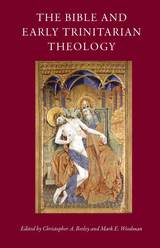
Based on a multi-year consultation in the Society of Biblical Literature, The Bible and Early Trinitarian Theology features leading scholars from both fields, who bring new insights to the relationship between patristic exegesis and current strategies of biblical interpretation, specifically with reference to the doctrine of the Trinity. Following an account of how each field came to study patristic exegesis, the book offers new studies of Trinitarian theology in Old Testament, Johannine, and Pauline biblical texts and the patristic interpretation of them, combining the insights of modern historical criticism with classical historical theology. It promises to make a valuable contribution to both fields, suggesting several new avenue into the study of early biblical literature and the development of Trinitarian theology.
Under the broad umbrella of the Christian religion, there exists a great divide between two fundamentally different ways of thinking about key aspects of the Christian faith. Eugene Webb explores the sources of that divide, looking at how the Eastern and Western Christian worlds drifted apart due both to the different ways they interpreted their symbols and to the different roles political power played in their histories. Previous studies have focused on historical events or on the history of theological ideas. In Search of the Triune God delves deeper by exploring how the Christian East and the Christian West have conceived the relation between symbol and experience.
Webb demonstrates that whereas for Western Christianity discussion of the doctrine of the Trinity has tended toward speculation about the internal structure of the Godhead, in the Eastern tradition the symbolism of the Triune God has always been closely connected to religious experience. In their approaches to theology, Western Christianity has tended toward a speculative theology, and Eastern Christianity toward a mystical theology.
This difference of focus has led to a large range of fundamental differences in many areas not only of theology but also of religious life. Webb traces the history of the pertinent symbols (God as Father, Son of God, Spirit of God, Messiah, King, etc.) from the Hebrew Bible and New Testament through patristic thinkers and the councils that eventually defined orthodoxy. In addition, he shows how the symbols, interpreted through the different cultural lenses of the East and the West, gradually took on meanings that became the material of very different worldviews, especially as the respective histories of the Eastern and Western Christian worlds led them into different kinds of entanglement with ambition and power.
Through this incisive exploration, Webb offers a dramatic and provocative new picture of the history of Christianity.
An approach to Trinitarian theology often favors overly technical language, or undue triteness. Maspero succeeds in leading both scholar and student to see how the unfolding of the mystery of the Trinity and its dogmatic development is a discovery of the “mystery from which all true love flows” in history. This discovery is only possible because of God’s self-revelation and immanence––that is, his heart and his “within.” The revelation of his being wholly and eternally Father and Son and the Love between them has made a more complete unity know to humanity through the perfect unity of divine communion. The foundation of all being and reality is this communion of love, personal unity that is given in relation and not in spite of relation. After a career of studying theology and theoretical physics, Maspero is especially keen on emphasizing the radical nature of this concept. It is an extension of Greek philosophy but ripped open and assigned immeasurable new value in communion and relation.
The brevity of this work limits the amount of citations and textual references given, and Maspero instead urges the reader to study the book alongside Scripture. His manner of writing respects the impossibility of speaking of God in his immanence, but he nonetheless carves out a place for the Trinity in the human intellect, a place where the Jewish and Christian God might be encountered. As Maspero observes, truth is found in the personal dimension, but “just as in the use of a map for a journey, the cognitive grasp of the Trinity is to prevent us from getting lost, to keep us from reducing and simplifying the Trinity into something we understand merely on a natural level.” A highlight of this work is Maspero’s reliance on Mary, Theotokos, in his presentation of Trinitarian theology, the person who first opened herself to this manner of thinking.

Harvard University Press takes pride in publishing the third edition of a work whose depth, scope, and wisdom have gained it international recognition as a classic in its field. Harry Austryn Wolfson, world-renowned scholar and most lucid of scholarly writers, here presents in ordered detail his long-awaited study of the philosophic principles and reasoning by which the Fathers of the Church sought to explain the mysteries of the Trinity and the Incarnation.
Professor Wolfson first discusses the problem of the relation of faith and reason. Starting with Paul, who, differentiating between the wisdom of God and the wisdom of the world, averred that he was not going to adorn his teachings with persuasive arguments based on the wisdom of the world, Professor Wolfson describes the circumstances and influences which nevertheless brought about the introduction of philosophy into matters of faith and analyzes the various attitudes of the Fathers towards philosophy.
The Trinity and the Incarnation are Professor Wolfson’s next concern. He analyzes the various ways in which these topics are presented in the New Testament, and traces the attempts on the part of the Fathers to harmonize these presentations. He shows how the ultimate harmonized formulation of the two doctrines was couched in terms of philosophy; how, as a result of philosophic treatment, there arose with regard to the Trinity the problem of three and one and with regard to the Incarnation the problem of two and one; and how, in their attempts to solve these problems, the Fathers drew upon principles which in philosophy were made use of in the solution of certain aspects of the problem of the one and the many. In the final part of this volume, entitled “The Anathematized,” he deals with Gnosticism and other heresies which arose during the Patristic period with regard to the Trinity and the Incarnation.

READERS
Browse our collection.
PUBLISHERS
See BiblioVault's publisher services.
STUDENT SERVICES
Files for college accessibility offices.
RECENTLY PUBLISHED



UChicago Accessibility Resources
home | accessibility | search | about | contact us
BiblioVault ® 2001 - 2024
The University of Chicago Press