
 A SCHOLARLY BOOK REPOSITORY
Results by Title
3 books about 1843-1920
3 books about 1843-1920
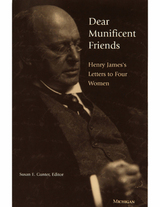
Dear Munificent Friends
Henry James's Letters to Four Women
Susan E. Gunter, Editor
University of Michigan Press, 2000
Henry James was not only a prolific novelist but also a prolific letter writer. This edition of 150 previously unpublished letters to four of his female contemporaries reveals James to be a warm, witty, and astute commentator on a world now lost. The James revealed in these engaging letters is a vital, clever, and lively man with an intense interest in affairs of his day. The letters present a delightful picture of Victorian-Edwardian culture, including health cures (Fletcherizing and going to health spas), literary scandals (he feared writer Edith Wharton would be destroyed by her mad husband Teddy), domestic affairs (the marriage market, child rearing, antiquing, decorating, and gardening), and historical events (the Civil War, Queen Victoria's funeral, England's great Coal Strike, the Dreyfus case, and World War I).Susan Gunter has selected and annotated correspondence between James and four women in his social milieu: Alice Howe Gibbens James, wife of William James; Mary Cadwalader Jones, wife of Frederic Rhinelander Jones (New York socialite and Edith Wharton's brother); Mary Frances Prothero, wife of Cambridge academic Sir George Prothero; and Lady Louisa Wolseley, wife of Viscount Garnet Wolseley, commander-in-chief of the British Forces. Of the 10,000 extant letters by James, over two-thirds of them have never been published. The selection presented here is designed to reveal the writer's human side, his humorous and warm views of Anglo-American life over a fifty-year span, as well as his intimate participation in nineteenth-century women's daily lives. Editor Susan Gunter has provided an introduction that offers a helpful historical overview of nineteenth-century women's roles, a biographical register of people mentioned in the letters, a chronology, and brief biographies of the four women correspondents. Readers interested in gender studies, biography, intellectual and cultural history, and literary history will find this book fascinating.
[more]
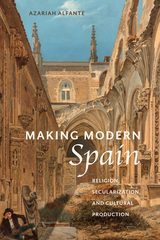
Making Modern Spain
Religion, Secularization, and Cultural Production
Azariah Alfante
Bucknell University Press, 2024
In this elegantly written study, Alfante explores the work of select nineteenth-century writers, intellectuals, journalists, politicians, and clergy who responded to cultural and spiritual shifts caused by the movement toward secularization in Spain. Focusing on the social experience, this book probes the tensions between traditionalism and liberalism that influenced public opinion of the clergy, sacred buildings, and religious orders. The writings of Cecilia Böhl de Faber (Fernán Caballero), Gustavo Adolfo Bécquer, Benito Pérez Galdós, and José María de Pereda addressed conflicts between modernizing forces and the Catholic Church about the place of religion and its signifiers in Spanish society. Foregrounding expropriation (government confiscation of civil and ecclesiastical property) and exclaustration (the expulsion of religious communities), and drawing on archival research, the history of disentailment, cultural theory, memory studies, and sociology, Alfante demonstrates how Spain’s liberalizing movement profoundly influenced class mobility and faith among the populace.
[more]

The Reframing of Realism
Galdós & the Discourses of the 19th-Century Spanish Novel
Hazel Gold
Duke University Press, 1993
In virtually every aspect of human behavior, ritual, language, and art, perceptions are organized through the act of framing. In the writing of Benito Perez Galdós, Spain's most prolific and innovative nineteenth-century novelist, Hazel Gold finds this principle insistently at work. By exploring Galdós's methods of structuring and evaluating literary and historical experience, Gold illuminates the novelist's art and uncovers the far-reaching narratological, social, and epistemological implications of his framing strategies.
A close look at Galdós's novels reveals the artist at pains to contain and interpret what he perceived to be the distinctive and often disheartening experience of bourgeois liberalism of his day. At the same time, he can be seen here undermining or negating the accepted conventions of realist fiction. Looking beyond text to context, Gold examines the ways in which Galdós's work itself has been framed by readers and critics in accordance with changing allegiances to contemporary literary theory and the canon.
The highly ambiguous status of the frame in Galdós's fictions confirms the author's own signal position as a writer poised at the limits between realism and modernity. Gold's work will command the interest of students of Spanish and comparative literature, narrative theory, and the novel, as well as all those for whom realism and representation are at issue.
A close look at Galdós's novels reveals the artist at pains to contain and interpret what he perceived to be the distinctive and often disheartening experience of bourgeois liberalism of his day. At the same time, he can be seen here undermining or negating the accepted conventions of realist fiction. Looking beyond text to context, Gold examines the ways in which Galdós's work itself has been framed by readers and critics in accordance with changing allegiances to contemporary literary theory and the canon.
The highly ambiguous status of the frame in Galdós's fictions confirms the author's own signal position as a writer poised at the limits between realism and modernity. Gold's work will command the interest of students of Spanish and comparative literature, narrative theory, and the novel, as well as all those for whom realism and representation are at issue.
[more]
READERS
Browse our collection.
PUBLISHERS
See BiblioVault's publisher services.
STUDENT SERVICES
Files for college accessibility offices.
RECENTLY PUBLISHED




UChicago Accessibility Resources
home | accessibility | search | about | contact us
BiblioVault ® 2001 - 2026
The University of Chicago Press