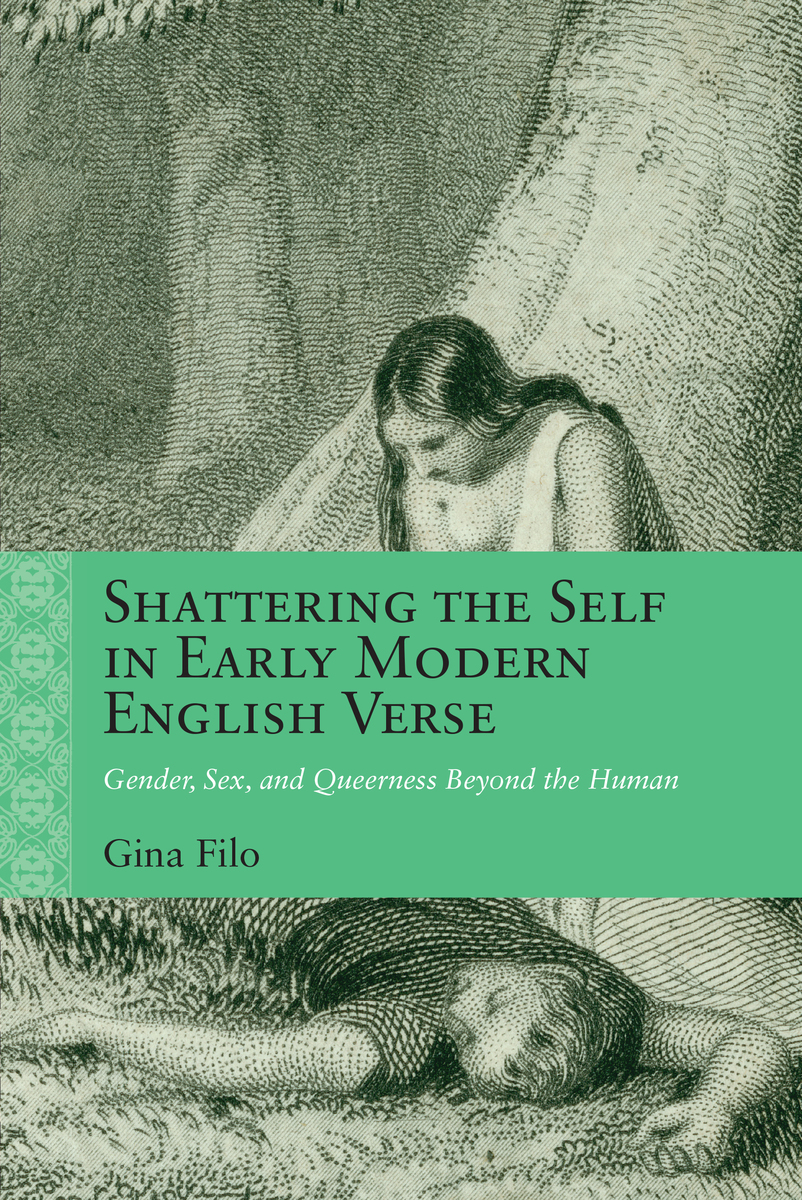
Shattering the Self in Early Modern English Verse: Gender, Sex, and Queerness Beyond the Human
Northwestern University Press, 2026
Cloth: 978-0-8101-4882-6 | Paper: 978-0-8101-4881-9 | eISBN: 978-0-8101-4883-3
Library of Congress Classification PR535.S48F55 2026
See other books on: 17th Century | Early modern, 1500-1700 | English poetry | Queer theory | Self
See other titles from Northwestern University Press
Cloth: 978-0-8101-4882-6 | Paper: 978-0-8101-4881-9 | eISBN: 978-0-8101-4883-3
Library of Congress Classification PR535.S48F55 2026
ABOUT THIS BOOK | AUTHOR BIOGRAPHY | REVIEWS | TOC | REQUEST ACCESSIBLE FILE
ABOUT THIS BOOK
Reconfiguring our understanding of early modern English erotic and literary landscapes
Rejecting the ideals of stability and sexual mastery demanded of masculine subjects, early modern English poets threw the limits of bodies and selves into question to embrace erotic experiences of genderqueer and transspecies embodiment and affiliation. Through close readings of still-canonical and lesser-read writers including William Shakespeare, John Donne, and Thomas Traherne, Gina Filo shows how these experimental encounters at the limits of the human were inextricable parts of the early modern literary and sexual imaginaries.
In its exploration of nonnormative forms of erotic attachment and embodiment, Shattering the Self in Early Modern English Verse: Gender, Sex, and Queerness Beyond the Human contributes to the burgeoning fields of early modern trans and ecocritical studies while also drawing on contemporary queer theory. Filo neither seeks to naively recuperate a fantasized past nor cedes relationality, sociality, or generativity to the normative. Instead, she shows how the embrace of erotic possibility, flexible, unstable subjectivities, and querying of the limits of “the human” were core features of early modern poetics, reconfiguring our understanding of English literary history and queer relationality today.
Rejecting the ideals of stability and sexual mastery demanded of masculine subjects, early modern English poets threw the limits of bodies and selves into question to embrace erotic experiences of genderqueer and transspecies embodiment and affiliation. Through close readings of still-canonical and lesser-read writers including William Shakespeare, John Donne, and Thomas Traherne, Gina Filo shows how these experimental encounters at the limits of the human were inextricable parts of the early modern literary and sexual imaginaries.
In its exploration of nonnormative forms of erotic attachment and embodiment, Shattering the Self in Early Modern English Verse: Gender, Sex, and Queerness Beyond the Human contributes to the burgeoning fields of early modern trans and ecocritical studies while also drawing on contemporary queer theory. Filo neither seeks to naively recuperate a fantasized past nor cedes relationality, sociality, or generativity to the normative. Instead, she shows how the embrace of erotic possibility, flexible, unstable subjectivities, and querying of the limits of “the human” were core features of early modern poetics, reconfiguring our understanding of English literary history and queer relationality today.
See other books on: 17th Century | Early modern, 1500-1700 | English poetry | Queer theory | Self
See other titles from Northwestern University Press