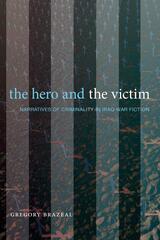
front cover of The Hero and the Victim
The Hero and the Victim
Narratives of Criminality in Iraq War Fiction
Gregory Brazeal
Lever Press, 2024
Two decades after the US invasion of Iraq in 2003, a canon of American literature about the war has begun to emerge. Gregory Brazeal’s The Hero and the Victim situates Iraq War fiction in war literature’s broader history. In contrast to the emphasis of most pre-modern war literature on the figure of the warrior-as-hero, and the growing modern emphasis on the figure of the soldier-as-victim, Iraq War fiction reflects the troubled emergence of a new narrative: the story of the ordinary soldier as a wrongdoer or even criminal. To a greater extent than earlier literature about American wars, Iraq War fiction is haunted by depictions of moral injury and expressions of unresolved guilt. 

The emphasis on soldier criminality in Iraq War fiction can be partly explained by the rise of moral cosmopolitanism and its blurring of the traditional conceptual lines between war and crime. The anti-war literature of the twentieth century often presented fallen soldiers on both sides equally as victims and viewed the distinction between heroes and villains as part of the illusion that battlefield experience strips away. Written in the long shadow of Nuremberg, Iraq War fiction grapples with the possibility that the soldiers on one’s own side may not be the heroes in the story, or even the victims, but participants in a wrong, and perhaps even complicit in crimes. The Hero and the Victim contributes to the ongoing, public reexamination of American traditions by confronting a topic that has, up to now, been largely untouched: the moral celebration of military service. 

The Hero and the Victim explores the theme of soldier criminality through close readings of several works by American authors, including Kevin Powers’s The Yellow Birds, Phil Klay’s Redeployment, Helen Benedict’s Sand Queen, Chris Kyle’s American Sniper, and Roy Scranton’s War Porn. This volume will be an essential text for students of American literature, historians of war culture, and any scholar interested in representations of the Iraq War.
[more]

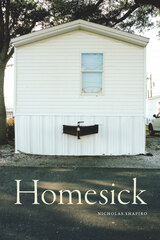
front cover of Homesick
Homesick
Nicholas Shapiro
Duke University Press, 2025
Following Hurricane Katrina, the Federal Emergency Management Agency (FEMA) distributed over 120,000 trailers for emergency housing. Produced from engineered wood containing toxic amounts of formaldehyde, these shelters were vectors of illness and death. Although they were subsequently banned, FEMA trailers were resold and again used for housing, scattering their harm to other people and areas. In Homesick, Nicholas Shapiro draws on almost fifteen years working with impacted community members to trace how the story of toxic emergency housing units expands into a story of how all of our shelters became a seat of exposure and how we can collectively struggle for cleaner indoor air. Throughout, Shapiro questions the efficacy of the fundamental tools used to cultivate accountability, repair, and change, arguing for their reimagining. Detailing health effects as well as community and individual efforts to achieve better life, health, and justice, Shapiro highlights how homesickness for an otherwise future can herald meaningful change.
[more]

front cover of Hound Dog
Hound Dog
A Song by Big Mama Thornton and Interpreted by Elvis Presley and Others
Eric Weisbard
Duke University Press, 2023
Many listeners first heard “Hound Dog” when Elvis Presley’s single topped the pop, country, and R&B charts in 1956. But some fans already knew the song from Big Mama Thornton’s earlier recording, a giant but exclusively R&B hit. In Hound Dog Eric Weisbard examines the racial, commercial, and cultural ramifications of Elvis’s appropriation of a Black woman’s anthem. He rethinks the history and influences of rock music in light of Rolling Stone's replacement of Presley’s “Hound Dog” with Thornton’s version in its 2021 “500 Greatest Songs of All Time” list. Taking readers from Presley and Thornton to Patti Page’s “Doggie in the Window,” the Stooges’ “I Wanna Be Your Dog,” and other dog ditties, Weisbard uses “Hound Dog” to reflect on one of rock’s fundamental dilemmas: the whiteness of the wail.
[more]

logo for Duke University Press
How Dungeons & Dragons Changed the Way We Play
Aaron Trammell
Duke University Press, 2026
First released in 1974, Dungeons & Dragons revolutionized game design and interactive media by allowing players to create and perform their own fictional characters in a fantasy world as expansive as their imaginations would allow. That freedom, and the rules that governed it, weren’t a creative coincidence. In How Dungeons & Dragons Changed the Way We Play, Aaron Trammell excavates the game as an artifact of a burgeoning counterculture obsessed with individualism as well as quantification. Mapping the world onto a grid, building characters whose every trait is assigned a point value, and advancing the game’s narrative through dice throws—countless core mechanics are tied to numbers. Putting the game design of D&D into dialogue with the social and political tensions of the 1970s and 80s, Trammell illuminates how the integrated quantification in the game design led to reductionism, reinforced oppressive gender and racial norms, and accustomed generations of players to the bigoted, xenophobic mores of the Cold War era. He delivers a history of both how games can shape players and how players, united by their own shared values, can shape games in turn.
[more]

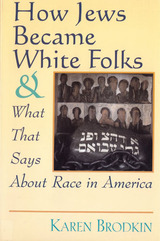
front cover of How Jews Became White Folks and What That Says About Race in America
How Jews Became White Folks and What That Says About Race in America
Brodkin, Karen
Rutgers University Press, 1998
The fashion identities in the context of a wider conversation about American nationhood, to whom it belongs and what belonging means. Race and ethnicity, class, gender, and sexuality are all staple ingredients in this conversation. They are salient aspects of social being from which economic practices, political policies, and popular discourses create "Americans." Because all of these facets of social being have such significant meaning on a national scale, they also have major consequences for both individuals and groups in terms of their success and well-being, as well as how they perceive themselves socially and politically.

The history of Jews in the United States is one of racial change that provides useful insights on race in America. Prevailing classifications have sometimes assigned Jews to the white race and at other times have created an off-white racial designation for them. Those changes in racial assignment have shaped the ways American Jews of different eras have constructed their ethnoracial identities. Brodkin illustrates these changes through an analysis of her own family's multi-generational experience. She shows how Jews experience a kind of double vision that comes from racial middleness: on the one hand, marginality with regard to whiteness; on the other, whiteness and belonging with regard to blackness.

Class and gender are key elements of race-making in American history. Brodkin suggests that this country's racial assignment of individuals and groupsconstitutes an institutionalized system of occupational and residential segregation, is a key element in misguided public policy, and serves as a pernicious foundational principle in the construction of nationhood. Alternatives available to non-white and alien "others" have been either to whiten or to be consigned to an inferior underclass unworthy of full citizenship. The American ethnoracial map-who is assigned to each of these poles-is continually changing, although the binary of black and white is not. As a result, the structure within which Americans form their ethnoracial, gender, and class identities is distressingly stable. Brodkin questions the means by which Americans construct their political identities and what is required to weaken the hold of this governing myth.
[more]

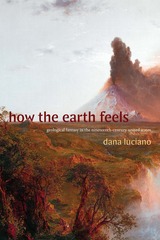
front cover of How the Earth Feels
How the Earth Feels
Geological Fantasy in the Nineteenth-Century United States
Dana Luciano
Duke University Press, 2024
In How the Earth Feels Dana Luciano examines the impacts of the new science of geology on nineteenth-century US culture. Drawing on early geological writings, Indigenous and settler accounts of earthquakes, African American antislavery literature, and other works, Luciano reveals how geology catalyzed transformative conversations regarding the intersections between humans and the nonhuman world. She shows that understanding the earth’s history geologically involved confronting the dynamic nature of inorganic matter over vast spans of time, challenging preconceived notions of human agency. Nineteenth-century Americans came to terms with these changes through a fusion of fact and imagination that Luciano calls geological fantasy. Geological fantasy transformed the science into a sensory experience, sponsoring affective and even erotic connections to the matter of the earth. At the same time, it was often used to justify accounts of evolution that posited a modern, civilized, and Anglo-American whiteness as the pinnacle of human development. By tracing geology’s relationship with biopower, Luciano illuminates how imagined connections with the earth shaped American dynamics of power, race, and colonization.
[more]

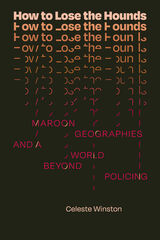
front cover of How to Lose the Hounds
How to Lose the Hounds
Maroon Geographies and a World beyond Policing
Celeste Winston
Duke University Press, 2023
In How to Lose the Hounds Celeste Winston explores marronage—the practice of flight from and placemaking beyond slavery—as a guide to police abolition. She examines historically Black maroon communities in the Maryland suburbs of Washington, DC, that have been subjected to violent excesses of police power from slavery until the present day. Tracing the long and ongoing historical geography of Black freedom struggles in the face of anti-Black police violence in these communities, Winston shows how marronage provides critical lessons for reimagining public safety and community well-being. These freedom struggles take place in what Winston calls maroon geographies—sites of flight from slavery and the spaces of freedom produced in multigenerational Black communities. Maroon geographies constitute part of a Black placemaking tradition that asserts life-affirming forms of community. Winston contends that maroon geographies operate as a central method of Black flight, holding ground, and constructing places of freedom in ways that imagine and plan a world beyond policing.
[more]

front cover of Humanity's Ruins
Humanity's Ruins
Ethics, Feminism, and Genocidal Humanitarianism
Danielle Bouchard
Duke University Press, 2025
In Humanity’s Ruins, Danielle Bouchard examines how genocidal aspirations animate contemporary Western humanitarian projects and discourses. Drawing on anticolonial and antiracist feminist critique, Bouchard argues that humanitarianism has functioned in the Cold War and post-Cold War eras to perpetuate longer-lived, fundamentally racist conceptualizations of humanity’s defining characteristics. She examines the aesthetics of humanitarian texts, which are filled with figures of the wounded, dead, and disappeared—the atomic bomb victim whose only remainder is a shadow imprinted on concrete, the grievously injured Muslim woman, the vanished members of Amazonian “uncontacted” tribes, the dying African—to elucidate how the appearance of these figures reaffirms a genocidal view of humanity that aligns with the continuation of Western imperial warfare. Humanitarian discourses conceive of humanity as a community which, by definition, is under existential threat from some humans who are explicitly or implicitly understood as needing to be eliminated. Bouchard invokes “humanity’s ruins” to expose the genocidal fantasy of a human world in which such threat has been eliminated in the interest of supposedly ensuring humanity’s survival.
[more]


Send via email Share on Facebook Share on Twitter