 A SCHOLARLY BOOK REPOSITORY
8 start with D start with D
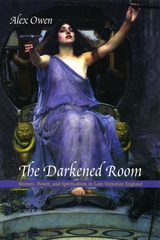
The hugely popular spiritualist movement, which maintained that women were uniquely qualified to commune with spirits of the dead, offered female mediums a new independence, authority, and potential to undermine conventional class and gender relations in the home and in society.
Using previously unexamined sources and an innovative approach, Alex Owen invokes the Victorian world of darkened séance rooms, theatrical apparitions, and moving episodes of happiness lost and regained. She charts the struggles between spiritualists and the medical and legal establishments over the issue of female mediumship, and provides new insights into the gendered dynamics of Victorian society.

“Delightful.”—Times Literary Supplement • “Intriguing.”—The Sydney Morning Herald • “Fascinating, well-illustrated.”—Nature • “Altogether surprising and hard to categorise.”—London Review of Books • “There are many stories to be told here, and Bashford tells them well.”—Literary Review
The astonishing history of palmistry and biometrics—from occult physicians to the very foundations of modern science and medicine.
Why did Isaac Newton read books on chiromancy, the occult science of hand reading that revealed the secrets of the soul? Why did Charles Darwin claim that the hand gave humans dominion over all other species? Why did psychoanalyst Charlotte Wolff climb into the primate cages of the London Zoo, taking hundreds of delicate palm prints? Why did Francis Galton, the father of fingerprinting, take palm prints too? And why did world-leading geneticists study the geometry of palm lines in their search for the secrets of chromosomal syndromes?
Decoding the Hand is an astounding history of magic, medicine, and science, of an enduring search for how our bodily surfaces might reveal an inner self—a soul, a character, an identity. From sixteenth-century occult physicians influenced by the Kabbalah to twentieth-century geneticists, and from criminologists to eugenicists, award-winning historian Alison Bashford takes us on a remarkable journey into the strange world of hand readers, revealing how signs on the hand—its shape, lines, marks, and patterns—have been elaborately decoded over the centuries. Sometimes learned, sometimes outrageously deceptive, sometimes earnest, and, more often than we ever expected, medically and scientifically trained, these palm readers of the past prove to be essential links in the human quest to peer into bodies, souls, minds, and selves. Not only for fortune-telling palmists were the future and the past, health, and character laid bare in the hand, but for other experts in bodies and minds as well: anatomists, psychiatrists, embryologists, primatologists, evolutionary biologists, geneticists, and more.
Drawing telling parallels between the divination promised by palmistry and the appeal to self-knowledge offered by modern genetic testing, Decoding the Hand also makes clear that palm-reading is far from a relic or simple charlatanism. Bashford’s sagacious history of human hands touching and connecting opens wide the essential human pursuit of what lies within and beyond.
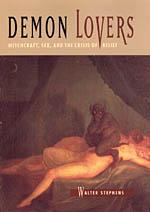
As Walter Stephens demonstrates in Demon Lovers, it was not Hausmännin or other so-called witches who were obsessive about sex with demons—instead, a number of devout Christians, including trained theologians, displayed an uncanny preoccupation with the topic during the centuries of the "witch craze." Why? To find out, Stephens conducts a detailed investigation of the first and most influential treatises on witchcraft (written between 1430 and 1530), including the infamous Malleus Maleficarum (Hammer of Witches).
Far from being credulous fools or mindless misogynists, early writers on witchcraft emerge in Stephens's account as rational but reluctant skeptics, trying desperately to resolve contradictions in Christian thought on God, spirits, and sacraments that had bedeviled theologians for centuries. Proof of the physical existence of demons—for instance, through evidence of their intercourse with mortal witches—would provide strong evidence for the reality of the supernatural, the truth of the Bible, and the existence of God. Early modern witchcraft theory reflected a crisis of belief—a crisis that continues to be expressed today in popular debates over angels, Satanic ritual child abuse, and alien abduction.
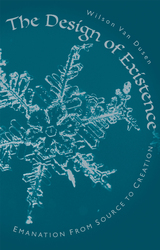
In The Design of Existence, Wilson Van Dusen offers spiritual explorers a guidebook for mystical experience, describing the inner landscape in detail. Though considering himself a scientist, Van Dusen approaches reality as a mystic, using the writings of 18th-century visionary Emanuel Swedenborg as a lens. For Swedenborg and Van Dusen, our interior realm reflects the external cosmos, which makes a mystical sense of oneness possible: "We are in a massive order, far greater than we can see. Yet we are not alien to this order. We are created out of it."
For Van Dusen's mysticism, Swedenborg is the exemplar of universality. A scientist who mastered fields as varied as chemistry, physiology, optics, and metallurgy, Swedenborg turned inward to investigate the psychological and the spiritual. He affirmed the value of other religious cultures and even wrote in gender-inclusive Latin. He had startlingly contemporary insights: he saw that the spiritual must inform everyday experience, that feelings must aid the intellect in seeking the spiritual, that the quest for the soul leads to understanding the cosmos and vice versa.
Van Dusen uses Swedenborg's ideas as the basis for a true universal mysticism. In The Design of Existence, he invites each of us to confront mystical experience as proof that we and the cosmos share a spiritual design, which orders our lives as surely as it orders the universe itself.
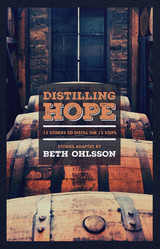
“Old stories are universal and want to be told. To bring those stories out into the world as a vehicle for navigating sobriety and recovery is a glorious thing.
I was hired to be an addictions counselor for the therapeutic community at the Frederick County Adult Detention Center. Susan Gordon encouraged me to tell them stories. I thought she was crazy, but I trusted her judgment and told them stories. The impact those stories had on those men changed my life. I worked in addictions for 15 years, taking those stories with me to very agency in which I worked. The women at the Center 4 Clean Start in Salisbury, MD were every bit as receptive to story as the men who were in jail.”
--Beth Ohlsson
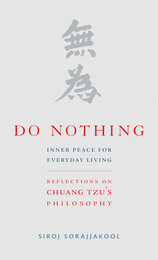
"Words," writes Chuang Tzu, "are for catching ideas; once you've caught the idea, you can forget the words." In Do Nothing, author Siroj Sorajjakool lends us some of his insightful words to help us all "catch" the provocative ideas of one of China's most important literary and philosophical giants—one who emerged at a time when China had several such giants philosophizing on Tao or "the Way."
Though his thinking dates back to the fourth century, Chuang Tzu's Tao has profound implications for our modern lives. He welcomes an existence that is radically removed from the image of normalcy that society often projects, wherein the individual must always strive for more, always seek greater productivity, and always try to better him or herself and his or her place in life. Chuang Tzu would posit that the definitions of normalcy, success, and happiness are arbitrarily assigned and that our rigid and unquestioning adherence to these so-called "norms" leads to existential restlessness and unease. Instead of striving, he would say, be still. Instead of acquiring, embrace nothingness. Instead of seeking to understand the limitlessness of the universe during your brief and extremely limited existence, enjoy the wonder of it.
Siroj Sorajjakool suggests that when we can embrace nothingness, we undergo a spiritual transformation that liberates us to see more clearly and truly find ourselves. He offers a very personal exploration of Chuang Tzu's Tao, first in its historical and literary context, and then in the context of our twenty-first century existence. What emerges is a liberating and highly readable meditation on the many lessons we can "catch" from Chuang Tzu on how we view our aspirations, our joys and sorrows, our successes and failures, and what it means to be a worthwhile person.
READERS
Browse our collection.
PUBLISHERS
See BiblioVault's publisher services.
STUDENT SERVICES
Files for college accessibility offices.
RECENTLY PUBLISHED


UChicago Accessibility Resources
home | accessibility | search | about | contact us
BiblioVault ® 2001 - 2026
The University of Chicago Press