
 A SCHOLARLY BOOK REPOSITORY
9 start with D start with D
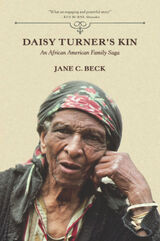
In 1983, folklorist Jane Beck began a series of interviews with Turner, then one hundred years old and still relating four generations of oral history. Beck uses Turner's storytelling to build the Turner family saga, using at its foundation the oft-repeated touchstone stories at the heart of their experiences: the abduction into slavery of Turner's African ancestors; Daisy's father Alec Turner learning to read; his return as a soldier to his former plantation to kill his former overseer; and Daisy's childhood stand against racism. Other stories re-create enslavement and her father's life in Vermont--in short, the range of life events large and small, transmitted by means so alive as to include voice inflections. Beck, at the same time, weaves in historical research and offers a folklorist's perspective on oral history and the hazards--and uses--of memory.
Publication of this book is supported by grants from the Andrew W. Mellon Foundation and the L. J. and Mary C. Skaggs Folklore Fund.
One privateer was given an extraordinary task: to sail across the Atlantic to attack British slave trading posts and ships on the coast of West Africa. Based on a little-known contemporary primary source, The Journal of the Good Ship Marlborough, the story of this remarkable voyage is told here for the first time and will have a major impact on our understanding of the Atlantic slave trade and the American Revolution. The voyage of the Marlborough was the brainchild of John Brown, a prominent Rhode Island merchant—and an investor in two slave trading voyages himself. The motivation was not altruistic. The officers and crew of the Marlborough wanted to advance the cause of independence from Britain through harming Britain’s economy, but they also desired to enrich themselves by selling the plunder they captured—including enslaved Africans.
The work of the Marlborough and other American privateers was so disruptive that it led to an unintended consequence: virtually halting the British slave trade. British slave merchants, alarmed at losing money from their ships being captured, invested in many fewer slave voyages. As a result tens of thousands of Africans were not forced onto slave ships, transported to the New World, and consigned to a lifetime of slavery or an early death.
In Dark Voyage: An American Privateer’s War on Britain’s African Slave Trade, veteran researcher and writer Christian McBurney recreates the harrowing voyage of the Marlborough, while placing it in the context of Atlantic World slavery. In Africa, Marlborough’s officers come across an array of African and European slave traders willing to assist them in attacking the British. This book is also the first study to detail the many captures American privateers made of British slave ships during the Revolutionary War.

Brown’s lifespan covered most of the period between the Revolution and the Civil War, a time of the still-early beginnings of the United States. Only then had his kind of “celebrity” started to matter. From different economic and moral perspectives, politically aware Americans clashed over different visions for the future of the country. At that time, any disruptive figure might be taken as a barometer of the progress or the decline of the republic. A function of the widely varying newspapers and magazines of that day, celebrity offered Americans an angle of vision, happily or not, as to who they were or were becoming or believed themselves to be—as if by a mirror reflection.
In The Day They Hanged Old Brown, John Van Atta examines the creation of celebrity in John Brown’s time and how it differed from modern day perceptions. Yet, as applicable as the concept of celebrity is in this case, the story of Brown’s notoriety represents far more. To his admirers, Brown was not merely a celebrity; he was a hero and, after his sacrificial death, a martyr. Not all celebrities rise to such levels. This book traces the meaning of heroism and martyrdom—as well as the opposite side of that coin, villainy—and suggests that John Brown’s story and legacy helped to redefine these concepts for many Americans during the era of the Civil War, before modern historians began to deliberate him.
During the drafting of the Declaration of Independence in 1776, Thomas Jefferson and enslaved valet Robert Hemmings spent several months at 700 Market Street in Philadelphia. The editors and contributors to Declaration House reflect on the history of this site and illuminate the entangled legacy of freedom and enslavement at the core of our nation’s founding. They expand our history by revisiting and mapping this historic place in the city and nation, past and present, as a way to tend to our democracy today.
At the center of the book is artist Sonya Clark’s revelatory public artwork “The Descendants of Monticello,” a multichannel video installation created in collaboration with Hemmings’ collateral descendants and others who are related to the hundreds of people enslaved at Monticello. Interviews and essays about the project and the site consider history, memory, and the founding of our country. Like Clark’s project, Declaration House asks the timely question, "What does the Declaration of Independence mean to us today?"
Contributors: Niya Bates, Kerry Bickford, Paul Buchanan, Sonya Clark, Andrew M. Davenport, Kai Davis, Husnaa Haajarah Hashim, J. Calvin Jefferson Sr., Jabari Jefferson, Jane Kamensky, Matthew Kenyatta, Salamishah Tillet, Gayle Jessup White, Auriana Woods, and the editors
In 2015, students at the University of Cape Town demanded the removal of a statue of Cecil Rhodes, the imperialist, racist business magnate, from their campus. Their battle cry, #RhodesMustFall, sparked an international movement calling for the decolonization of universities all over the world.
Today, as the movement develops beyond the picket line, how might it go on to radically transform the terms upon which universities exist? In this book, students, activists, and scholars discuss the possibilities and the pitfalls of doing decolonial work in the heart of the establishment. Subverting curricula, demanding diversity, and destroying old boundaries, this is a radical call for a new era of education. Chapters include:
*Rhodes Must Fall: Oxford and Movements for Change (Dalia Febrial)
*Race and the Neoliberal University ((John Holmwood)
*Black/Academia (Robbie Shilliam)
*The Challenge for Black Studies in the Neoliberal University (Kehinde Andrews)
*Open Initiatives for Decolonising the Curriculum (Pat Lockley)
*Decolonising Education: A Pedagogic Intervention (Carol Azumah Dennis)
*Understanding Eurocentrism as a Structural Problem of Undone Science (William Jamal Richardson)
As the book’s insightful Introduction states, "Taking colonialism as a global project as a starting point, it becomes difficult to turn away from the Western university as a key site through which colonialism—and colonial knowledge in particular—is produced, consecrated, institutionalized and naturalized." Offering resources for students and academics to challenge and resist colonialism inside and outside the classroom, Decolonizing the University provides the tools for radical change in educational disciplines, pedagogies, and institutions.
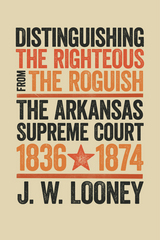
During the period from 1836 to 1874, the legal system in the new state of Arkansas developed amid huge social change. While the legislature could, and did, determine what issues were considered of importance to the populace, the Arkansas Supreme Court determined the efficacy of legislation in cases involving land titles, banks, transportation, slavery, family law, property, debt, contract, criminal law, and procedure.
Distinguishing the Righteous from the Roguish examines the court’s decisions in this era and shows how Arkansas, as a rural slave-holding state, did not follow the transformational patterns typical of some other states during the nineteenth century. Rather than using the law to promote broad economic growth and encourage social change, the Arkansas court attempted to accommodate the interests of the elite class by preserving the institution of slavery. The ideology of paternalism is reflected in the decisions of the court, and Looney shows how social and political stability—an emphasis on preserving the status quo of the so-called “righteous”—came at the expense of broader economic development.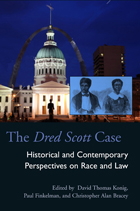
In 1846 two slaves, Dred and Harriet Scott, filed petitions for their freedom in the Old Courthouse in St. Louis, Missouri. As the first true civil rights case decided by the U.S. Supreme Court, Dred Scott v. Sandford raised issues that have not been fully resolved despite three amendments to the Constitution and more than a century and a half of litigation.
The Dred Scott Case: Historical and Contemporary Perspectives on Race and Law presents original research and the reflections of the nation’s leading scholars who gathered in St. Louis to mark the 150th anniversary of what was arguably the most infamous decision of the U.S. Supreme Court. The decision, which held that African Americans “had no rights” under the Constitution and that Congress had no authority to alter that, galvanized Americans and thrust the issue of race and law to the center of American politics. This collection of essays revisits the history of the case and its aftermath in American life and law. In a final section, the present-day justices of the Missouri Supreme Court offer their reflections on the process of judging and provide perspective on the misdeeds of their nineteenth-century predecessors who denied the Scotts their freedom.
Contributors: Austin Allen, Adam Arenson, John Baugh, Hon. Duane Benton, Christopher Alan Bracey, Alfred L. Brophy, Paul Finkelman, Louis Gerteis, Mark Graber, Daniel W. Hamilton, Cecil J. Hunt II, David Thomas Konig, Leland Ware, Hon. Michael A. Wolff

The Dutch Atlantic interrogates the Dutch involvement in Atlantic slavery and assesses the historical consequences of this for contemporary European society.
Kwame Nimako and Glenn Willemsen show how the slave trade and slavery intertwined economic, social and cultural elements, including nation-state formation in the Netherlands and across Europe. They explore the mobilisation of European populations in the implementation of policies that facilitated Atlantic slavery and examine how European countries created and expanded laws that perpetuated colonisation.
Addressing key themes such as the incorporation of the formerly enslaved into post-slavery states and contemporary collective efforts to forget and/or remember slavery and its legacy in the Netherlands, this is an essential text for students of European history and postcolonial studies.
READERS
Browse our collection.
PUBLISHERS
See BiblioVault's publisher services.
STUDENT SERVICES
Files for college accessibility offices.
RECENTLY PUBLISHED





UChicago Accessibility Resources
home | accessibility | search | about | contact us
BiblioVault ® 2001 - 2026
The University of Chicago Press