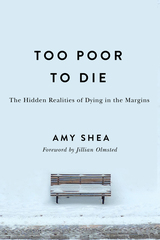
"Thoughtful and insightful, and backed up by solid research, Shea's collection of essays comfortably sits at the intersection of the personal and the critical. Too Poor to Die is an important narrative meditation on a difficult topic in American life: the uncertain, overlooked fate of unhoused people facing death."— Ethan Gildorf, author of Fantasy Freaks and Gaming Geeks
"This subject is more important than ever as funeral costs continue to rise and an increasing death rate puts more pressure on funeral homes to do more with the same facilities. I'm proud to see Amy join the ranks of those fighting for respectful services at fair costs in this industry fraught with misinformation and ballooning expenses. The work to balance the wishes of the dying with the economics of the businesses striving to provide these services is complicated and worth paying attention to before the time comes for your family to encounter funeral homes yourself."— Casey Husseman Brandt, Executive Director of The People's Memorial
"An unflinching and illuminating look at subjects that our culture too often sweep under the rug but can no longer afford to ignore. Shea's prose glimmers with creativity, compassion, and intelligence."— Justin Hocking, author of A Field Guide to the Subterranean
"Shea cares a great deal about those for whom society tends to care so little. WithToo Poor to Die, she has crafted a poignant and exacting exploration of the intersection between marginal existence and end-of-life care—the embodiment of death-positive thinking and socially conscious research. It's a heart swell and a wake-up call."— Christopher Notarnicola, contributor, The Best American Essays 2017
"Shea deftly examines how our society fails those who live on the margins, both in life and in death. This compassionate and unflinching book will break your heart for the better."— Beth Winegarner, author of San Francisco's Forgotten Cemeteries: A Buried History
"In her powerful book, Shea captures the many indignities and challenges that the unhoused and disenfranchised individuals among us experience, bringing these into sharp, undeniable focus. She also shares hope, in the form of the many caring people and programs seeking to restore that dignity and, most importantly, among the unhoused and poverty-stricken individuals themselves as they seize their own sources of joy, meaning, and advocacy." — Jeannie Meyer, clinical nurse specialist for palliative care at UCLA Health
"An urgently needed book that challenges many of the end-of-life assumptions that run rampant across the seemingly nonstop death and dying self-help industrial publishing complex. Too few books actually take the time to discuss what actually happens when you die homeless, alone, and without contactable immediate family, let alone how just because a person is homeless doesn't mean they aren't loved, grieved, or missed."— John Troyer, Centre for Death and Society at the University of Bath
"This book is essential reading for anyone wanting or needing to know more about how we can understand and support those who are dying, especially people experiencing poverty. Well researched and personally grounded, these essays are also acts of, and a template for, activism."— Elizabeth Reeder, author of Microbursts
"Shea pulls no punches in illustrating the 'raw reality of poverty and homelessness in death' so that we can better understand the inequities and disparities, and inspire change. With heart and detail, she takes us on her journey of first-hand learning about
the social and cultural problems associated with who is 'deserving' of dignity, close to death and once dead. . . .Too Poor to Die is for anyone who is interested in social injustices in our society."
— Laura Carroll, Laura Carroll's Blog
"Shea explores the political economy of death and its management within a system that cares little for the marginalized and where dying with dignity has become one more human right turned into an expensive luxury. Too Poor to Die blends personal narrative, sociology, and documentary research to draw a portrait of lives on the margins of a society that continually neglects them, even after death. Shea resists any sentimental portraits of poverty, instead honing in on a granular, personal engagement that emphasizes the humanity of those struggling to live and die with dignity. She shows how the act of witnessing can honor the lives of those who might otherwise become yet one more statistic, one more name on a list of the forgotten. Such attentiveness is an act of care that adds urgency to the clear need for rethinking how dying is embedded in living and how dying with dignity requires attention to the lives and living conditions of all."— David Buuck, author of Noise in the Face of