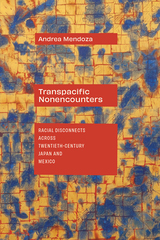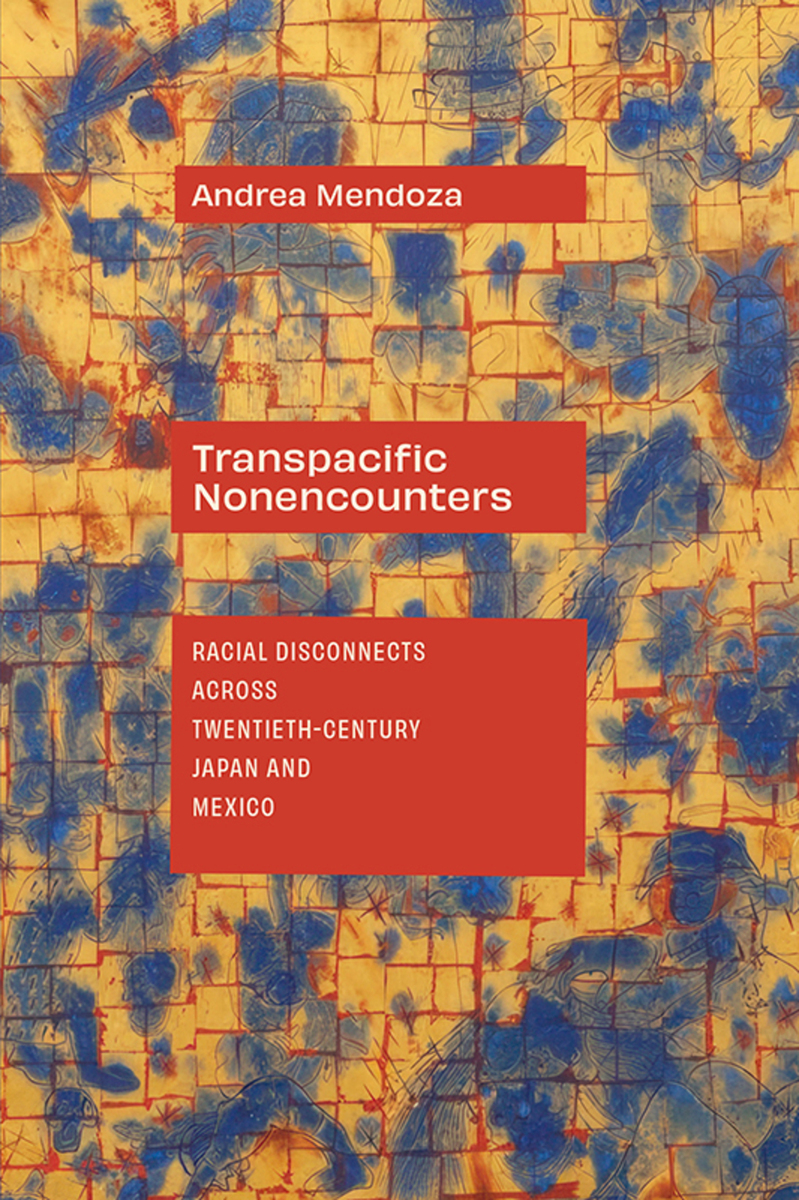
Transpacific Nonencounters: Racial Disconnects Across Twentieth-Century Japan and Mexico
Duke University Press, 2026
Cloth: 978-1-4780-3373-8 | Paper: 978-1-4780-3862-7 | eISBN: 978-1-4780-9459-3 (OA) | eISBN: 978-1-4780-6220-2 (standard)
Library of Congress Classification PL720.55.M6M463 2026
See other books on: Asian Studies | Comparative literature | Japanese literature | Nationalism in literature | Race in literature
See other titles from Duke University Press
Cloth: 978-1-4780-3373-8 | Paper: 978-1-4780-3862-7 | eISBN: 978-1-4780-9459-3 (OA) | eISBN: 978-1-4780-6220-2 (standard)
Library of Congress Classification PL720.55.M6M463 2026
ABOUT THIS BOOK | AUTHOR BIOGRAPHY | REVIEWS | TOC | REQUEST ACCESSIBLE FILE
ABOUT THIS BOOK
In Transpacific Nonencounters, Andrea Mendoza works across the seemingly unconnected histories of race and nation in modern Mexico and Japan, showing the commonalities in the way race figures in their state and social formations through a method Mendoza calls the theory of nonencounter. Intellectual and cultural productions of racial knowledge were important for the formation of the modernizing Mexican and Japanese states at the beginning of the twentieth century and helped conceive the project of national modernity through ideologies that promoted multiracial and multiethnic belonging—mestizaje and Pan-Asian co-prosperity. Despite the diasporic, economic, and political points of contact that connected these states throughout the twentieth century, however, traditional Eurocentric comparative and area-based studies treat the formations and legacies of Mexican mestizo nationalism and Japanese imperialism as wholly unrelated phenomena. Transpacific Nonencounters proposes a theory of nonencounter to formulate the logic of disciplinary disconnection, offering a framework and hermeneutic for a transpacific account of how Japanese imperialism and Mexican mestizo settler nationalism structured and reinforced one another through the modern formations of race and racism.
See other books on: Asian Studies | Comparative literature | Japanese literature | Nationalism in literature | Race in literature
See other titles from Duke University Press