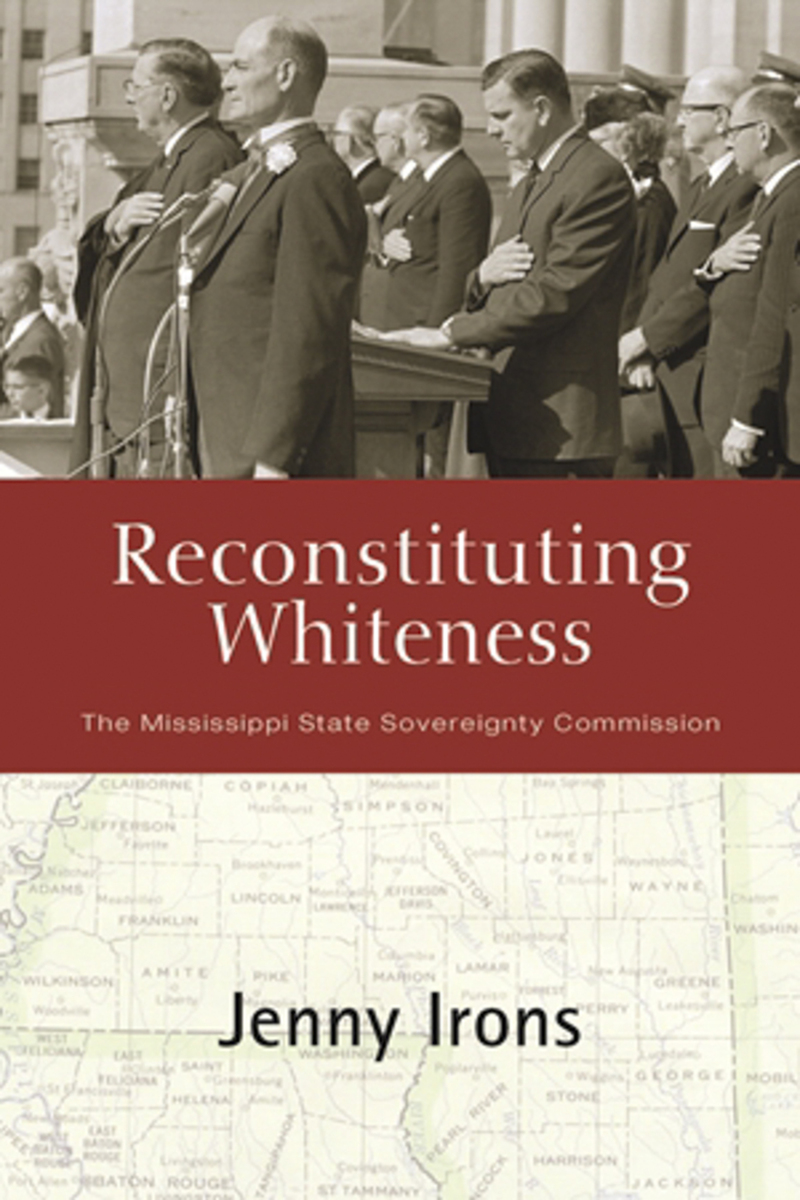
Reconstituting Whiteness: The Mississippi State Sovereignty Commission
Vanderbilt University Press, 2010
Cloth: 978-0-8265-1685-5 | eISBN: 978-0-8265-1687-9 (PDF)
Library of Congress Classification F350.A1I76 2010
Dewey Decimal Classification 305.809076209045
Cloth: 978-0-8265-1685-5 | eISBN: 978-0-8265-1687-9 (PDF)
Library of Congress Classification F350.A1I76 2010
Dewey Decimal Classification 305.809076209045
ABOUT THIS BOOK | AUTHOR BIOGRAPHY | REVIEWS | TOC
ABOUT THIS BOOK
In Reconstituting Whiteness, sociologist Jenny Irons explores the tactics and legacy of the Mississippi State Sovereignty Commission, an agency of the state that existed from 1956 to 1977 and was devoted exclusively to defending and supporting the institution of segregation. Using a myriad of surveillance and public relations efforts, the commission was unique in its expanse and resistance during a time of change.
Going far beyond a mere institutional history, however, Irons uses the commission as a tool to explore the intersection of state-organized defense of white supremacy and the dramatically shifting racial constructs of the civil rights era. Ultimately, the commission failed to protect segregation, but as a state entity, it adapted racism in new terms.
Reconstituting Whiteness is an insightful study of the methods Mississippi state government used to move the goal posts of what was considered "decent" and "acceptable" white supremacy and racism, as it raced against time to define whiteness while the boundaries of segregation fell all around it.
Going far beyond a mere institutional history, however, Irons uses the commission as a tool to explore the intersection of state-organized defense of white supremacy and the dramatically shifting racial constructs of the civil rights era. Ultimately, the commission failed to protect segregation, but as a state entity, it adapted racism in new terms.
Reconstituting Whiteness is an insightful study of the methods Mississippi state government used to move the goal posts of what was considered "decent" and "acceptable" white supremacy and racism, as it raced against time to define whiteness while the boundaries of segregation fell all around it.
See other books on: 1951- | Civil Rights | Mississippi | States' rights (American politics) | White supremacy movements
See other titles from Vanderbilt University Press