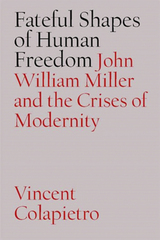
Fateful Shapes of Human Freedom: John William Miller and the Crises of Modernity
Vanderbilt University Press, 2003
Cloth: 978-0-8265-1409-7 | Paper: 978-0-8265-1433-2 | eISBN: 978-0-8265-9157-9 (PDF)
Library of Congress Classification B945.M4764C65 2003
Dewey Decimal Classification 191
Cloth: 978-0-8265-1409-7 | Paper: 978-0-8265-1433-2 | eISBN: 978-0-8265-9157-9 (PDF)
Library of Congress Classification B945.M4764C65 2003
Dewey Decimal Classification 191
ABOUT THIS BOOK | AUTHOR BIOGRAPHY | REVIEWS | TOC
ABOUT THIS BOOK
John William Miller's radical revision of the idealistic tradition anticipated some of the most important developments in contemporary thought, developments often associated with thinkers like Heidegger, Benjamin, Foucault, Derrida, and Rorty. In this study, Vincent Colapietro situates Miller's powerful but neglected corpus not only in reference to Continental European philosophy but also to paradigmatic figures in American culture like Lincoln, Emerson, Thoreau, and James.
The book is not simply a study of a particular philosopher or a single philosophical movement (American idealism). It is rather a philosophical confrontation with a cluster of issues in contemporary life. These issues revolve around such topics as the grounds and nature of authority, the scope and forms of agency, and the fateful significance of historical place. These issues become especially acute given Colapietro's insistence that the only warrant for our practices is to be found in these historically evolved and evolving practices themselves.