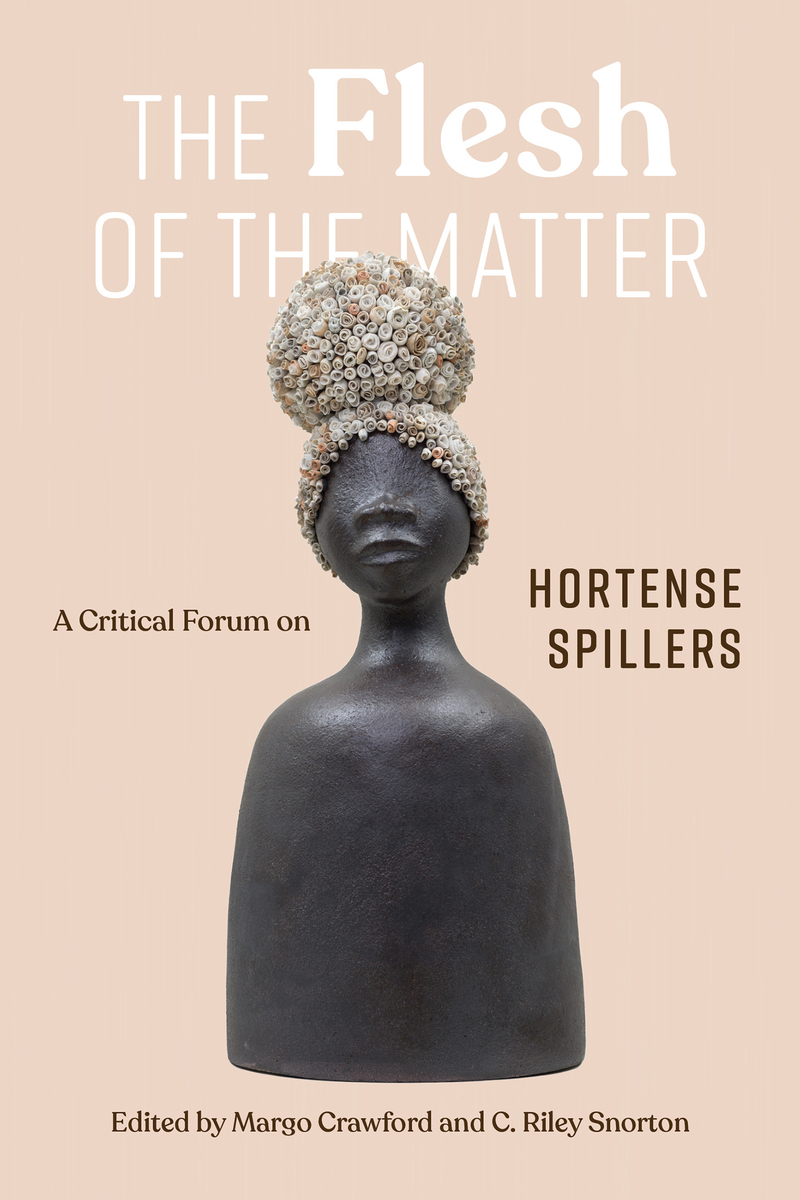
The Flesh of the Matter: A Critical Forum on Hortense Spillers
Vanderbilt University Press, 2024
Cloth: 978-0-8265-0750-1 | Paper: 978-0-8265-0749-5 | eISBN: 978-0-8265-0751-8 (ePub) | eISBN: 978-0-8265-0752-5 (PDF)
Library of Congress Classification PN75.S64F58 2024
Dewey Decimal Classification 801.95092
Cloth: 978-0-8265-0750-1 | Paper: 978-0-8265-0749-5 | eISBN: 978-0-8265-0751-8 (ePub) | eISBN: 978-0-8265-0752-5 (PDF)
Library of Congress Classification PN75.S64F58 2024
Dewey Decimal Classification 801.95092
ABOUT THIS BOOK | AUTHOR BIOGRAPHY | REVIEWS | TOC
ABOUT THIS BOOK
PROSE Awards Category Winner—Media and Cultural Studies, 2025
Hortense Spillers is one of the most important literary critics and Black feminist scholars of the last fifty years. Her 1987 scholarly article “Mama’s Baby, Papa’s Maybe: An American Grammar Book” is one of the most-cited essays in African American literary studies.
Edited by Margo Natalie Crawford and C. Riley Snorton, The Flesh of the Matter: A Critical Forum on Hortense Spillers is the first collection to take up directly how Spillers’s writing on literature, culture, and theory have been signal posts to the varied and universal threads of Black thought, as well as countless other areas of the academy. Interspersed with archival fragments from Spillers’s papers kept at the Pembroke Center for Feminist Thought at Brown University, the fourteen essays in this collection demonstrate a fidelity to the ways of reading Spillers has taught us, the nomenclature of enslavement keyed into the American lexicon, and the ways that history permeates our cultural boundaries today.
Hortense Spillers is one of the most important literary critics and Black feminist scholars of the last fifty years. Her 1987 scholarly article “Mama’s Baby, Papa’s Maybe: An American Grammar Book” is one of the most-cited essays in African American literary studies.
Edited by Margo Natalie Crawford and C. Riley Snorton, The Flesh of the Matter: A Critical Forum on Hortense Spillers is the first collection to take up directly how Spillers’s writing on literature, culture, and theory have been signal posts to the varied and universal threads of Black thought, as well as countless other areas of the academy. Interspersed with archival fragments from Spillers’s papers kept at the Pembroke Center for Feminist Thought at Brown University, the fourteen essays in this collection demonstrate a fidelity to the ways of reading Spillers has taught us, the nomenclature of enslavement keyed into the American lexicon, and the ways that history permeates our cultural boundaries today.
See other books on: Crawford, Margo Natalie | Flesh | Gumbs, Alexis Pauline | Matter | Moten, Fred
See other titles from Vanderbilt University Press