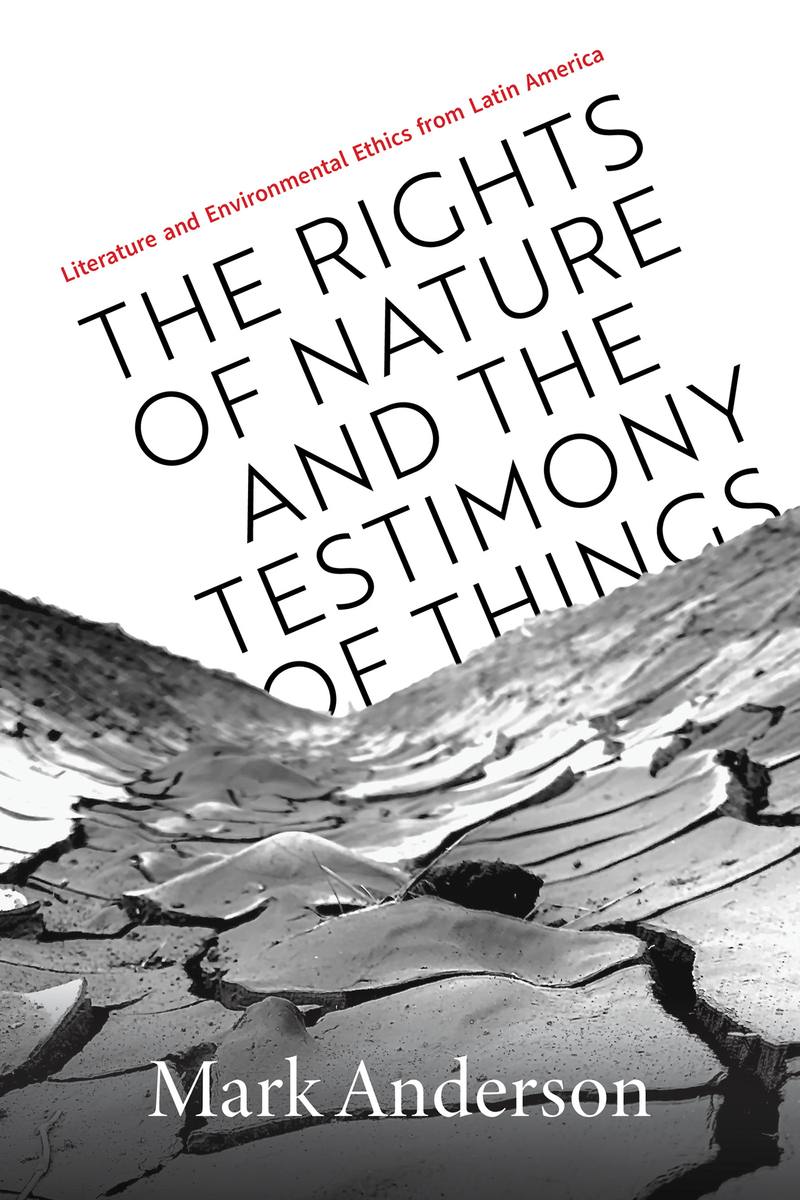
The Rights of Nature and the Testimony of Things: Literature and Environmental Ethics from Latin America
Vanderbilt University Press, 2024
Cloth: 978-0-8265-0678-8 | Paper: 978-0-8265-0677-1 | eISBN: 978-0-8265-0679-5 (ePub) | eISBN: 978-0-8265-0680-1 (PDF)
Library of Congress Classification PN849.L29
Dewey Decimal Classification 860.998
Cloth: 978-0-8265-0678-8 | Paper: 978-0-8265-0677-1 | eISBN: 978-0-8265-0679-5 (ePub) | eISBN: 978-0-8265-0680-1 (PDF)
Library of Congress Classification PN849.L29
Dewey Decimal Classification 860.998
ABOUT THIS BOOK | AUTHOR BIOGRAPHY | REVIEWS | TOC
ABOUT THIS BOOK
The Rights of Nature and the Testimony of Things begins by analyzing the ethical debates and political contexts relating to Latin American “rights of nature” legislation and the political ontology of nonhuman speech within a framework of intercultural and multispecies diplomacy. Author Mark Anderson shows how Latin American authors and thinkers complicate traditional humanistic perspectives on nature, the social, and politics, exploring how animals, plants, and environments as a whole might be said to engage in social relations and political speech or self-representation.
Drawing Native Amazonian thought into productive tension with a variety of posthumanist theoretical frameworks—ranging from Derrida’s conceptualization of passive decision and hospitality to biosemiotics, Karen Barad’s theorization of intra-activity, and Isabelle Stengers’ proposal for cosmopolitical diplomacy—Anderson analyzes literary works by Julio Cortázar, Clarice Lispector, José Eustasio Rivera, and Davi Kopenawa that reframe environmental ethics in terms of collective, multispecies work and reciprocal care and politics as a cosmopolitics of friendship rooted in diplomacy across difference. Finally, Anderson examines the points of connection and divergences between Latin American relational ontologies and Euro American posthumanist theories within Indigenous Latin American remodernization projects that reappropriate and repurpose ancestral practices as well as develop new technologies with the goal of forging alternative modernities compatible with a livable future for all species.
Drawing Native Amazonian thought into productive tension with a variety of posthumanist theoretical frameworks—ranging from Derrida’s conceptualization of passive decision and hospitality to biosemiotics, Karen Barad’s theorization of intra-activity, and Isabelle Stengers’ proposal for cosmopolitical diplomacy—Anderson analyzes literary works by Julio Cortázar, Clarice Lispector, José Eustasio Rivera, and Davi Kopenawa that reframe environmental ethics in terms of collective, multispecies work and reciprocal care and politics as a cosmopolitics of friendship rooted in diplomacy across difference. Finally, Anderson examines the points of connection and divergences between Latin American relational ontologies and Euro American posthumanist theories within Indigenous Latin American remodernization projects that reappropriate and repurpose ancestral practices as well as develop new technologies with the goal of forging alternative modernities compatible with a livable future for all species.
See other books on: Ecocriticism | Ecology in literature | Ethics in literature | Latin American literature | Rights
See other titles from Vanderbilt University Press