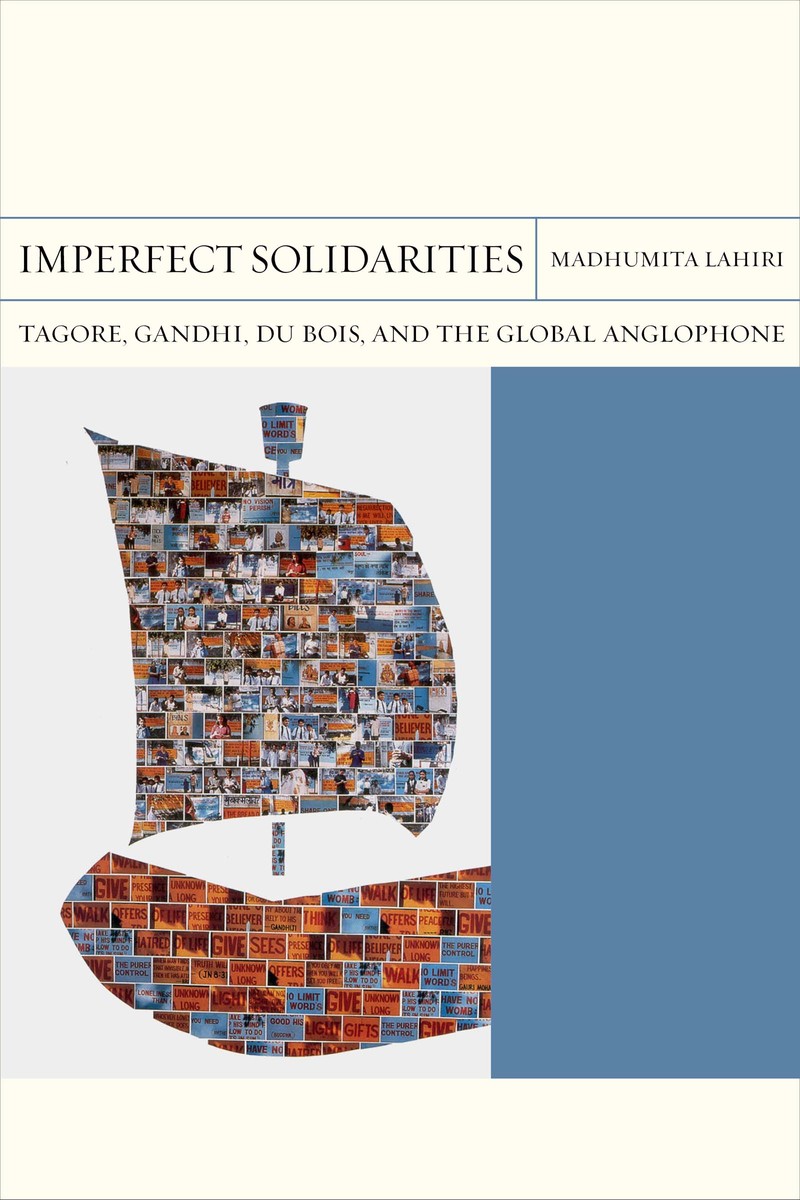
“This beautifully written and deeply insightful book on anticolonial neologisms and ‘print internationalism’ gives light to the connection between language and revolution. Indispensable reading for anyone with an interest in the textual and literary stakes of postcolonial studies.” —Leela Gandhi, author of The Common Cause: Postcolonial Ethics and the Practice of Democracy, 1900–1950
— -
“This book constitutes an important intervention into current debates on world and transnational literature by providing a new and completely original take on the idea of the ‘global Anglophone,’ a concept that this project rescues from its current anodyne interpretation . . . By complicating current ideas of internationalism, the book distinguishes itself by paying attention to the difficulties, embarrassments, and contradictions of transnational ventures. In contrast to romantic ideas of global anti-imperial solidarity, this book meticulously demonstrates a more complicated and interesting picture.” —Isabel Hofmeyr, author of Gandhi’s Printing Press: Experiments in Slow Reading — -
“Put aside misgivings about writing ‘in the language of the colonizer.’ In this astonishing book Madhumita Lahiri shows just how print internationalism, female agency, and the English language could be mobilized to write against Anglo-American hegemony at its apex. ’Imperfect’ though they may have been, Tagore, Gandhi and Du Bois challenged racism and the almighty dollar by inventing new cosmopolitan publics, linking South to South in ways we must learn from today.” —Haun Saussy, author of Are We Comparing Yet? and translator of Jean Métellus’s When the Pipirite Sings (Northwestern, 2019)
“One of the most valuable contributions of this volume is its attention to a broad array of archival sources—periodicals, speeches, multiple editions—that give a sense of the media specificity of print internationalism. But because the core texts and figures are so well known, Lahiri’s major contribution is not so much the ‘what’ of what we are reading, but the ‘how.’ Throughout the text, Lahiri calls on us to employ a more careful, perhaps more generous form of reading than the pursuit of political resolution and ‘normative tone’ she claims emerges from traditional postcolonial analyses. In contrast, she attempts to rehabilitate the ‘sociability of reading’ through which differently situated readers would have encountered each other in these textual spaces: reading ‘not with or against the grain, but from somewhere—or, ideally, from two places at once.’” —Roanne Kantor, Comparative Literature
“Lahiri’s reading practice is admirably dialectical while also noting the instrumental role that women played in the work of the three luminaries she examines: specifically, Jessie Redmon Fauset with Du Bois, Sister Nivedita (née Margaret Noble) with Tagore, and Sonja Schlesin with Gandhi.” —Bassam Sidiki, Pyriscence
— -
“Put aside misgivings about writing ‘in the language of the colonizer.’ In this astonishing book Madhumita Lahiri shows just how print internationalism, female agency, and the English language could be mobilized to write against Anglo-American hegemony at its apex. ’Imperfect’ though they may have been, Tagore, Gandhi and Du Bois challenged racism and the almighty dollar by inventing new cosmopolitan publics, linking South to South in ways we must learn from today.” —Haun Saussy, author of Are We Comparing Yet? and translator of Jean Métellus’s When the Pipirite Sings (Northwestern, 2019)
“One of the most valuable contributions of this volume is its attention to a broad array of archival sources—periodicals, speeches, multiple editions—that give a sense of the media specificity of print internationalism. But because the core texts and figures are so well known, Lahiri’s major contribution is not so much the ‘what’ of what we are reading, but the ‘how.’ Throughout the text, Lahiri calls on us to employ a more careful, perhaps more generous form of reading than the pursuit of political resolution and ‘normative tone’ she claims emerges from traditional postcolonial analyses. In contrast, she attempts to rehabilitate the ‘sociability of reading’ through which differently situated readers would have encountered each other in these textual spaces: reading ‘not with or against the grain, but from somewhere—or, ideally, from two places at once.’” —Roanne Kantor, Comparative Literature
“Lahiri’s reading practice is admirably dialectical while also noting the instrumental role that women played in the work of the three luminaries she examines: specifically, Jessie Redmon Fauset with Du Bois, Sister Nivedita (née Margaret Noble) with Tagore, and Sonja Schlesin with Gandhi.” —Bassam Sidiki, Pyriscence
“Lahiri’s concern with the past is but only to propose a comradeship for the present and the future. She is commendable with her research and her detailed depiction of minute instances in favour of her proposition.” —Ayan Chakraborty, Journal of Comparative Literature and Aesthetics— -