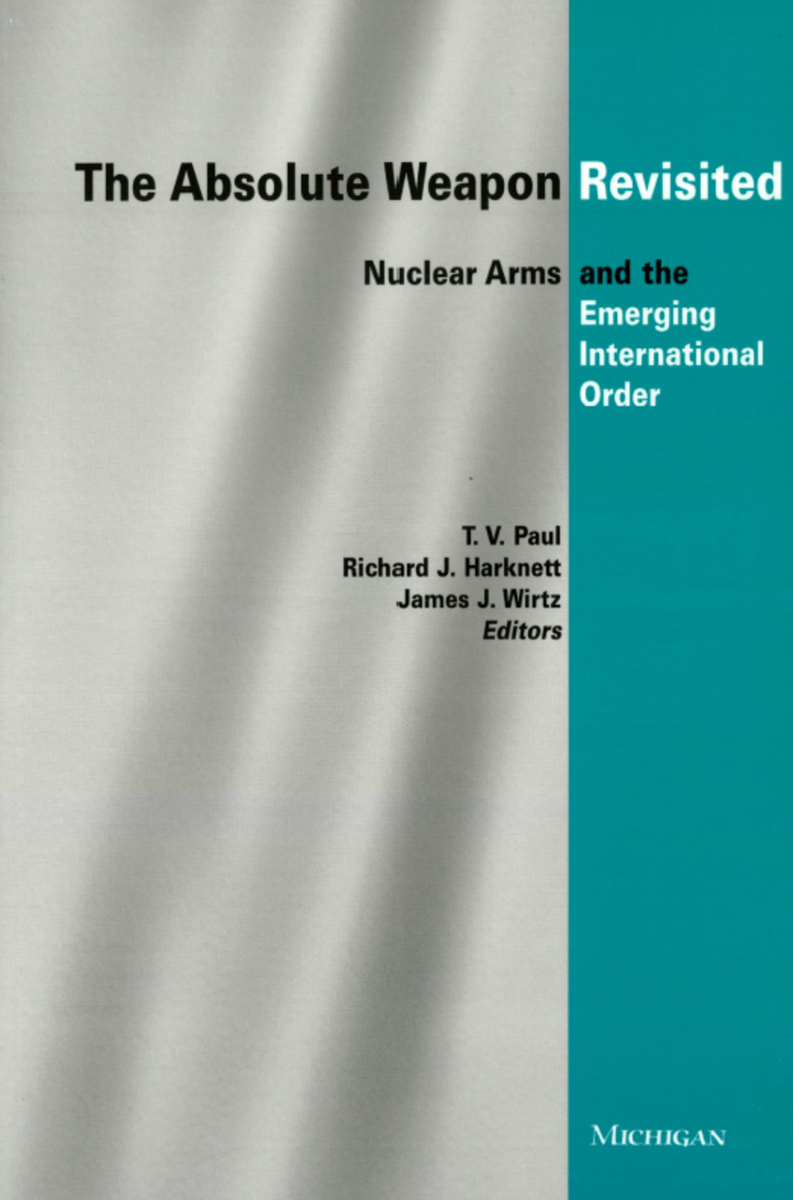
The Absolute Weapon Revisited: Nuclear Arms and the Emerging International Order
University of Michigan Press, 2000
Cloth: 978-0-472-10863-3 | Paper: 978-0-472-08700-6 | eISBN: 978-0-472-22395-4 (standard)
Library of Congress Classification U264.A27 1998
Dewey Decimal Classification 327.1747
Cloth: 978-0-472-10863-3 | Paper: 978-0-472-08700-6 | eISBN: 978-0-472-22395-4 (standard)
Library of Congress Classification U264.A27 1998
Dewey Decimal Classification 327.1747
ABOUT THIS BOOK | AUTHOR BIOGRAPHY | REQUEST ACCESSIBLE FILE
ABOUT THIS BOOK
Soon after nuclear weapons devastated the Japanese cities of Hiroshima and Nagasaki, Bernard Brodie and several colleagues wrote The Absolute Weapon, which predicted that the atomic bomb would revolutionize international politics. In The Absolute Weapon Revisited, a group of noted scholars explores the contemporary role of nuclear weapons in the world after the end of the Cold War. Although superpower rivalry has faded, the complexities of living with nuclear weapons remain. Working from different theoretical perspectives, the contributors offer a set of provocative assessments of nuclear deterrence and the risks of nuclear proliferation and disarmament. Some argue that assured destruction capabilities remain important, while others argue that nuclear deterrence will be increasingly irrelevant. Arms control, crisis stability, and continuity and change in nuclear doctrine as well as new issues such as virtual nuclear states and information warfare, are some of the issues addressed by the contributors to The Absolute Weapon Revisited. The contributors are Zachary Davis, Colin S. Gray, Richard J. Harknett, Ashok Kapur, Robert Manning, William C. Martel, Eric Mlyn, John Mueller, J. V. Paul, George Quester, and James J. Wirtz. This book will be of interest to scholars, policymakers and students interested in issues of nuclear strategy and deterrence, arms control, nonproliferation and disarmament, international security and peace studies.
See other books on: 1989- | Arms Control | Deterrence (Strategy) | Nuclear weapons | World politics
See other titles from University of Michigan Press