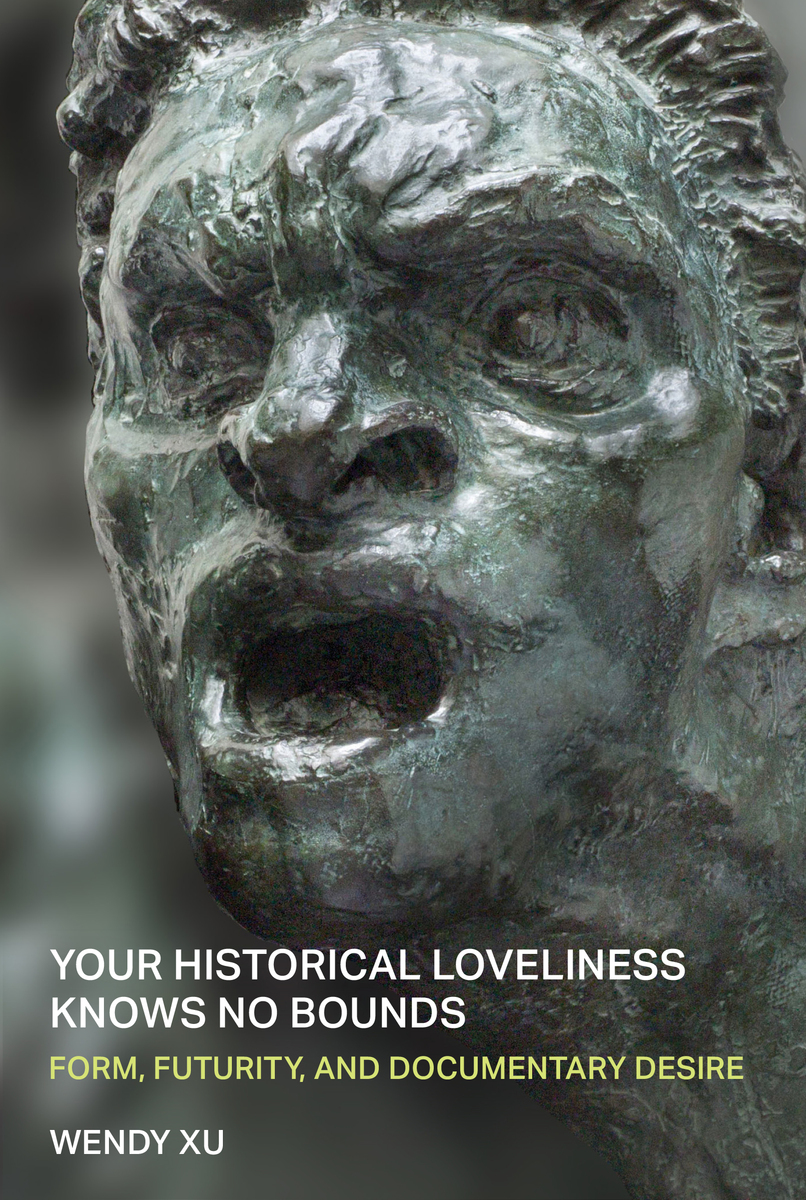
Your Historical Loveliness Knows No Bounds: Form, Futurity, and Documentary Desire
University of Michigan Press, 2025
Paper: 978-0-472-04000-1 | eISBN: 978-0-472-22231-5 (standard)
See other books on: Bounds | Form | Futurity | Interviews | Literary Collections
See other titles from University of Michigan Press
Paper: 978-0-472-04000-1 | eISBN: 978-0-472-22231-5 (standard)
ABOUT THIS BOOK | AUTHOR BIOGRAPHY | REVIEWS | TOC | REQUEST ACCESSIBLE FILE
ABOUT THIS BOOK
Moving freely between essay, close-reading, ekphrasis, memoir, travelogue, lecture notes, poetry, and even monologue, Your Historical Loveliness Knows No Bounds presents a series of “thinking-throughs” of formally innovative and politically oriented poets pushing the boundaries of what poetry can hold. Tracing a personal family history of immigration amidst larger concerns of diaspora, “unsayability,” and absence, Wendy Xu reads the work of poets including Layli Long Soldier, Inger Christensen, Ocean Vuong, Liu Xia, giovanni singleton, Bei Dao, Diana Khoi Nguyen, and others. She explores existential and pedagogical questions in poetry from the point of view of a reader and a teacher. Why write? and why invite the paradoxes of a documentary approach into that writing?
Not an overview or primer, least of all the final word, this free-ranging exploration of contemporary poetry considers larger questions of belonging, diaspora, the violence of language, the allure of the past, genre, witness, and form. It returns to memorable touchstone texts in the author’s life with renewed curiosity about their inner workings. Essays move with restless curiosity across topics, bringing them into conversation with poetry, from considering depictions of Christ in Pier Paolo Pasolini’s The Gospel According to St. Matthew, to the ecstatic illegible texts of Henri Michaux, discomfiting likenesses of agoraphobia and political imprisonment, and the epistolary trouble of fan-mail. Xu is drawn to poetry works of radical hybridity alongside personal experiences of formal intensity, as an immigrant daughter, a parentified child, an occasional agoraphobe, and a writer. Your Historical Loveliness Knows No Bounds is a tour of poetic influences and the futures they’ve made possible.
Not an overview or primer, least of all the final word, this free-ranging exploration of contemporary poetry considers larger questions of belonging, diaspora, the violence of language, the allure of the past, genre, witness, and form. It returns to memorable touchstone texts in the author’s life with renewed curiosity about their inner workings. Essays move with restless curiosity across topics, bringing them into conversation with poetry, from considering depictions of Christ in Pier Paolo Pasolini’s The Gospel According to St. Matthew, to the ecstatic illegible texts of Henri Michaux, discomfiting likenesses of agoraphobia and political imprisonment, and the epistolary trouble of fan-mail. Xu is drawn to poetry works of radical hybridity alongside personal experiences of formal intensity, as an immigrant daughter, a parentified child, an occasional agoraphobe, and a writer. Your Historical Loveliness Knows No Bounds is a tour of poetic influences and the futures they’ve made possible.
See other books on: Bounds | Form | Futurity | Interviews | Literary Collections
See other titles from University of Michigan Press