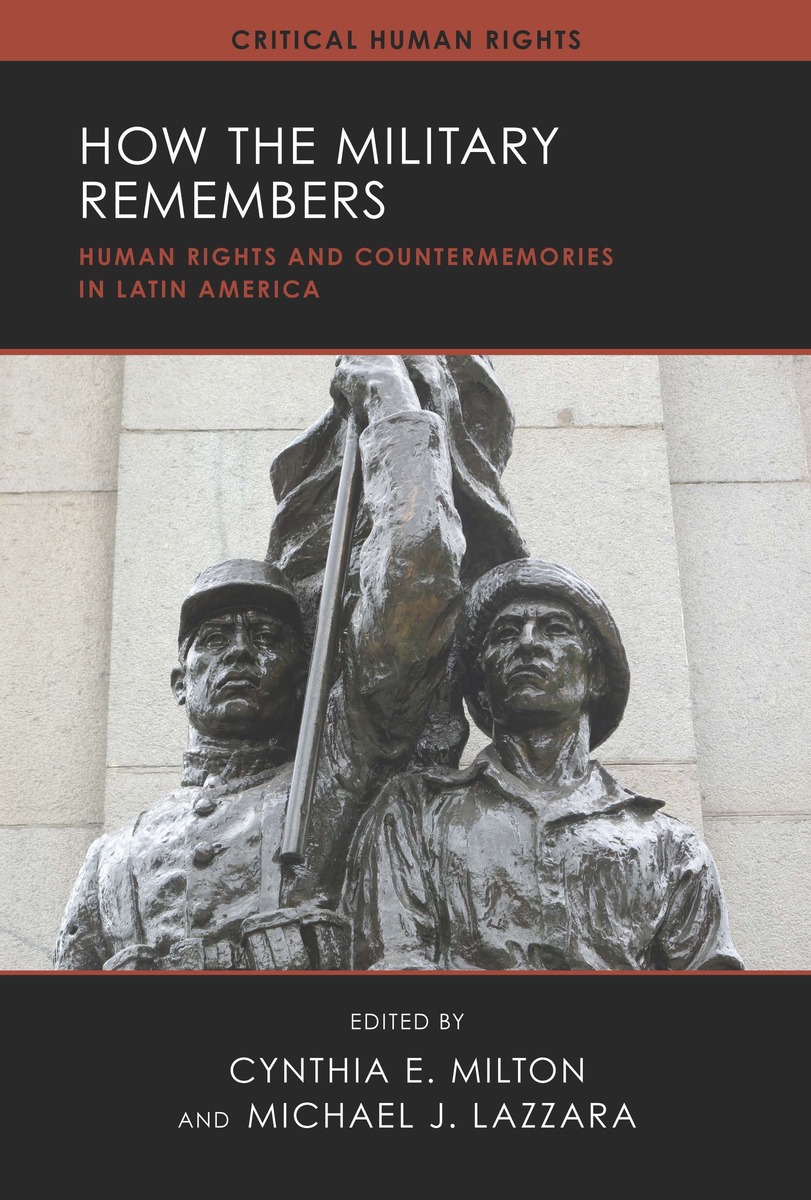
How the Military Remembers: Human Rights and Countermemories in Latin America
edited by Cynthia E. Milton and Michael Lazzara
University of Wisconsin Press, 2025 Cloth: 978-0-299-35270-7 | eISBN: 978-0-299-35278-3 (ePub) | eISBN: 978-0-299-35273-8 (PDF) Library of Congress Classification JC599.L3H69 2025 Dewey Decimal Classification 323.098
ABOUT THIS BOOK | AUTHOR BIOGRAPHY | REVIEWS | TOC | REQUEST ACCESSIBLE FILE
ABOUT THIS BOOK
This groundbreaking collection of essays examines how Latin American militaries construct memories of past human rights violations in ways that challenge established public memory and human rights discourse. While previous studies have focused on democratization, transitional justice, and victim-centered narratives, this volume takes a different approach. It highlights the importance of deconstructing the military’s own active memory work, or their “countermemories”—a term the editors use to describe military narratives that are both counterintuitive and that run counter to the victim-oriented memories that have long dominated the region’s public memory.
With attention to the distinct cultural, political, and historical contexts across Latin America, the essays reveal how military figures and institutions appropriate mechanisms of truth-telling and accountability to reframe the past, blur the lines between perpetrator and victim, and weaponize memory itself.
Contributors: Mariana Achugar, Gabriela Fried Amilivia, Rebecca Atencio, Jo-Marie Burt, Rachel Hatcher, Nicolás Rodríguez Idárraga, Michael J. Lazzara, Cynthia E. Milton, Carla Granados Moya, María Emma Wills Obregón, Leith Passmore, Valentina Salvi, Gladys Vásquez Zevallos
AUTHOR BIOGRAPHY
Cynthia E. Milton is a professor in the Department of History at the University of Victoria, director of the Centre for Global Studies, and a Fellow of the Royal Society of Canada. Her books include Conflicted Memory: Military Cultural Interventions and the Human Rights Era in Peru.
Michael J. Lazzara is a professor of Latin American literature and cultural studies in the Department of Spanish and Portuguese and the associate vice provost of academic programs and partnerships in Global Affairs at the University of California, Davis. His books include Civil Obedience: Complicity and Complacency in Chile Since Pinochet.
Contributors: Mariana Achugar, Gabriela Fried Amilivia, Rebecca Atencio, Jo-Marie Burt, Rachel Hatcher, Nicolás Rodríguez Idárraga, Michael J. Lazzara, Cynthia E. Milton, Carla Granados Moya, María Emma Wills Obregón, Leith Passmore, Valentina Salvi, Gladys Vásquez Zevallos
REVIEWS
“Examines how the militaries of Latin American countries confront truth commissions, memory sites, trials, and reparations. This book is indispensable for understanding the continent’s ongoing ‘memory wars.’”
— Emilio Crenzel, author of Memory of the Argentina Disappearances: The Political History of “Nunca Más”
“A timely volume. The arguments and analysis offer original perspectives on complicated processes, and the study usefully expands upon foundational sources in the field of memory studies. This excellent text is essential reading.”
— Nancy Gates Madsen, author of Trauma, Taboo, and Truth-Telling: Listening to Silences in Postdictatorship Argentina
“Timely. . . . Milton, Lazzara, and the book’s contributors show how memory is a contested territory and how important political moments such as the establishment of truth commissions, the trials of perpetrators of state violence, and the creation of museums and documentaries can serve as arenas where these memories are disputed.”
— The Latin Americanist
TABLE OF CONTENTS
List of Illustrations
Acknowledgments
List of Abbreviations
Introduction
Cynthia E. Milton and Michael J. Lazzara
PART I. Refashioning Military Men in Democracies
1 In the Name of the Father: Uncovering the Paternity of Military Memories of Dictatorship in Brazil
Rebecca Atencio
2 Fiction, Freedom, and Relativism: Human Rights in Pinochetista Memory in Post-Pinochet Chile (1998–2019)
Leith Passmore
3 Heroes and Genocidaires: Retired Officers of the Argentinian Army and Their Memories of the Recent Past
Valentina Salvi
4 Perpetrator Confessions and Discourses of Impunity in Post-transitional Uruguay: The Cases of Gavazzo and Tróccoli
Mariana Achugar and Gabriela Fried Amilivia
5 Military Narratives of Heroism and Sacrifice in War Crimes Trials in Guatemala
Jo-Marie Burt
PART II. Memorializing Military Memories
6 “The Hero of Joateca”: The Salvadoran Military’s Stubborn Memory of Domingo Monterrosa
Rachel Hatcher
7 Visualizing Soldiers as Victims: Kidnapping, and Photographic Proof of Survival in Colombia
Nicolás Rodríguez Idárraga
8 Captive to History: Military Memories and Censorship in Peruvian Public Spaces
Cynthia E. Milton
9 An Unorthodox Relationship: Colombia’s Public Forces and the National Center for Historical Memory (2012–2019)
María Emma Wills Obregón
PART III. Inheriting Military Pasts
10 The Challenges and Risks of Producing “Memory with History” Within the Peruvian Army
Carla Granados and Gladys Vásquez
11 Relatives of Perpetrators and Collaborators in Chile: Implicated Subjects, Memory, and Responsibility
Michael J. Lazzara
Contributors
Index
REQUEST ACCESSIBLE FILE
If you are a student who cannot use this book in printed form, BiblioVault may be able to supply you
with an electronic file for alternative access.
Please have the accessibility coordinator at your school fill out this form.