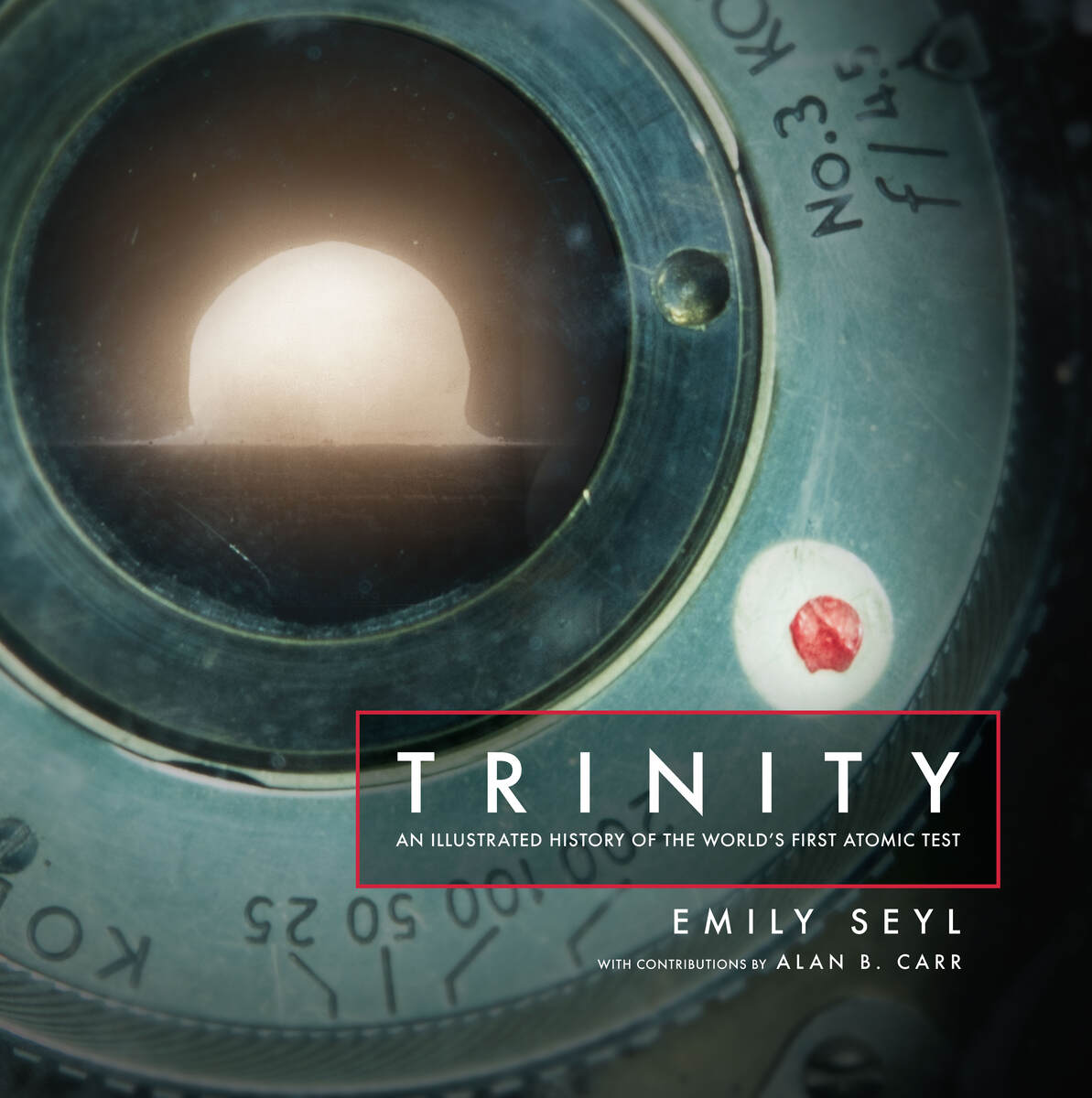
“As the world continues to come to terms with the hope and peril of our new age, eighty years after it began, Trinity stands as a clear dividing line for humanity. We see in its receding light an age-old prophecy, that mastery of nature comes with a price.”
— Charles Oppenheimer, Founder and Co-Executive Director, The Oppenheimer Project, from the afterword
“Fascinating and timely. These images bring to life an important, indeed transformative, moment in modern history, with implications for politics and world affairs as well as for science and technology. Trinity is a valuable project of historical documentation.”
— Philip Ball, author of "Beyond Weird: Why Everything You Thought You Knew About Quantum Physics Is Different"
"The great mushroom cloud of an atomic or hydrogen bomb detonation has been called 'a thing of terrible beauty.' Indeed, at its most dramatic, Seyl’s illustrated history of the inaugural atomic bomb test, and beyond, possesses a hypnotic, terrifying majesty. The experience of reading this book is both admiring and unsettling. . . . A singular event captured in ordinary—and extraordinary—images."
— Kirkus Reviews
"A history of the culmination of the Manhattan Project, documented through hundreds of carefully restored photographs, some recently declassified."
— The Bookseller, "Books Spotlight: University Presses"
"Stunning. . . . To honor the complexity of the Manhattan Project, great care is taken to communicate the manifold, intricate procedures of the Trinity test in an inclusive, understandable fashion. Exceptional descriptions reveal the labyrinthine procedures and mind-boggling feats of logistics, forming digestible, enlightening paragraphs that respect the complexity of the operation itself. Indeed, the sheer breadth of the book’s coverage is staggering. Images of maps, schematics, laboratories, staff at work, the testing grounds, classified documents, handwritten notes, and leading-edge recording equipment can all be found within, each with its own informative caption. It is the most comprehensive visual record of the Trinity detonation ever assembled, containing restored images of the blast that have only just become public. . . . Trinity is an amazing photographic history of the revolutionary test that kicked off the atomic age."
— Foreword Reviews
“This illustrated history of the world’s first atomic test features hundreds of fully restored photographs and still frames from the Trinity site during the setup, execution, and aftermath of the test. Most images are drawn from the archives of Los Alamos National Laboratory in New Mexico. These visual artifacts form magnificent, often two-page spreads that depict scientists and soldiers, diagrams, maps, documents, buildings, industrial equipment, and nuclear devices. Hundreds of scientists and soldiers monitored the test while hundreds of cameras and scientific instruments recorded the explosion and aftermath. Cameras also recorded events at Tinian Island, where two atomic bombs were prepped for deployment, and documented the devastation wrought by the bombing of Japan.”
— Library Journal
“At last, after many decades, we now have the definitive pictorial history of the Trinity test, loaded with astonishing images newly released from the classified archives and authoritative text beautifully written by Seyl. For those of us who have long studied that first atomic bomb, the Los Alamos team has put together the book that we could only imagine.”
— Jon Else, documentary filmmaker and author of "Frenchman Flat: The Rise and Fall of Atomic Bombs"
“Featuring hundreds of carefully restored photographs, still frames, maps, and once-top-secret documents, this book is a visual journey through the very first atomic test, codenamed Trinity, that was conducted in the New Mexico desert in 1945. The stunning imagery paints a vivid picture of an emerging and destructive technology and the very human experience of bringing it into being.”
— Liz Greene, Nautilus
“Many books describe how the first atomic bomb was built. But this history by Seyl stands apart. It tells the story of the bomb’s Trinity test in New Mexico in July 1945 through restored photographs from the Los Alamos National Laboratory’s National Security Research Center, where Seyl works. These include images of once-clandestine documents and experiments, as well as unfamiliar restored photographs of ‘trinitite’—green glass found at the test crater—which fell from the bomb’s fireball in molten drops.”
— Andrew Robinson, Nature
"A new book about the Trinity test, the world’s first atomic explosion, presents startlingly vivid views of the event. Based on a twenty-year effort to restore and release hundreds of photographs taken during the Manhattan Project, the book, simply titled Trinity, is a treasure trove of some 350 of these images, along with maps, memos, diagrams, blueprints, and pictures of lab-notebook pages."
— Glenn Zorpette, IEEE Spectrum
"Through several hundred previously classified photographs and documents, Seyl’s Trinity: An Illustrated History of the World’s First Atomic Test tells the story of the human and scientific efforts that led to humanity commandeering the atom’s power. . . . Trinity meticulously illustrates just how many people and resources it required. Seyl says she intended her book to be an immersive experience that could help readers understand the test’s history and intricacies better, helping them build a foundation for thinking about nuclear weapons now. . . . The Trinity test changed everything, and we live in that changed world now."
— Karmela Padavic-Callaghan, New Scientist
“Seyl tells the extraordinary story of the development and detonation of this first nuclear device—both scientific experiment and military proving ground—as an achievement as unsettling as it was remarkable. Trinity is a step-by-step account that serves as a fine companion piece to the feature film Oppenheimer. And it is every bit as compelling.”
— Bill Thompson, The Post and Courier