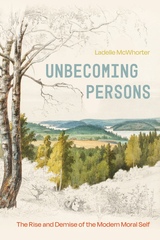
Unbecoming Persons: The Rise and Demise of the Modern Moral Self
University of Chicago Press, 2025
Cloth: 978-0-226-84358-2 | Paper: 978-0-226-84359-9 | eISBN: 978-0-226-84360-5
Library of Congress Classification BD450.M372 2025
Dewey Decimal Classification 128
Cloth: 978-0-226-84358-2 | Paper: 978-0-226-84359-9 | eISBN: 978-0-226-84360-5
Library of Congress Classification BD450.M372 2025
Dewey Decimal Classification 128
ABOUT THIS BOOK | AUTHOR BIOGRAPHY | REVIEWS | TOC | REQUEST ACCESSIBLE FILE
ABOUT THIS BOOK
A damning genealogy of modern personhood and a bold vision for a new ethics rooted in belonging rather than individuality.
In the face of ecological crisis, economic injustice, and political violence, the moral demands of being a good person are almost too much to bear. In Unbecoming Persons, Ladelle McWhorter argues that this strain is by design. Our ideas about personhood, she shows, emerged to sustain centuries of colonialism, slavery, and environmental destruction. We must look elsewhere to find our way out.
This history raises a hard question: Should we be persons at all, or might we live a good life without the constraints of individualism or the illusion of autonomy? In seeking an answer, McWhorter pushes back on the notion of our own personhood—our obsession with identity, self-improvement, and salvation—in search of a better way to live together in this world. Although she finds no easy answers, McWhorter ultimately proposes a new ethics that rejects both self-interest and self-sacrifice and embraces perpetual dependence, community, and the Earth
In the face of ecological crisis, economic injustice, and political violence, the moral demands of being a good person are almost too much to bear. In Unbecoming Persons, Ladelle McWhorter argues that this strain is by design. Our ideas about personhood, she shows, emerged to sustain centuries of colonialism, slavery, and environmental destruction. We must look elsewhere to find our way out.
This history raises a hard question: Should we be persons at all, or might we live a good life without the constraints of individualism or the illusion of autonomy? In seeking an answer, McWhorter pushes back on the notion of our own personhood—our obsession with identity, self-improvement, and salvation—in search of a better way to live together in this world. Although she finds no easy answers, McWhorter ultimately proposes a new ethics that rejects both self-interest and self-sacrifice and embraces perpetual dependence, community, and the Earth
See other books on: Demise | McWhorter, Ladelle | Persons | Philosophical anthropology | Social
See other titles from University of Chicago Press