
 A SCHOLARLY BOOK REPOSITORY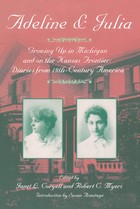
The keeping of journals and diaries became an almost everyday pastime for many Americans in the nineteenth century. Adeline and Julia Graham, two young women from Berrien Springs, Michigan, were both drawn to this activity, writing about the daily events in their lives, as well as their 'grand adventures.' These are fascinating, deeply personal accounts that provide an insight into the thoughts and motivation of two sisters who lived more than a century ago. Adeline began keeping a diary when she was sixteen, from mid-1880 through mid-1884; through it we see a young woman coming of age in this small community in western Michigan. Paired with Adeline's account is her sister Julia's diary, which begins in 1885 when she sets out with three other young women to homestead in Greeley County, Kansas, just east of the Colorado border. It is a vivid and colorful narrative of a young woman's journey into America's western landscape.
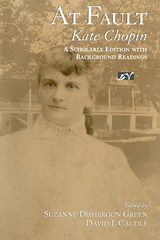
The novel centers on Therese Lafirme, a widow who owns and runs a plantation in post–Civil War Louisiana. She encounters David Hosmer, who buys timber rights to her property to secure raw materials for his newly constructed sawmill. When David remarries, a love triangle develops between David, Fanny (his alcoholic wife), and Therese, who tries to balance her strong moral sensibility against her growing love for David. In depicting these relationships, Chopin acutely dramatizes the conflict between growing industrialism and the agrarian traditions of the Old South—as well as the changes to the land and the society that inevitably resulted from that conflict.
Editors Suzanne Disheroon Green and David J. Caudle provide meticulous annotations to the text of At Fault, facilitating the reader’s understanding of the complex and exotic culture and language of nineteenth-century Louisiana. Also included is a substantial body of supporting materials thatcontextualize the novel, ranging from a summary of critical responses to materials illuminating the economic, social, historical, and religious influences on Chopin’s texts.
The Editors: Suzanne Disheroon Green is an assistant professor of English at Northwestern State University in Natchitoches, Louisiana. She is the co-author, with David J. Caudle, of Kate Chopin: An Annotated Bibliography of Critical Works, and co-editor with Lisa Abney, of the forthcoming Songs of the New South: Writing Contemporary Louisiana
David J. Caudle, who is completing his doctorate at the University of North Texas, has published essays and book chapters dealing with American literature and linguistic approaches to literature.
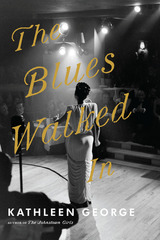
Lena’s father wants her to settle down and give up show business, but she’s entranced by the music and culture of the Hill. It’s a mecca for jazz singers and musicians, and nightspots like the Crawford Grill attract crowds of blacks and whites. Lena table-hops with local jazzmen as her father chaperones her through the clubs where she‘ll later perform. Singing makes her feel alive, and to her father’s dismay, reviewers can’t get enough of her. Duke Ellington adores her, Billy Strayhorn can’t wait to meet her, and she becomes “all the rage” in clubs and Hollywood for her beauty and almost-whiteness. Her signature version of “Stormy Weather” makes her a legend. But after sitting around for years at MGM as the studio heads try to figure out what to do with her, she isn’t quite sure what she’s worth.
Marie and Josiah follow Lena’s career in Hollywood and New York through movie magazines and the Pittsburgh Courier. Years pass until their lives are brought together again when Josiah is arrested for the murder of a white man. Marie and Lena decide they must get Josiah out of prison—whatever the personal cost.
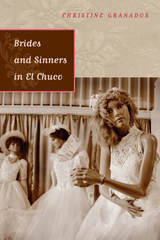
In the border town of El Paso—better known to its Mexican American residents as El Chuco—dramas unfold in humdrum households every day as working-class men come home from their jobs and as their wives and children do their best to cope with life. Christine Granados now plumbs the heart of this community in fourteen startling stories, uncovering the dreams and secrets in which ordinary people sometimes lose themselves. Many fictional accounts of barrio life play up tradition and nostalgia; Brides and Sinners in El Chuco is a trip to the darker side. Here are memories of growing up in a place where innocence is always tempered by reality—true-to-life stories, told in authentic language, of young women, from preteens to twenty-somethings, learning to negotiate their way through troubled times and troubled families. In the award-winning story “The Bride,” a young girl recalls her sister as a perennial bride on Halloween, planning for her eventual big day in a pink notebook with lists of potential husbands, only to see her dream thwarted at the junior prom. In another, we meet Bobbi, the class slut, whose D-cup chest astounds the other girls and entices everyone—even those who shouldn’t be tempted.
Granados’ tales boldly portray women’s struggle for solidarity in the face of male abuse, and as these characters come to grips with self-discovery, sibling rivalry, and dysfunctional relationships, she shows what it means for Chicanas to grow up in protective families while learning to survive in the steamy border environment. Brides and Sinners in El Chuco is an uncompromising look at life with all its hard edges—told with enough softness to make readers come back for more.
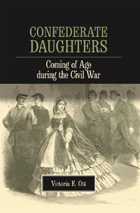
Confederate Daughters: Coming of Age during the Civil War explores gender, age, and Confederate identity by examining the lives of teenage daughters of Southern slaveholding, secessionist families. These young women clung tenaciously to the gender ideals that upheld marriage and motherhood as the fulfillment of female duty and to the racial order of the slaveholding South, an institution that defined their status and afforded them material privileges. Author Victoria E. Ott discusses how the loyalty of young Southern women to the fledgling nation, born out of a conservative movement to preserve the status quo, brought them into new areas of work, new types of civic activism, and new rituals of courtship during the Civil War.
Social norms for daughters of the elite, their preparation for their roles as Southern women, and their material and emotional connections to the slaveholding class changed drastically during the Civil War. When differences between the North and South proved irreconcilable, Southern daughters demonstrated extraordinary agency in seeking to protect their futures as wives, mothers, and slaveholders.
From a position of young womanhood and privilege, they threw their support behind the movement to create a Confederate identity, which was in turn shaped by their participation in the secession movement and the war effort. Their political engagement is evident from their knowledge of military battles, and was expressed through their clothing, social activities, relationships with peers, and interactions with Union soldiers.
Confederate Daughters also reveals how these young women, in an effort to sustain their families throughout the war, adjusted to new domestic duties, confronting the loss of slaves and other financial hardships by seeking paid work outside their homes.
Drawing on their personal and published recollections of the war, slavery, and the Old South, Ott argues that young women created a unique female identity different from that of older Southern women, the Confederate bellehood. This transformative female identity was an important aspect of the Lost Cause mythology—the version of the conflict that focused on Southern nationalism—and bridged the cultural gap between the antebellum and postbellum periods.
Augmented by twelve illustrations, this book offers a generational understanding of the transitional nature of wartime and its effects on women’s self-perceptions. Confederate Daughters identifies the experiences of these teenage daughters as making a significant contribution to the new woman in the New South.
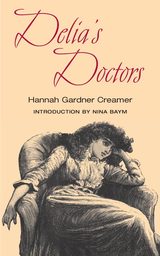
This early feminist novel is a wickedly funny slice of mid-nineteenth-century Americana peppered with details of the era’s freakish medical tactics and leavened with a smart and sassy commentary about the societal restraints on women’s physical and intellectual abilities.
First published in 1852, Delia’s Doctors is one of four known novels by Hannah Gardner Creamer, an American writer whose life and career have been all but absent from the annals of American history. In the book, eighteen-year-old Delia Thornton is ill. Her condition, more psychological than physical, worsens during the bitter winter, even as doctor after doctor attempts to cure her.
As Delia typifies the female heroine whose sickness is aggravated by listlessness and inactivity, her brother’s fiancée, Adelaide Wilmot, is Delia’s more robust counterpart. Adelaide thinks she could do anything, if only she were a man, and she dreams of being a physician. Quick to point out the shortcomings of male doctors in treating female illnesses, Adelaide saves Delia and delivers a series of arguments against New England patriarchy.
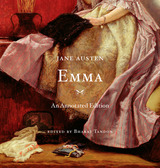
Emma, perhaps the most technically accomplished of all of Austen’s novels, is also, after Pride and Prejudice, her most popular one. Its numerous film and television adaptations testify to the world’s enduring affection for the headstrong, often misguided Emma Woodhouse and her many romantic schemes. Like the previous volumes in Harvard’s celebrated annotated Austen series, Emma: An Annotated Edition is a beautiful and illuminating gift edition that will be treasured by readers.
Stimulating and helpful annotations appear in the book’s margins, offering information, definitions, and commentary. In his Introduction, Bharat Tandon suggests several ways to approach the novel, enabling a larger appreciation of its central concerns and accomplishments. Appearing throughout the book are many illustrations, often in color, which help the reader to better picture the Regency-era world that serves as the stage for Emma’s matchmaking adventures.
Whether explaining the intricacies of early nineteenth-century dinner etiquette or speculating on Highbury’s deliberately imprecise geographical location, Tandon serves as a delightful and entertaining guide. For those coming to the novel for the first time or those returning to it, Emma: An Annotated Edition offers a valuable portal to Austen’s world.

Sacred chants are Ada Franklin’s power and her medicine. By saying them, she can remove warts, stanch bleeding, and draw the fire from burns. At age twenty, her reputation as a faith healer defines her in her rural Pennsylvania community. But on the day in 1953 that her family’s barn is consumed by flame, her identity as a healer is upended. The heat, the roar of the blaze, and the bellows of the trapped cows change Ada. For the first time, she fears death and—for the first time—she doubts God. With her belief goes her power to heal. Then Ada meets an agnostic named Will Burk and his pet raven, Cicero.
Fire Is Your Water is acclaimed memoirist Jim Minick’s first novel. Built on magical realism and social observation in equal measure, it never gives way to sentimentality and provides an insider’s glimpse into the culture of Appalachia. A jealous raven, a Greek chorus of one, punctuates the story with its judgments on the characters and their actions, until a tragic accident brings Ada and Will together in a deeper connection.
Ostensibly a novel about gossip on a cruise ship, The Fisher King is much more: a highly stylized narrative infused with Greek mythology, legend, and satire.
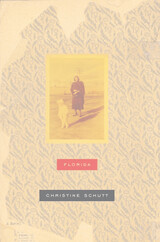
Florida is the portrait of the artist as a young woman, an orphan's story full of loss and wonder, a familiar tale told in original language. Alice Fivey, fatherless at age seven, is left in the care of her relatives at ten when her love-wearied mother loses custody of her and submits to the sanitarium and years of psychiatric care. A namesake daughter locked in the orphan's move-around life, she must hold still while the seamstress pins her into someone not her mother. But they share the same name, so she is her mother, isn't she?
Alice finds consolation in books and she herself is a storyteller who must build a home for herself word by right word. Florida is her story, recalled in brief scenes of spare beauty and strangeness as Alice moves from house to house, ever further from the desolation of her mother's actions, ever closer to the meaning of her experience. In this most elegiac and luminous novel, Schutt gives voice to the feast of memory, the mystery of the mad and missing, and above all, the life-giving power of language.


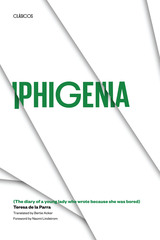
Winner, Harvey L. Johnson Award, Southwest Council on Latin American Studies, 1994
"...I didn't want to tell you the truth for anything in the world, because it seemed very humiliating to me..." The truth is that Iphigenia is bored and, more than bored, buried alive in her grandmother's house in Caracas, Venezuela. After the excitement of being a beautiful, unchaperoned young woman in Paris, her father's death has sent her back to a forgotten homeland, where rigid decorum governs. Two men—the married man she adores and the wealthy fiancé she abhors—offer her escape from her prison. Which of these impossible suitors will she choose?
Iphigenia was first published in 1924 in Venezuela, where it hit patriarchal society like a bomb. Teresa de la Parra was accused of undermining the morals of young women with this tale of a passionate woman who lacks the money to establish herself in the liberated, bohemian society she craves. Yet readers have kept the novel alive for decades, and this first English translation now introduces its heroine to a wider audience.
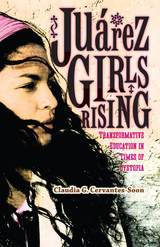
Working-class girls in Ciudad Juárez grow up in a context marked by violence against women, the devastating effects of drug cartel wars, unresponsive and abusive authorities, and predatory U.S. capitalism: under constantly precarious conditions, these girls are often struggling to shape their lives and realize their aspirations. Juárez native Claudia G. Cervantes-Soon explores the vital role that transformative secondary education can play in promoting self-empowerment and a spirit of resistance to the violence and social injustice these girls encounter.
Bringing together the voices of ten female students at Preparatoria Altavista, an innovative urban high school founded in 1968 on social justice principles, Cervantes-Soon offers a nuanced analysis of how students and their teachers together enact a transformative educational philosophy that promotes learning, self-authorship, and hope. Altavista’s curriculum is guided by the concept of autogestión, a holistic and dialectical approach to individual and collective identity formation rooted in the students’ experiences and a critical understanding of their social realities. Through its sensitive ethnography, this book shows how female students actively construct their own meaning of autogestión by making choices that they consider liberating and empowering.
Juárez Girls Rising provides an alternative narrative to popular and often simplistic, sensationalizing, and stigmatizing discourses about those living in this urban borderland. By merging the story of Preparatoria Altavista with the voices of its students, this singular book provides a window into the possibilities and complexities of coming of age during a dystopic era in which youth hold on to their critical hope and cultivate their wisdom even as the options for the future appear to crumble before their eyes.
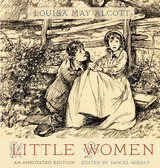
Little Women has delighted and instructed readers for generations. For many, it is a favorite book first encountered in childhood or adolescence. Championed by Gertrude Stein, Simone de Beauvoir, Theodore Roosevelt, and J. K. Rowling, it is however much more than the “girls’ book” intended by Louisa May Alcott’s first publisher. In this richly annotated, illustrated edition, Daniel Shealy illuminates the novel’s deep engagement with issues such as social equality, reform movements, the Civil War, friendship, love, loss, and of course the passage into adulthood.
The editor provides running commentary on biographical contexts (Did Alcott, like Jo, have a “mood pillow”?), social and historical contexts (When may a lady properly decline a gentleman’s invitation to dance?), literary allusions (Who is Mrs. Malaprop?), and words likely to cause difficulty to modern readers (What is a velvet snood? A pickled lime?). With Shealy as a guide, we appreciate anew the confusions and difficulties that beset the March sisters as they overcome their burdens and journey toward maturity and adulthood: beautiful, domestic-minded Meg, doomed and forever childlike Beth, selfish Amy, and irrepressible Jo. This edition examines the novel’s central question: How does one grow up well?
Little Women: An Annotated Edition offers something for everyone. It will delight both new and returning readers, young and old, male and female alike, who will want to own and treasure this beautiful edition full of color illustrations and photographs.
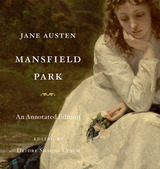
Jane Austen’s most ambitious novel, Mansfield Park, has always generated debate. Austen herself noted that debate when she conducted a reader survey, recording her acquaintances’ mixed reviews in a booklet she entitled “Opinions of Mansfield Park.” Is this novel’s dutiful heroine, Fanny Price, admirable? Or is she (as Austen’s own mother asserted) “insipid”? Is Fanny actually the heroine, or does that title belong more properly to her rival, Mary Crawford? Does Fanny’s uncle, Sir Thomas Bertram, act as her benefactor, or as a domestic tyrant? In her notes and introduction to this final volume in Harvard’s celebrated annotated Austen series, Deidre Shauna Lynch outlines the critical disagreements Mansfield Park has sparked and suggests that Austen’s design in writing the novel was to highlight, not downplay, the conflicted feelings its plot and heroine can inspire.
Lynch also engages head-on with the novel’s experimentalism, its technical virtuosity, and its undiminished capacity, two centuries later, to disturb and to move. Annotations clarify the nuances of Austen’s language and explain the novel’s literary allusions and its engagements with topical controversies over West Indian slavery and the conduct of Britain’s war against France. The volume’s numerous illustrations enable readers to picture the world Mansfield Park’s characters inhabit, underscoring the novel’s close attention to setting and setting’s impact on character.
Mansfield Park: An Annotated Edition opens up facets of the novel for even devoted Janeites while extending an open hand to less experienced readers. It will be a welcome addition to the shelf of any library.
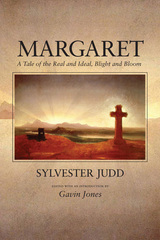
As Gavin Jones points out in his new introduction, Margaret perhaps stands alone in its creation of a female character who grows in social rather than domestic power. The novel also remains unique in its exploration of transcendental philosophy in novelistic form. Part eco-criticism, part seduction novel, part temperance tract, and part social history, Margaret is a virtual handbook for understanding the literary culture of mid-nineteenth-century America, the missing piece in puzzling out connections between writers such as Hawthorne, Melville, Whitman, and Thoreau.
Margaret was widely read and deeply influential on both British and American writers throughout the nineteenth century but controversial for its representations of alcoholism and capital punishment. Judd's novel remains resonant for today's readers as it overturns conventional views of the literary representation of women and the origins of the American Renaissance.
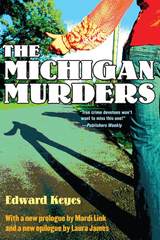
"True crime devotees won't want to miss this one!"
---Publishers Weekly
"Very engrossing . . . in the finest you can't put it down tradition."
---Hartford Courant
"This factual account of each murder, through the conviction of the killer, has all the excitement of a first-rate work of fiction, and is told straight, without the usual sociological jargon. Keyes collaborated with Robin Moore on The French Connection; The Michigan Murders is his first solo effort, and it is a good one."
---Miami Herald
"The Michigan Murders is the ultimate True Crime classic, unfolding like great mystery fiction while still delivering the powerful charge of real life."
---Jamie Agnew, Aunt Agatha's Mystery Bookshop
With a new prologue by Mardi Link and a new epilogue by Laura James
The true story of the savage coed killings---by the boy who could have lived next door!
Southeastern Michigan was rocked in the late 1960s by the terrifying serial murders of young women, whose bodies were dumped in Ann Arbor and Ypsilanti. In each case, few clues were left at the scene, and six separate police agencies were unable to end the horror. Then, almost by accident, a break came. The suspect: John Norman Collins, a young, quiet, all-American boy.
Collins was caught, went to trial, and, on August 19, 1970, was found guilty and sentenced to life imprisonment with no possibility of parole. He is now in his sixties and is serving his sentence in Marquette, Michigan.
Collins was one of the first serial killers exposed in the region, and his crimes had many in the area locking their doors for the first time. Edward Keyes's harrowing The Michigan Murders covers every step of the case. It fell out of print for more than a decade before being revived for this special edition.
Mardi Link, author of the new prologue, is the author of two regionally best-selling true crime books based in northern Michigan, When Evil Came to Good Hart and Isadore's Secret.
Laura James, author of the new epilogue, is a trial lawyer, crime historian, and true crime author who blogs about the true crime genre at her Web site CLEWS (www.laurajames.com).
Edward Keyes, now deceased, spent several years in the early 1970s investigating the Michigan murders. He also authored the works Double Dare and Cocoanut Grove. The Michigan Murders was a finalist for the Edgar Allan Poe Award for Best Fact Crime in 1977.
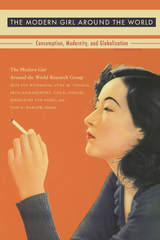
Scholars of history, women’s studies, literature, and cultural studies follow the Modern Girl around the world, analyzing her manifestations in Germany, Australia, China, Japan, France, India, the United States, Russia, South Africa, and Zimbabwe. Along the way, they demonstrate how the economic structures and cultural flows that shaped a particular form of modern femininity crossed national and imperial boundaries. In so doing, they highlight the gendered dynamics of interwar processes of racial formation, showing how images and ideas of the Modern Girl were used to shore up or critique nationalist and imperial agendas. A mix of collaborative and individually authored chapters, the volume concludes with commentaries by Kathy Peiss, Miriam Silverberg, and Timothy Burke.
Contributors: Davarian L. Baldwin, Tani E. Barlow, Timothy Burke, Liz Conor, Madeleine Yue Dong, Anne E. Gorsuch, Ruri Ito, Kathy Peiss, Uta G. Poiger, Priti Ramamurthy, Mary Louise Roberts, Barbara Sato, Miriam Silverberg, Lynn M. Thomas, Alys Eve Weinbaum

As a teenager, Lake joins her grandparents in Missouri and spends her youth seeking answers to her questions about the past, trying to understand the complex pattern of betrayals that shaped it. Only when she herself becomes party to a betrayal as devastating as any committed by her mother does Lake begin to understand.
Passanante writes with a keen eye for the details of behavior that reveal the yearnings and fears beneath the surface. She shows us that the path to understanding is never a smooth one, and that love is often far more complex than we can imagine. Western Literature Series.
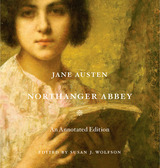
The star of Northanger Abbey is seventeen-year-old Catherine Morland, Jane Austen’s youngest and most impressionable heroine. Away from home for the first time, on a visit to Bath with family friends, Catherine, a passionate consumer of novels (especially of the gothic variety), encounters a world in which everything beckons as a readable text: not only books, but also conversations and behaviors, clothes, carriages, estates, and vistas. In her lively introduction to this newest volume in Harvard’s celebrated annotated Austen series, Susan Wolfson proposes that Austen’s most underappreciated, most playful novel is about fiction itself and how it can take possession of everyday understandings.
The first of Austen’s major works to be completed (it was revised in 1803 and again in 1816–17), Northanger Abbey was published months after Austen’s death in July 1817, together with Persuasion. The 1818 text, whose singularly frustrating course to publication Wolfson recounts, is the basis for this freshly edited and annotated edition.
Wolfson’s running commentary will engage new readers while offering delights for scholars and devoted Janeites. A wealth of color images bring to life Bath society in Austen’s era—the parade of female fashions, the carriages running over open roads and through the city’s streets, circulating libraries, and nouveau-riche country estates—as well as the larger cultural milieu of Northanger Abbey. This unique edition holds appeal not just for “Friends of Jane” but for all readers looking for a fuller engagement with Austen’s extraordinary first novel.

In this award-winning debut collection, Molly McNett couples laugh-out-loud dialogue and wry observation reminiscent of Flannery O’Connor with disquieting strains of dashed hope, troubled sexuality, and disillusionment.
The adults in these stories can seem as hapless and helpless as the younger characters. Two neglected daughters use the language of clothes to cope with their parents’ divorce and their father’s mail-order bride. A young girl’s bizarre sexual fantasies help her gain control over the chaos of her family life. A gang of teenagers accuse a farmer of bestiality. A divorced father tries to create a pony-filled world that might appeal to his daughters. In the title story, Mr. Bob, the minister’s housesitter, loses a dog but finds someone to believe in. And in “Helping,” the darkest story in this amazing collection, Ruthie’s anger conquers her religious faith when she takes care of a severely disabled child.
We meet McNett’s endearing, often foolish characters at a point when their minds are open to manipulation by the people and events around them, and the conclusions they draw are heartbreaking: I am not allowed weakness; life treats people unequally; perhaps there is no God. Yet throughout they find quiet moments of possibility, courage, and a return to faith and comfort.
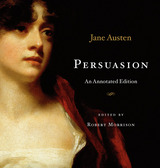
Published posthumously with Northanger Abbey in 1817, Persuasion crowns Jane Austen’s remarkable career. It is her most passionate and introspective love story. This richly illustrated and annotated edition brings her last completed novel to life with previously unmatched vitality. In the same format that so rewarded readers of Pride and Prejudice: An Annotated Edition, it offers running commentary on the novel (conveniently placed alongside Austen’s text) to explain difficult words, allusions, and contexts, while bringing together critical observations and scholarship for an enhanced reading experience. The abundance of color illustrations allows the reader to see the characters, locations, clothing, and carriages of the novel, as well as the larger political and historical events that shape its action.
In his Introduction, distinguished scholar Robert Morrison examines the broken engagement between Anne Elliot and Frederick Wentworth, and the ways in which they wander from one another even as their enduring feelings draw them steadily back together. His notes constitute the most sustained critical commentary ever brought to bear on the novel and explicate its central conflicts as well as its relationship to Austen’s other works, and to those of her major contemporaries, including Lord Byron, Walter Scott, and Maria Edgeworth.
Specialists, Janeites, and first-time readers alike will treasure this annotated and beautifully illustrated edition, which does justice to the elegance and depth of Jane Austen’s time-bound and timeless story of loneliness, missed opportunities, and abiding love.
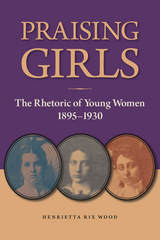
The site of the study—Kansas City, Missouri—reflects the diverse rhetorical experiences of girls in cities across the United States at the beginning of the last century. Four case studies examine the writing of privileged white girls at a college preparatory school, Native American girls at an off-reservation boarding school, African American girls at a segregated high school, and working- and middle-class girls at a large whites-only public high school. Wood’s analysis reveals a contemporary concept of epideictic rhetoric that accounts for issues of gender, race, class, and age.
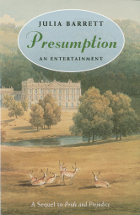
"An elegant emulation and continuation of Pride and Prejudice. . . . Jointly composed by two admirers of Jane Austen, the book often achieves crisp replication of her style. . . . Presumption shows how sequel-writing can, like parody, be a sharp exercise in literary appreciation."—Peter Kemp, Times Literary Supplement
Julia Barrett is a pseudonym for Julia Braun Kessler and Gabrielle Donnelly.
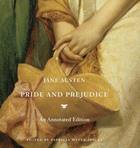
Along with the plays of William Shakespeare and the works of Charles Dickens, Jane Austen’s novels are among the most beloved books of Western literature. Pride and Prejudice (1813) was in Austen’s lifetime her most popular novel, and it was the author’s personal favorite. Adapted many times to the screen and stage, and the inspiration for numerous imitations, it remains today her most widely read book. Now, in this beautifully illustrated and annotated edition, distinguished scholar Patricia Meyer Spacks instructs the reader in a larger appreciation of the novel’s enduring pleasures and provides analysis of Darcy, Elizabeth Bennet, Lady Catherine, and all the characters who inhabit the world of Pride and Prejudice.
This edition will be treasured by specialists and first-time readers, and especially by devoted Austen fans who think of themselves as Friends of Jane. In her Introduction, Spacks considers Austen’s life and career, the continuing appeal of Pride and Prejudice, and its power as a stimulus for fantasy (Maureen Dowd, writing in the New York Times, can hold forth at length on Obama as a Darcy-figure, knowing full well her readers will “understand that she wished to suggest glamour and sexiness”). Her Introduction also explores the value and art of literary annotation. In her running commentary on the novel, she provides notes on literary and historical contexts, allusions, and language likely to cause difficulty to modern readers. She offers interpretation and analysis, always with the wisdom, humor, and light touch of an experienced and sensitive teacher.
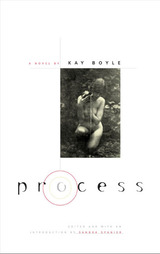
Three quarters of a century after the manuscript of Kay Boyle’s first novel disappeared, a carbon copy of it was discovered by Sandra Spanier, the preeminent Boyle authority. Set off by Spanier’s substantial introduction, Process is published here for the first time in paperback.
A classic bildungsroman, Process tells the story of Kerith Day, who is in search of her own identity and place in the world. A keenly critical observer of the dreary industrial landscape and the beaten-down inhabitants of her native Cincinnati, Ohio, Kerith is determined to discover something better. She places her faith in art and politics and sets off for France, where workers and radicals are on the same side.
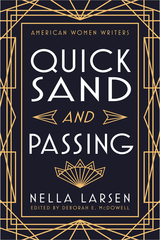
"Quicksand and Passing are novels I will never forget. They open up a whole world of experience and struggle that seemed to me, when I first read them years ago, absolutely absorbing, fascinating, and indispensable." —Alice Walker
"A tantalizing mix of moral fable and sensuous colorful narrative, exploring female sexuality and racial solidarity."—Women's Studies International Forum
Rutgers' all-time bestselling book, Nella Larsen's novels Quicksand (1928) and Passing (1929) document the historical realities of Harlem in the 1920s and shed a bright light on the social world of the black bourgeoisie. The novels' greatest appeal and achievement, however, is not sociological, but psychological. As noted in the editor's comprehensive introduction, Larsen takes the theme of psychic dualism, so popular in Harlem Renaissance fiction, to a higher and more complex level, displaying a sophisticated understanding and penetrating analysis of black female psychology.
Passing is now a major motion picture written, produced, and directed by Rebecca Hall. It premiered at Sundance in 2021 and is available on Netflix.
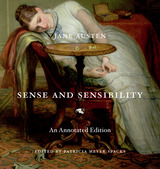
Sense and Sensibility (1811) marked the auspicious debut of a novelist identified only as “A Lady.” Jane Austen’s name has since become as familiar as Shakespeare’s, and her tale of two sisters has lost none of its power to delight. Patricia Meyer Spacks guides readers to a deeper appreciation of the richness of Austen’s delineation of her heroines, Elinor and Marianne Dashwood, as they experience love, romance, and heartbreak. On display again in the editor’s running commentary are the wit and light touch that delighted readers of Spacks’s Pride and Prejudice: An Annotated Edition.
In her notes, Spacks elucidates language and allusions that have become obscure (What are Nabobs? When is rent day?), draws comparisons to Austen’s other work and to that of her precursors, and gives an idea of how other critics have seen the novel. In her introduction and annotations, she explores Austen’s sympathy with both Elinor and Marianne, the degree to which the sisters share “sense” and “sensibility,” and how they must learn from each other. Both manage to achieve security and a degree of happiness by the novel’s end. Austen’s romance, however, reveals darker overtones, and Spacks does not leave unexamined the issue of the social and psychological restrictions of women in Austen’s era.
As with other volumes in Harvard’s series of Austen novels, Sense and Sensibility: An Annotated Edition comes handsomely illustrated with numerous color reproductions that vividly recreate Austen’s world. This will be an especially welcome addition to the library of any Janeite.
Thinking Outside the Girl Box is a true story about a remarkable youth development program in rural West Virginia. Based on years of research with adolescent girls—and adults who devoted their lives to working with them—Thinking Outside the Girl Box reveals what is possible when young people are challenged to build on their strengths, speak and be heard, and engage critically with their world.
Based on twelve years of field research, the book traces the life of the Lincoln County Girls’ Resiliency Program (GRP), a grassroots, community nonprofit aimed at helping girls identify strengths, become active decision makers, and advocate for social change. In the late 1990s and early 2000s, the GRP flourished. Its accomplishments were remarkable: girls recorded their own CDs, published poetry, conducted action research, opened a coffeehouse, performed an original play, and held political rallies at West Virginia’s State Capitol. The organization won national awards, and funding flowed in. Today, in 2013, the programming and organization are virtually nonexistent.
Thinking Outside the Girl Box raises pointed questions about how to define effectiveness and success in community-based programs and provides practical insights for anyone working with youth. Written in an accessible, engaging style and drawing on collaborative ethnographic research that the girls themselves helped conduct, the book tells the story of an innovative program determined to challenge the small, disempowering “boxes” girls and women are so often expected to live in.

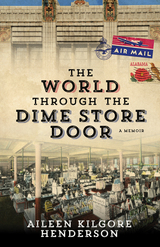
In the 1930s, the rural South was in the throes of the Great Depression. Farm life was monotonous and hard, but a timid yet curious teenager thought it worth recording. Aileen Kilgore Henderson kept a chronicle of her family’s daily struggles in Tuscaloosa County alongside events in the wider world she gleaned from shortwave radio and the occasional newspaper. She wrote about Howard Hughes’s round-the-world flight and her horror at the rise to power in Germany of a bizarre politician named Adolf Hitler. Henderson longed to join the vast world beyond the farm, but feared leaving the refuge of her family and beloved animals.
Yet, with her father’s encouragement, she did leave, becoming a clerk in the Kress dime store in downtown Tuscaloosa. Despite long workdays and a lengthy bus commute, she continued to record her observations and experiences in her diary, for every day at the dime store was interesting and exciting for an observant young woman who found herself considering new ideas and different points of view.
Drawing on her diary entries from the 1930s and early 1940s, Henderson recollects a time of sweeping change for Tuscaloosa and the South. The World through the Dime Store Door is a personal and engaging account of a Southern town and its environs in transition told through the eyes of a poor young woman with only a high school education but gifted with a lively mind and an openness to life.
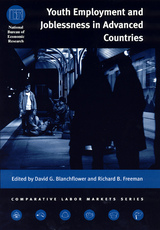
This volume brings together key studies, providing detailed analyses of the difficult economic situation plaguing young workers. Why have demographic changes and additional schooling failed to resolve youth unemployment? How effective have those economic policies been which aimed to improve the labor skills and marketability of young people? And how have youths themselves responded to the deteriorating job market confronting them? These questions form the empirical and organizational bases upon which these studies are founded.
READERS
Browse our collection.
PUBLISHERS
See BiblioVault's publisher services.
STUDENT SERVICES
Files for college accessibility offices.
RECENTLY PUBLISHED





UChicago Accessibility Resources
home | accessibility | search | about | contact us
BiblioVault ® 2001 - 2024
The University of Chicago Press