
 A SCHOLARLY BOOK REPOSITORY
Results by Title
2 books about Writing Revolution
2 books about Writing Revolution
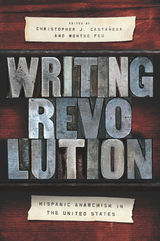
Writing Revolution
Hispanic Anarchism in the United States
Edited by Christopher J. Castañeda and Montse Feu
University of Illinois Press, 2019
In the late nineteenth through mid-twentieth centuries, the anarchist effort to promote free thought, individual liberty, and social equality relied upon an international Spanish-language print network. These channels for journalism and literature promoted anarchist ideas and practices while fostering transnational solidarity and activism from Buenos Aires to Los Angeles to Barcelona. Christopher J. Castañeda and Montse Feu edit a collection that examines many facets of Spanish-language anarchist history. Arranged chronologically and thematically, the essays investigate anarchist print culture's transatlantic origins; Latina/o labor-oriented anarchism in the United States; the anarchist print presence in locales like Mexico's borderlands and Steubenville, Ohio; the history of essential publications and the individuals behind them; and the circulation of anarchist writing from the Spanish-American War to the twenty-first century.Contributors: Jon Bekken, Christopher Castañeda, Jesse Cohn, Sergio Sánchez Collantes, María José Domínguez, Antonio Herrería Fernández, Montse Feu, Sonia Hernández, Jorell A. Meléndez-Badillo, Javier Navarro Navarro, Michel Otayek, Mario Martín Revellado, Susana Sueiro Seoane, Kirwin R. Shaffer, Alejandro de la Torre, and David Watson
[more]

Writing Revolution in Latin America
From Martí to García Márquez to Bolaño
Juan E. De Castro
Vanderbilt University Press, 2019
PROSE Awards Literature Subject Category Winner, 2020
In the politically volatile period from the 1960s through the end of the twentieth century, Latin American authors were in direct dialogue with the violent realities of their time and place. Writing Revolution in Latin America is a chronological study of the way revolution and revolutionary thinking is depicted in the fiction composed from the eye of the storm.
From Mexico to Chile, the gradual ideological evolution from a revolutionary to a neoliberal mainstream was a consequence of, on the one hand, the political hardening of the Cuban Revolution beginning in the late 1960s, and, on the other, the repression, dictatorships, and economic crises of the 1970s and beyond. Not only was socialist revolution far from the utopia many believed, but the notion that guerrilla uprisings would lead to an easy socialism proved to be unfounded. Similarly, the repressive Pinochet dictatorship in Chile led to unfathomable tragedy and social mutation.
This double-edged phenomenon of revolutionary disillusionment became highly personal for Latin American authors inside and outside Castro's and Pinochet's dominion. Revolution was more than a foreign affair, it was the stuff of everyday life and, therefore, of fiction.
Juan De Castro's expansive study begins ahead of the century with José Martí in Cuba and continues through the likes of Mario Vargas Llosa in Peru, Gabriel García Márquez in Colombia, and Roberto Bolaño in Mexico (by way of Chile). The various, often contradictory ways the authors convey this precarious historical moment speaks in equal measure to the social circumstances into which these authors were thrust and to the fundamental differences in the ways they themselves witnessed history.
In the politically volatile period from the 1960s through the end of the twentieth century, Latin American authors were in direct dialogue with the violent realities of their time and place. Writing Revolution in Latin America is a chronological study of the way revolution and revolutionary thinking is depicted in the fiction composed from the eye of the storm.
From Mexico to Chile, the gradual ideological evolution from a revolutionary to a neoliberal mainstream was a consequence of, on the one hand, the political hardening of the Cuban Revolution beginning in the late 1960s, and, on the other, the repression, dictatorships, and economic crises of the 1970s and beyond. Not only was socialist revolution far from the utopia many believed, but the notion that guerrilla uprisings would lead to an easy socialism proved to be unfounded. Similarly, the repressive Pinochet dictatorship in Chile led to unfathomable tragedy and social mutation.
This double-edged phenomenon of revolutionary disillusionment became highly personal for Latin American authors inside and outside Castro's and Pinochet's dominion. Revolution was more than a foreign affair, it was the stuff of everyday life and, therefore, of fiction.
Juan De Castro's expansive study begins ahead of the century with José Martí in Cuba and continues through the likes of Mario Vargas Llosa in Peru, Gabriel García Márquez in Colombia, and Roberto Bolaño in Mexico (by way of Chile). The various, often contradictory ways the authors convey this precarious historical moment speaks in equal measure to the social circumstances into which these authors were thrust and to the fundamental differences in the ways they themselves witnessed history.
[more]
READERS
Browse our collection.
PUBLISHERS
See BiblioVault's publisher services.
STUDENT SERVICES
Files for college accessibility offices.
RECENTLY PUBLISHED


UChicago Accessibility Resources
home | accessibility | search | about | contact us
BiblioVault ® 2001 - 2026
The University of Chicago Press