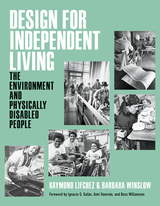

front cover of Design for Independent Living
Design for Independent Living
The Environment and Physically Disabled People
Raymond Lifchez
University of Minnesota Press, 2027

A new edition of the classic and innovative resource that relies on personal lived experience to guide accessible design

In 1979, University of California architecture professors Raymond Lifchez and Barbara Winslow published this account of ongoing collaborations with members of a robust disability community in Berkeley, California. In the first attempt by architects to know disabled people and to design from their perspective, they employed an empathetic approach that differed from typical accessible design guidelines.

Instead of presenting architectural designs to resolve existing barriers, Design for Independent Living turns to disabled people to tell their own stories through interviews and photographs of their own homes, workplaces, and lives in public. The disabled informants of the project were members of the Independent Living movement—the activists who shaped the disability rights movement in the late twentieth century in the United States—and their contributions demonstrate the necessity of liberating design from ableist, restrictive ways of thinking about personal and public life.

Now with a new foreword by three scholars of design and disability history, Design for Independent Living is an indispensable resource for architecture and design experts who seek a socially informed practice that looks to the people most affected by design to understand its potentials and its shortcomings.

Retail e-book files for this title are screen-reader friendly with images accompanied by short alt text and/or extended descriptions.
[more]

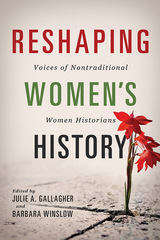
front cover of Reshaping Women's History
Reshaping Women's History
Voices of Nontraditional Women Historians
Julie A. Gallagher, Barbara Winslow
University of Illinois Press, 2018
Award-winning women scholars from nontraditional backgrounds have often negotiated an academic track that leads through figurative--and sometimes literal--minefields. Their life stories offer inspiration, but also describe heartrending struggles and daunting obstacles. Reshaping Women's History presents autobiographical essays by eighteen accomplished scholar-activists who persevered through poverty or abuse, medical malpractice or family disownment, civil war or genocide. As they illuminate their own unique circumstances, the authors also address issues all-too-familiar to women in the academy: financial instability, the need for mentors, explaining gaps in resumes caused by outside events, and coping with gendered family demands, biases, and expectations. Eye-opening and candid, Reshaping Women's History shows how adversity, and the triumph over it, enriches scholarship and spurs extraordinary efforts to affect social change. Contributors: Frances L. Buss, Nupur Chaudhuri, Lisa DiCaprio, Julie R. Enszer, Catherine Fosl, Midori Green, La Shonda Mims, Stephanie Moore, Grey Osterud, Barbara Ransby, Linda Reese, Annette Rodriguez, Linda Rupert, Kathleen Sheldon, Donna Sinclair, Rickie Solinger, Pamela Stewart, Waaseyaa'sin Christine Sy, and Ann Marie Wilson.
[more]

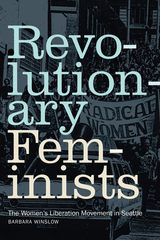
front cover of Revolutionary Feminists
Revolutionary Feminists
The Women's Liberation Movement in Seattle
Barbara Winslow
Duke University Press, 2023
Revolutionary Feminists tells the story of the radical women’s liberation movement in Seattle in the 1960s and 1970s from the perspective of a founding member, Barbara Winslow. Drawing on her collection of letters, pamphlets, and photographs as well as newspaper accounts, autobiographies, and interviews, Winslow emphasizes the vital role that Black women played in the women’s liberation movement to create meaningful intersectional coalitions in an overwhelmingly White city. Winslow brings the voices and visions of those she calls the movement’s “ecstatic utopians” to life. She charts their short-term successes and lasting achievements, from organizing women at work and campaigning for subsidized childcare to creating women-centered rape crisis centers, health clinics, and self-defense programs. The Seattle movement was essential to winning the first popular vote in the United States to liberalize abortion laws. Despite these achievements, Winslow critiques the failure of the movement's White members to listen to Black, Latina, Indigenous, and Asian American and Pacific Islander feminist activists. Reflecting on the Seattle movement’s accomplishments and shortcomings, Winslow offers a model for contemporary feminist activism.
[more]


Send via email Share on Facebook Share on Twitter