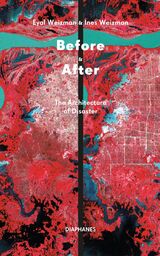
Before & After
The Architecture of Disaster
Eyal Weizman and Ines Weizman
Diaphanes, 2025
A study of the history of before-and-after images of catastrophes, bombed-out cities, and large-scale political transformations.
Catastrophes, bombed-out cities, large-scale political transformations: “Image complexes” of humanitarian and ecological upheaval document the world as a sequence of catastrophes. But who decides how events are presented, determines the resolution of our visual worlds, and controls the circulation or censorship of images?
Eyal and Ines Weizman trace the history of the before-and-after image from nineteenth-century photography to contemporary satellite images and discover a gap that not only conceals the devastating event: it is the human subject itself that is in danger of disappearing from the images. Does humanitarian work, the documentation and reconstruction of war crimes, in which people’s fates and rights should be at the center of attention, paradoxically enter a post-human phase? How can the gap between images become a site of critical counter-reading rather than a symbol of erasure?
In the context of their current research, Eyal and Ines Weizman discuss the history, present, and future of the paradigm of the before-and-after image in an exclusive conversation with Marie Glassl.
[more]