
 A SCHOLARLY BOOK REPOSITORY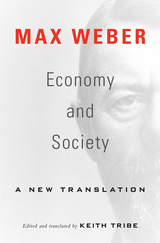
The definitive new translation of Max Weber’s classic work of social theory—arguably the most important book by the foremost social theorist of the twentieth century.
Max Weber’s Economy and Society is the foundational text for the social sciences of the twentieth and twenty-first centuries, presenting a framework for understanding the relations among individual action, social action, economic action, and economic institutions. It also provides a classification of political forms based upon “systems of rule” and “rulership” that has shaped debate about the nature and role of charisma, tradition, legal authority, and bureaucracy.
Keith Tribe’s major new translation presents Economy and Society as it stood when Weber died in June 1920, with three complete chapters and a fragment of a fourth. One of the English-speaking world’s leading experts on Weber’s thought, Tribe has produced a uniquely clear and faithful translation that balances accuracy with readability. He adds to this a substantial introduction and commentary that reflect the new Weber scholarship of the past few decades.
This new edition will become the definitive translation of one of the few indisputably great intellectual works of the past 150 years.
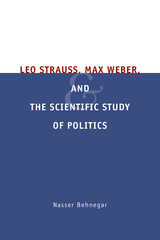
Behnegar's impressive book argues that Strauss was not against the scientific study of politics, but he did reject the idea that it could be built upon political science's unexamined assumption of the distinction between facts and values. Max Weber was, for Strauss, the most profound exponent of values relativism in social science, and Behnegar's explication artfully illuminates Strauss's critique of Weber's belief in the ultimate insolubility of all value conflicts.
Strauss's polemic against contemporary political science was meant to make clear the contradiction between its claim of value-free premises and its commitment to democratic principles. As Behnegar ultimately shows, values—the ethical component lacking in a contemporary social science—are essential to Strauss's project of constructing a genuinely scientific study of politics.


This searching work offers the first comprehensive introduction to Weber's thought for students and newcomers. Fritz Ringer locates Weber in his historical context, relating his ideas to the controversies and politics of his day. Ringer also considers the importance of Weber to contemporary life, discussing his insights into the limits of scholarly research and the future of Western capitalist societies. Weber, Ringer reminds us, believed in democracy, liberalism, and fundamental human rights; his ethic of responsibility remains as vital to our historical moment as it was to his own.
A concise and incisive look at the man and personality behind the thought, Max Weber is a masterful outing in intellectual biography and social theory.

Käsler offers a comprehensive account of Weber's views, giving attention both to the context in which Weber produced his most significant contributions to social science, and to the changes involved in his work over the course of his career. This volume also serves as an introduction to the controversies that Weber's writings have stimulated, from the time of their first appearance to the present day.
This book will be of vital interest to anyone concerned with Max Weber and will undoubtedly become the leading student text on Weber in the English-speaking world.

First published in German in 1959, Max Weber and German Politics appeared in a revised edition in 1974 and became available in an English translation only in 1984. In writing this work, Mommsen drew extensively on Weber's published and unpublished essays, newspaper articles, memoranda, and correspondence.

Ever since it was made known to English-speaking readers by R. H. Tawney and Tolcott Parsons, the thought of Max Weber has attracted increasing attention among students of sociology, history, economics, jurisprudence, political science, and political philosophy. His far-flung ideas were systematically brought together in his last book, Economy and Society, the major part of which was not published until after his death in 1921. Of this most comprehensive and significant of all of Weber’s writings, only the Introductory Part has so far been available in English.
The present book contains an English translation of those parts of Economy and Society in which Weber investigates the relationship between the social phenomenon “law” and the other spheres of social life, especially the economic and the political. The translation, by Edward A. Shils and Max Rheinstein, is accompanied by an extensive introduction and explanatory and bibliographical notes by Max Rheinstein. The Introduction will acquaint the reader with the problems of sociology of law in general and with Weber’s approach and methods in particular. The notes are meant to help the reader understand Weber’s wide-ranging references to institutions of Western and Oriental systems of law of both past and present; they also contain references to the sources used by Weber and to later literature which will help the reader evaluate Weber’s statements and conclusions.
Max Weber’s main problem was to discover the causes of the rise of modern capitalism. In his discussions of the law he is primarily concerned with finding what features of Western law, if any, were favorable to the development of the capitalistic economy and in what ways this economy has reacted upon methods of legal thought. Is logical rationality, peculiar to certain parts of the Western world, connected with that rational method of economic thought which is characteristic of Western capitalism? His concern with methods of legal thought renders Weber’s ideas specially significant for present American and English jurisprudence.
Among the other problems he discusses are those of freedom of contract, its origins, its rise and its place among the institutions of capitalist and non-capitalist societies; the development of rational processes of law making; the connections between kinds of legal thought and the types of social functionaries by whom law is shaped in a given society; the social factors favoring or counteracting codification; and the economic and political significance of ideas of natural law.
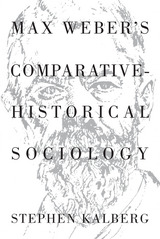

At a time when historical and cultural analyses are being subjected to all manner of ideological and disciplinary prodding and poking, the work of Max Weber, the brilliant social theorist and one of the most creative intellectual forces in the twentieth century, is especially relevant. In this significant study, Fritz Ringer offers a new approach to the work of Weber, interpreting his methodological writings in the context of the lively German intellectual debates of his day. According to Ringer, Weber was able to bridge the intellectual divide between humanistic interpretation and causal explanation in historical and cultural studies in a way that speaks directly to our own time, when methodological differences continue to impede fruitful cooperation between humanists and social scientists. In the place of the humanists' subjectivism and the social scientists' naturalism, Weber developed the flexible and realistic concepts of objective probability and adequate causation.
Grounding technical theories in specific examples, Ringer has written an essential text for all students of Weber and of social theory in the humanities and social sciences. Fully reconstructed, Max Weber's methodological position in fact anticipated the most fruitful directions in our own contemporary philosophies of the cultural and social sciences. Ringer's conceptualization of Weber's approach and achievement elucidates Weber's reconciliation of interpretive understanding and causal explanation and shows its relevance to intellectual life and culture in Weber's own time and in ours as well.

One of America’s leading political theorists analyzes the nihilism degrading—and confounding—political and academic life today. Through readings of Max Weber’s Vocation Lectures, she proposes ways to counter nihilism’s devaluations of both knowledge and political responsibility.
How has politics become a playpen for vain demagogues? Why has the university become an ideological war zone? What has happened to Truth? Wendy Brown places nihilism at the center of these predicaments. Emerging from European modernity’s replacement of God and tradition with science and reason, nihilism removes the foundation on which values, including that of truth itself, stand. It hyperpoliticizes knowledge and reduces the political sphere to displays of narcissism and irresponsible power plays. It renders the profound trivial, the future unimportant, and corruption banal.
To consider remedies for this condition, Brown turns to Weber’s famous Vocation Lectures, delivered at the end of World War I. There, Weber himself decries the effects of nihilism on both scholarly and political life. He also spells out requirements for re-securing truth in the academy and integrity in politics. Famously opposing the two spheres to each other, he sought to restrict academic life to the pursuit of facts and reserve for the political realm the pursuit and legislation of values.
Without accepting Weber’s arch oppositions, Brown acknowledges the distinctions they aim to mark as she charts reparative strategies for our own times. She calls for retrieving knowledge from hyperpoliticization without expunging values from research or teaching, and reflects on ways to embed responsibility in radical political action. Above all, she challenges the left to make good on its commitment to critical thinking by submitting all values to scrutiny in the classroom and to make good on its ambition for political transformation by twinning a radical democratic vision with charismatic leadership.
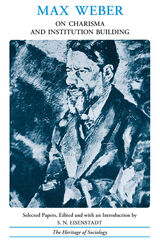
Max Weber on Charisma and Institution Building is a volume in "The Heritage of Sociology," a series edited by Morris Janowitz. Other volumes deal with the writings of George Herbert Mead, William F. Ogburn, Louis Wirth, W. I. Thomas, Robert E. Park, and the Scottish Moralists—Adam Smith, David Hume, Adam Ferguson, and others.

READERS
Browse our collection.
PUBLISHERS
See BiblioVault's publisher services.
STUDENT SERVICES
Files for college accessibility offices.
RECENTLY PUBLISHED






UChicago Accessibility Resources
home | accessibility | search | about | contact us
BiblioVault ® 2001 - 2024
The University of Chicago Press