
 A SCHOLARLY BOOK REPOSITORY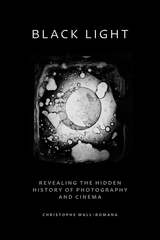
A radical assessment of the racial motives underlying the conception of photography and cinema
Conventional histories have long traced the origins of photography and cinema to the goal of reproducing the visible world. Black Light offers a radical counter to this understanding. Investigating the optical, cosmological, and racial thought that surrounded their conception, Christophe Wall-Romana argues that these media developed out of a desire to visualize what cannot be seen.
Taking as its starting point the concurrent invention of the telescope and industrialization of the transatlantic slave trade, Black Light shows how photography and cinema are entangled with two key preoccupations of the Enlightenment: visualizing the mysteries of the cosmos and managing Blackness. Wall-Romana uses literary and technological sources to demonstrate how racial and astronomical thinking interwove throughout the long development of our modern visual media. Retracing the impulses behind nonmimetic photoimaging and dynamic modeling, he exposes the racial underpinnings of research on photosensitive compounds such as silver nitrate and the racist lenses applied in post-Copernican cosmology.
Black Light charts the pivotal period from the seventeenth through the nineteenth century when Europeans were reckoning with “multiple worlds” and natural philosophy was giving way to “mechanical objectivity.” Wall-Romana shows how engagement with the nature of light was always entangled with racist discourses on Blackness—especially after the 1801 discovery of the invisible spectrum and its paradox of “black light.” Deprovincializing media archaeology, this book presents a groundbreaking historical framework with which to reenvision our dominant modes of seeing and understanding the world.
Retail e-book files for this title are screen-reader friendly with images accompanied by short alt text and/or extended descriptions.
A radical rethinking of the theory and the experience of mental images
Here, in English translation for the first time, is Gilbert Simondon’s fundamental reconception of the mental image and the theory of imagination and invention. Drawing on a vast range of mid-twentieth-century theoretical resources—from experimental psychology, cybernetics, and ethology to the phenomenological reflections of Sartre and Merleau-Ponty—Imagination and Invention provides a comprehensive account of the mental image and adds a vital new dimension to the theory of psychical individuation in Simondon’s earlier, highly influential work.
Simondon traces the development of the mental image through four phases: first a bundle of motor anticipations, the image becomes a cognitive system that mediates the organism’s relation to its milieu, then a symbolic and abstract integration of motor and affective experience to, finally, invention, a solution to a problem of life that requires the externalization of the mental image and the creation of a technical object. An image cannot be understood from the perspective of one phase alone, he argues, but only within the trajectory of its progressive metamorphosis.

With over 50 original essays by leading scholars, artists, critics, and curators, this is the first book to trace the “unwatchable” across our contemporary media environment, in which viewers encounter difficult content on various screens and platforms. Appealing to a broad academic and general readership, the volume offers multidisciplinary approaches to the vast array of troubling images that circulate in global visual culture.
READERS
Browse our collection.
PUBLISHERS
See BiblioVault's publisher services.
STUDENT SERVICES
Files for college accessibility offices.
RECENTLY PUBLISHED







UChicago Accessibility Resources
home | accessibility | search | about | contact us
BiblioVault ® 2001 - 2026
The University of Chicago Press