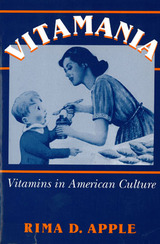
"Have you taken your vitamins today?" That question echoes daily through American households. Thanks to intensive research in nutrition and medicine, the importance of vitamins to health is undisputed. But millions of Americans believe that the vitamins they get in their food are not enough. Vitamin supplements have become a multibillion-dollar industry. At the same time, many scientists, consumer advocacy groups, and the federal Food and Drug Administration doubt that most people need to take vitamin pills.
Vitamania tells how and why vitamins have become so important to so many Americans. Rima Apple examines the claims and counterclaims of scientists, manufacturers, retailers, politicians, and consumers from the discovery of vitamins in the early twentieth century to the present. She reveals the complicated interests--scientific, professional, financial--that have propelled the vitamin industry and its would-be regulators. From early advertisements linking motherhood and vitamin D, to Linus Pauling's claims for vitamin C, to recent congressional debates about restricting vitamin products, Apple's insightful history shows the ambivalence of Americans toward the authority of science. She also documents how consumers have insisted on their right to make their own decisions about their health and their vitamins.
Vitamania makes fascinating reading for anyone who takes--or refuses to take--vitamins. It will be of special interest to students, scholars, and professionals in public health, the biomedical sciences, history of medicine and science, twentieth-century history, nutrition, marketing, and consumer studies.