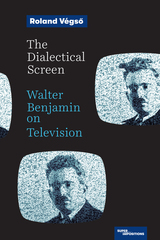
front cover of The Dialectical Screen
The Dialectical Screen
Walter Benjamin on Television
Roland Végso
Northwestern University Press, 2027

Exploring the meanings of media technologies through Walter Benjamin’s thought

Walter Benjamin’s prime years as a cultural critic coincided with the rise of televised broadcasting in Europe and North America, a unique period of rapid expansion in a new technological medium. So why would such a subtle and sensitive critic of media, known for his cultural criticism across genres, seem to have ignored or even missed the entire phenomenon of television? This book reveals how television, as a concept and a metaphor, in fact structures Benjamin’s philosophy.

Through a careful reading of Benjamin’s work across various media—literature, photography, cinema, radio, and television—Roland Végső reconstructs a powerful vision of media technologies as not merely tools of communication but as forces that shape how we imagine and construct the world as a conceptual totality. The Dialectical Screen provides a timely and provocative framework for understanding how media continue to shape our political, cultural, and existential horizons, recasting Benjamin's understanding of historical materialism in fundamentally tele-visual terms as a theoretical orientation that makes visible the perishing of the world itself.

[more]

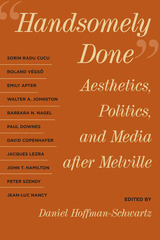
front cover of Handsomely Done
Handsomely Done
Aesthetics, Politics, and Media after Melville
Edited by Daniel Hoffman-Schwartz
Northwestern University Press, 2019
Handsomely Done: Aesthetics, Politics, and Media after Melville brings together leading and emerging scholars from comparative literature, critical theory, and media studies to examine Melville’s works in light of their ongoing afterlife and seemingly permanent contemporaneity. The volume explores the curious fact that the works of this most linguistically complex and seemingly most “untranslatable” of authors have yielded such compelling translations and adaptations as well as the related tendency of Melville’s writing to flash into relevance at every new historical-political conjuncture.

The volume thus engages not only Melville reception across media (Jorge Luis Borges, John Huston, Jean-Luc Godard, Led Zeppelin, Claire Denis) but also the Melvillean resonances and echoes of various political events and movements, such as the Attica uprising, the Red Army Faction, Occupy Wall Street, and Black Lives Matter. This consideration of Melville’s afterlife opens onto theorizations of intermediality, un/translatability, and material intensity even as it also continually faces the most concrete and pressing questions of history and politics. 
 
[more]


Send via email Share on Facebook Share on Twitter