
 A SCHOLARLY BOOK REPOSITORY
Making art relies on a process of intuitive discovery that begins prior to knowing and overrides intention. Anne Carson and the Unknown delves into the varied ways the contemporary poet and classicist Anne Carson engages with the unknown, both as a philosophical concept and as a method of creative practice. Bringing together various contemporary perspectives, ranging from the world of quantum physics to feminist literary criticism and media studies, this volume considers how contemporary poets like Anne Carson continue to show the relevance of the unknown in our turbulent times of global upheaval.
It covers Carson’s unusual travelogue about the collapse of civilizations and knowledge, positions her oeuvre in the context of a wider debate on post-critique, and reads her work as an engagement with a radically formalist Classics that goes back to ancient Greek’s etymological complexity. Taking an interdisciplinary approach, the volume dives into her work’s ambiguous relationships with trans experience and religion, the centrality of the psychoanalytical concept of the caesura, and her use of figures like Helen of Troy and Herakles. It also discusses the unknown as a visual mechanism in her recent creative collaboration with comics creator Rosanna Bruno. In this way, Carson provides a necessary counter to both Western scientific knowledge’s goals of predictability and rationality, and to the algorithmic certitudes sought by the engineering culture of technologists who prevail today.
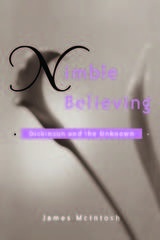
--Harold Bloom, Genius
" . . . a truly literary study in the largest, most humane, sense. Instead of subjecting poems to the distortions of theory, it brings biography, theology, psychology, and cultural history to bear on the intricacies of language, where all the issues of the poet's life and work converge, contend, and seek resolution."
--Albert Gelpi, American Literature
" . . . insightful readings of many of Dickinson's difficult poems and . . . a significant contribution to Dickinson studies."
---Choice
"McIntosh shows the power of Dickinson's religious quest in word, in verse, and in truth. He shows that she was much more than an ever-adolescent angry rebel trying to subvert the religious oppression of benighted Amherst neighbors."
---Emily Dickinson Journal
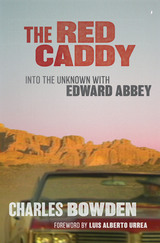
A passionate advocate for preserving wilderness and fighting the bureaucratic and business forces that would destroy it, Edward Abbey (1927–1989) wrote fierce, polemical books such as Desert Solitaire and The Monkey Wrench Gang that continue to inspire environmental activists. In this eloquent memoir, his friend and fellow desert rat Charles Bowden reflects on Abbey the man and the writer, offering up thought-provoking, contrarian views of the writing life, literary reputations, and the perverse need of critics to sum up “what he really meant and whether any of it was truly up to snuff.”
The Red Caddy is the first literary biography of Abbey in a generation. Refusing to turn him into a desert guru, Bowden instead recalls the wild man in a red Cadillac convertible for whom liberty was life. He describes how Desert Solitaire paradoxically “launched thousands of maniacs into the empty ground” that Abbey wanted to protect, while sealing his literary reputation and overshadowing the novels that Abbey considered his best books. Bowden also skewers the cottage industry that has grown up around Abbey’s writing, smoothing off its rougher (racist, sexist) edges while seeking “anecdotes, little intimacies . . . pieces of the True Beer Can or True Old Pickup Truck.” Asserting that the real essence of Abbey will always remain unknown and unknowable, The Red Caddy still catches gleams of “the fire that from time to time causes a life to become a conflagration.”
READERS
Browse our collection.
PUBLISHERS
See BiblioVault's publisher services.
STUDENT SERVICES
Files for college accessibility offices.
RECENTLY PUBLISHED


UChicago Accessibility Resources
home | accessibility | search | about | contact us
BiblioVault ® 2001 - 2026
The University of Chicago Press