
 A SCHOLARLY BOOK REPOSITORY
Results by Title
2 books about Tragic
2 books about Tragic
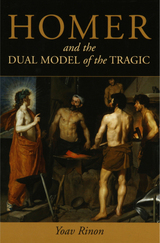
Homer and the Dual Model of the Tragic
Yoav Rinon
University of Michigan Press, 2008
Homer and the Dual Model of the Tragic interprets both of Homer's epics as demonstrating a sense of "the Tragic." While this view of human experience and society is customarily linked with Greek tragedy rather than epic, Rinon uses close readings of the texts to argue persuasively that both The Iliad and The Odyssey present a view of pathos interwoven with the knowledge that it is unavoidable and inexplicable. Using Aristotle's Poetics as a guide toward defining eutuchia and dystuchia, Rinon analyzes specific sections of the epics. He touches on the Cyclops episode and its use of Bakhtinian "heteroglossia," on the use of Hephaestus' creativity in both epics in the emergence of tragic signification, and on Demodocus' songs in book 8 of The Odyssey as seen through André Gide's mise en abîme. Other detailed readings look at individual themes and characters in the poems, including the image of the dog, the speeches in the ninth book of The Iliad, and numerous minor characters. Yoav Rinon's integration of classical philology, narratology, and post-colonial studies makes Homer and the Dual Model of the Tragic a widely interdisciplinary book, one that will appeal to both specialists and undergraduates in comparative literature, philosophy, and classical studies.
[more]
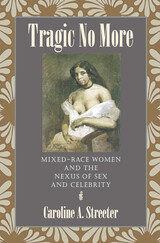
Tragic No More
Mixed-Race Women and the Nexus of Sex and Celebrity
Caroline A. Streeter
University of Massachusetts Press, 2012
This book examines popular representations of biracial women of black and white descent in the United States, focusing on novels, television, music, and film. Although the emphasis is on the 1990s, the historical arc of the study begins in the 1930s. Caroline A. Streeter explores the encounter between what she sees as two dominant narratives that frame the perception of mixed race in America. The first is based on the long-standing historical experience of white supremacy and black subjugation. The second is more recent and involves the post–Civil Rights expansion of interracial marriage and mixed-race identities. Streeter analyzes the collision of these two narratives, the cultural anxieties they have triggered, and the role of black/white women in the simultaneous creation and undoing of racial categories—a charged, ambiguous cycle in American culture.
Streeter's subjects include concert pianist Philippa Schuyler, Dorothy West's novel The Wedding (in print and on screen), Danzy Senna's novels Caucasia and Symptomatic, and celebrity performing artists Mariah Carey, Alicia Keys, and Halle Berry. She opens with a chapter that examines the layered media response to Essie Mae Washington-Williams, Senator Strom Thurmond's biracial daughter. Throughout the book, Streeter engages the work of feminist critics and others who have written on interracial sexuality and marriage, biracial identity, the multiracial movement, and mixed race in cultural studies.
Streeter's subjects include concert pianist Philippa Schuyler, Dorothy West's novel The Wedding (in print and on screen), Danzy Senna's novels Caucasia and Symptomatic, and celebrity performing artists Mariah Carey, Alicia Keys, and Halle Berry. She opens with a chapter that examines the layered media response to Essie Mae Washington-Williams, Senator Strom Thurmond's biracial daughter. Throughout the book, Streeter engages the work of feminist critics and others who have written on interracial sexuality and marriage, biracial identity, the multiracial movement, and mixed race in cultural studies.
[more]
READERS
Browse our collection.
PUBLISHERS
See BiblioVault's publisher services.
STUDENT SERVICES
Files for college accessibility offices.
RECENTLY PUBLISHED


UChicago Accessibility Resources
home | accessibility | search | about | contact us
BiblioVault ® 2001 - 2026
The University of Chicago Press