
 A SCHOLARLY BOOK REPOSITORY
Gary Winslett builds on new trade theories to explain when and why businesses are most likely to lobby governments to reduce these regulatory trade barriers. He argues that businesses prevail when they can connect with broader concerns about national economic competitiveness. He examines how activist organizations overcome collective action problems and defend regulatory differences, arguing that they succeed when they can link their desire for barriers with preventing needless death. Competitiveness and Death provides a political companion to new trade theories in economics, questioning cleavage-based explanations of trade politics, demonstrating the underappreciated importance of activists, suggesting the limits of globalization, providing in-depth examination of previously ignored trade negotiations, qualifying the California Effect (the shift toward stricter regulatory standards), and showing the relative rarity of regulations used as disguised protectionism.

Economic Regulation and Its Reform collects research by a group of distinguished scholars who explore these and other issues surrounding government economic intervention. Determining the consequences of such intervention requires a careful assessment of the costs and benefits of imperfect regulation. Moreover, government interventions may take a variety of forms, from relatively nonintrusive performance-based regulations to more aggressive antitrust and competition policies and barriers to entry. This volume introduces the key issues surrounding economic regulation, provides an assessment of the economic effects of regulatory reforms over the past three decades, and examines how these insights bear on some of today’s most significant concerns in regulatory policy.

In this integration of law and economic ideas, Herbert Hovenkamp charts the evolution of the legal framework that regulated American business enterprise from the time of Andrew Jackson through the first New Deal. He reveals the interdependent relationship between economic theory and law that existed in these decades of headlong growth and examines how this relationship shaped both the modern business corporation and substantive due process. Classical economic theory—the cluster of ideas about free markets—became the guiding model for the structure and function of both private and public law.
Hovenkamp explores the relationship of classical economic ideas to law in six broad areas related to enterprise in the nineteenth and early twentieth centuries. He traces the development of the early business corporation and maps the rise of regulated industry from the first charter-based utilities to the railroads. He argues that free market political economy provided the intellectual background for constitutional theory and helped define the limits of state and federal regulation of business behavior. The book also illustrates the unique American perspective on political economy reflected in the famous doctrine of substantive due process. Finally, Hovenkamp demonstrates the influence of economic theory on labor law and gives us a reexamination of the antitrust movement, the most explicit intersection of law and economics before the New Deal.
Legal, economic, and intellectual historians and political scientists will welcome these trenchant insights on an influential period in American constitutional and corporate history.
In most contexts, privatization is expected to yield greater efficiency and cost effectiveness while avoiding the corruption and bloated budgets of government regulation or monopoly control. But broad-scale privatization, if ill designed, has also yielded its share of difficulties in East Asia. Privatization sometimes has created a vacuum in corporate governance for some of the region's most important industries and in some cases merely reinstated the monopoly-like configurations. The papers presented in this book discuss the experiences of privatization in several industries, including railroad and telecom, corporate governance problems, accounting issues, and challenges for the future in East Asian countries.
The first section is theoretical in nature and proposes boundaries among government protection, market freedom, and shareholder expectations. The second part is constituted by country case studies, beginning with an analysis of both the Korean financial crisis that followed its 1997 law to privatize large, public sector corporations and the new ways Korean corporations finance themselves. Following is an evaluation of China's approach to privatization, with an in-depth look at the financial transitions of companies slated for initial public offering.
Providing provocative examples of the methods of privatization in the Asia-Pacific region specifically, these papers will be of huge import to any economist or policymaker interested in transposing those successes for their own region.

In many countries, public sector institutions impose heavy burdens on economic life: heavy and arbitrary taxes retard investment, regulations enrich corrupt bureaucrats, state firms consume national wealth, and the most talented people turn to rent-seeking rather than productive activities. As a consequence of such predatory policies--described in this book as the grabbing hand of the state--entrepreneurship lingers and economies stagnate.
The authors of this collection of essays describe many of these pathologies of a grabbing hand government, and examine their consequences for growth. The essays share a common viewpoint that political control of economic life is central to the many government failures that we observe. Fortunately, a correct diagnosis suggests the cures, including the best strategies of fighting corruption, privatization of state firms, and institutional building in the former socialist economies. Depoliticization of economic life emerges as the crucial theme of the appropriate reforms. The book describes the experiences with the grabbing hand government and its reform in medieval Europe, developing countries, transition economies, as well as today's United States.

Often considered one of the major forces behind economic growth and development, the entrepreneurial firm can accelerate the speed of innovation and dissemination of new technologies, thus increasing a country's competitive edge in the global market. As a result, cultivating a strong culture of entrepreneurial thinking has become a primary goal throughout the world.
Surprisingly, there has been little systematic research or comparative analysis to show how the growth of entrepreneurship differs among countries in various stages of development. International Differences in Entrepreneurship fills this void by explaining how a country's institutional differences, cultural considerations, and personal characteristics can affect the role that entrepreneurs play in its economy. Developing an understanding of the origins of entrepreneurs as well as the choices they make and the complexity of their activities across countries and industries are of central importance to this volume. In addition, contributors consider how environmental factors of individual economies, such as market regulation, government subsidies for banks, and support for entrepreneurial culture affect the industry and the impact that entrepreneurs have on growth in developing nations.
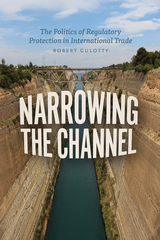
Narrowing the Channel demonstrates that globalization and globalized firms can paradoxically hinder rather than foster economic cooperation as larger firms seek to protect their markets through often unnecessarily strict product regulations. To illustrate the problem of regulatory protectionism, Robert Gulotty offers an in-depth analysis of contemporary rulemaking in the United States and the European Union in the areas of health, safety, and environmental standards. He shows how large firms seek regulatory schemes that disproportionately disadvantage small firms. When multinationals are embedded in the local economy, governments too have an incentive to use these regulations to shift profits back home. Today, the key challenge to governing global trade is not how much trade occurs but who is allowed to participate, and this book shows that new rules will be needed to allow governments to widen the benefits of global commerce and avoid further inequality and market concentration.


Averch describes and analyzes common strategies for solving problems in public policy. The strategies discussed include the use of markets, bureaus, regulation, planning and budgeting, benefit-cost, systems analysis, and evaluation. He examines the historical development of each strategy; describes how each strategy would ideally work; explains the necessary or sufficient conditions that permit each strategy to work; lists the potential failures of each strategy; and provides a judgment or appraisal of each strategy.
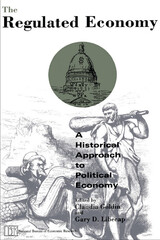
The Regulated Economy examines how constituent groups emerged and demanded government action to solve perceived economic problems, such as exorbitant railroad and utility rates, bank failure, falling agricultural prices, the immigration of low-skilled workers, workplace injury, and the financing of government. The contributors look at how preexisting policies, institutions, and market structures shaped regulatory activity; the origins of regulatory movements at the state and local levels; the effects of consensus-building on the timing and content of legislation; and how well government policies reflect constituency interests.
A wide-ranging historical view of the way interest group demands and political bargaining have influenced the growth of economic regulation in the United States, this book is important reading for economists, political scientists, and public policy experts.

This book will become the bible of regulatory reform. No broad, authoritative treatment of the subject has been available for many years except for Alfred Kahn’s Economics of Regulation (1970). And Stephen Breyer’s book is not merely a utilitarian analysis or a legal discussion of procedures; it employs the widest possible perspective to survey the full implications of government regulation—economic, legal, administrative, political—while addressing the complex problems of administering regulatory agencies.
Only a scholar with Judge Breyer’s practical experience as chief counsel to the Senate Judiciary Committee could have accomplished this task. He develops an ingenious original system for classifying regulatory activities according to the kinds of problems that have called for, or have seemed to call for, regulation; he then examines how well or poorly various regulatory regimes remedy these market defects. This enables him to organize an enormous amount of material in a coherent way, and to make significant and useful generalizations about real-world problems.
Among the regulatory areas he considers are health and safety; environmental pollution, trucking, airlines, natural gas, public utilities, and telecommunications. He further gives attention to related topics such as cost-of-service ratemaking, safety standards, antitrust, and property rights. Clearly this is a book whose time is here—a veritable how-to-do-it book for administration deregulators, legislators, and the judiciary; and because it is comprehensive and superbly organized, with a wealth of highly detailed examples, it is practical for use in law schools and in courses on economics and political science.
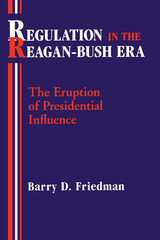
From Harry Truman through Jimy Carter, chief executives complained that federal bureaucrats disregarded their policy preferences. presidential influence over regulatory rule making was limited: congressional committees and interest groups commanded more attention. Then in February 1981 Ronal regan abruptly departed from tradition by ordering that regulatory agencies must submit proposed guidelines for Office of Management and Budget approval.
Barry D. friedman describes how the executive agencies and Congress responded warily and with skepticism, yet allowed the changes to remain; the judiciary was also willing to retreat from time-honored precedents that had preserved agency prerogative and now accorded due respect to the revolutionary Regan reform initiatives. Institutions that competed for leverage in the system continued to exercise restraint in their mutual relations because they recognized taht all benefitted from the others' viability.
This book shows that conventional political science theories and models are now obsolete because of the eruption of presidential control into bureaucratic affairs. new review procedures have restructured relations between the president and the agencies and among the government's three branches. because of Regan's radical initiative, President Bill Clinton and his successors will sit at the bargaining table when regulation policy is developed in Washington, and political theorists will have to work from a new conception of presidential prerogative.

Many consumers feel powerless in the face of big industry’s interests. And the dominant view of economic regulators (influenced by Mancur Olson’s book The Logic of Collective Action, published in 1965) agrees with them. According to this view, diffuse interests like those of consumers are too difficult to organize and too weak to influence public policy, which is determined by the concentrated interests of industrial-strength players. Gunnar Trumbull makes the case that this view represents a misreading of both the historical record and the core logic of interest representation. Weak interests, he reveals, quite often emerge the victors in policy battles.
Based on a cross-national set of empirical case studies focused on the consumer, retail, credit, pharmaceutical, and agricultural sectors, Strength in Numbers develops an alternative model of interest representation. The central challenge in influencing public policy, Trumbull argues, is not organization but legitimation. How do diffuse consumer groups convince legislators that their aims are more legitimate than industry’s? By forging unlikely alliances among the main actors in the process: activists, industry, and regulators. Trumbull explains how these “legitimacy coalitions” form around narratives that tie their agenda to a broader public interest, such as expanded access to goods or protection against harm. Successful legitimizing tactics explain why industry has been less powerful than is commonly thought in shaping agricultural policy in Europe and pharmaceutical policy in the United States. In both instances, weak interests carried the day.
In Varieties of State Regulation, Yukyung Yeo explores how, despite China’s increasing integration into the global market, the Chinese central party-state continues to oversee the most strategic sectors of its economy. Since the 1990s, as major state firms were spun off from the ministries that managed them under the central planning system, the nature of the state in governing the economy has been remarkably transformed into that of a regulator.
Based on over 100 interviews conducted with Chinese central and local officials, firms, scholars, journalists, and consultants, the book demonstrates that the form of central state control varies considerably across leading industrial sectors, depending on the dominant mode of state ownership, conception of control, and governing structure. By analyzing and comparing institutional dynamics across various sectors, Yeo explains variations in the pattern of China’s regulation of its economy. She contrasts the regulation of the automobile industry, a relatively decentralized sector, with the highly-centralized telecommunications industry, and demonstrates how China’s central party-state maintains regulatory authority over key local state-owned enterprises. Placing these findings in historical and comparative contexts, the book presents the evolution and current practice of state regulation in China and examines its compatibility with other contemporary government practices.
READERS
Browse our collection.
PUBLISHERS
See BiblioVault's publisher services.
STUDENT SERVICES
Files for college accessibility offices.
RECENTLY PUBLISHED







UChicago Accessibility Resources
home | accessibility | search | about | contact us
BiblioVault ® 2001 - 2024
The University of Chicago Press